
Quantum Physics Part 1 - Photoelectric effect
Diapositivas del conjunto (4)
-
- Electrons absorb energy from incident EM radiation.
- Electrons are emitted when they get enough energy causing current to flow in the circuit.
- The emitted electrons are called photoelectrons.
- *Photoelectric effect is the phenomenon where electrons are emitted from a metal surface when electromagnetic radiation of sufficiently high frequency is incident on the surface.
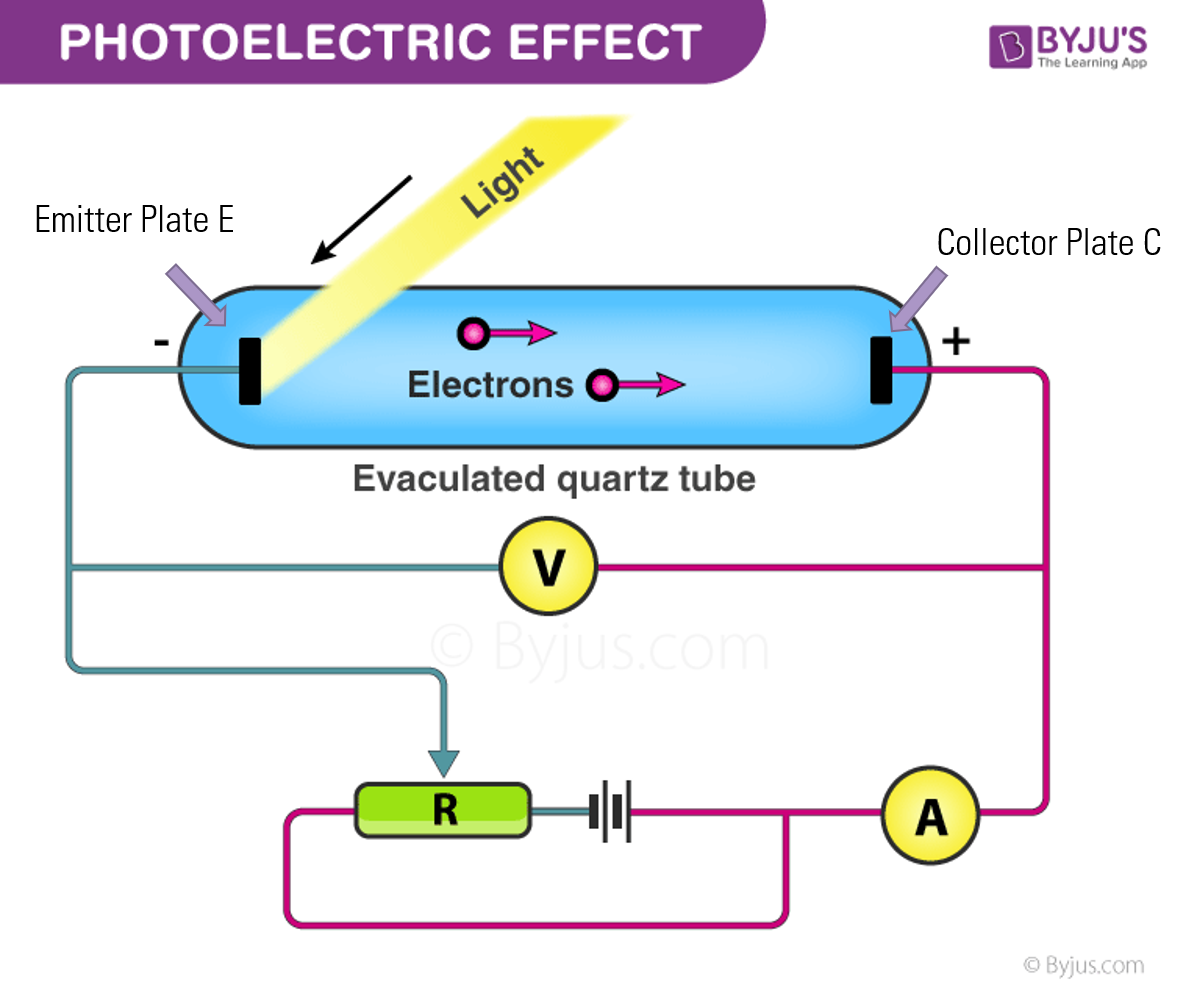
- *Photoelectric Experiment Setup:
- When radiation of sufficiently high frequency (greater than threshold frequency) is incident on the emitter plate E, it will emit electrons.
- The variable voltage source maintains electrodes at different know potentials. The emitted electrons from E (that have sufficient energy) will travel to the collector C and a current (known as photocurrent) will be detected by the ammeter as the electrons complete the loop in the circuit.
- Pie de imagen: Fig 1. The Photoelectric Experiment
-
- A photon is a discrete bundle (or quantum) of electromagnetic energy.
- E: energy of a single photon
- - dependent on frequency
- - for a given frequency, a beam of EM radiation of greater intensity simply means more photons per unit time and not greater energy
- Total E = total energy of all the photons
- n: no. of photons passing a unit area per unit time
- Work function energy φ of a material is defined as minimum amount of the energy necessary to remove an electron frm the surface of the material.
- range of kinetic energies, more energy required to let electrons below the surface to escape
- By principle of conservation of energy, photo energy absorbed is converted to maximum KE after overcoming work function of metal.
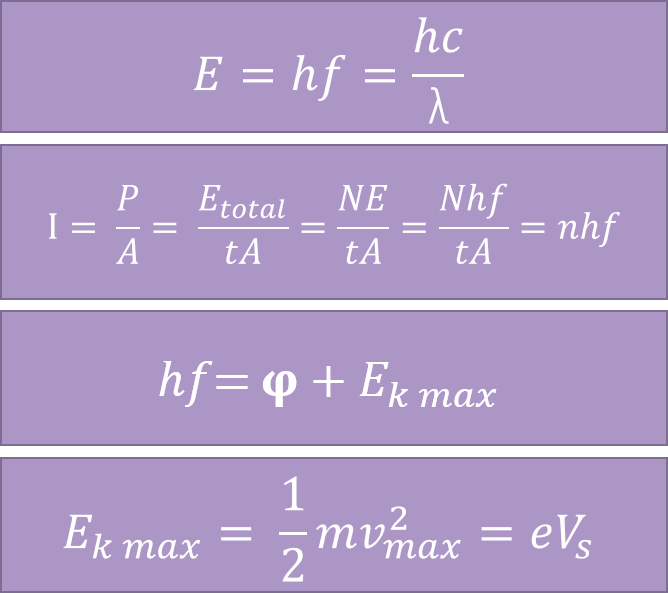
- Pie de imagen: Fig 2. equations for photoelectric effect
-
Quantum Analysis of the Photoelectric Effect
- When an EM radiation is directed at a metal surface, a stream of particles bombards the surface of the metal.
- Any free electron near the surface could absorb an incoming photon and gain all the energy of the photon.* (a photon must be absorbed as a whole by a single electron. Absorb all or nothing.
- If the gain in energy is sufficient, the electron can leave the plate. (escape)
- A photon that is not absorbed will be reflected or transmitted.
- Electrons are emitted INSTANTANEOUSLY:
- all the photon energy is delivered immediately to the electron in a single absorption hence no time delay and is independent on the intensity of the incident radiation.
-
- MINIMUM frequency of the incident radiation for the electron to escape.
- i.e. MAXIMUM wavelength of the incident radiation for the electron to escape
- For photoelectric emission to occur, f > threshold f or λ < threshold λ
Información
- Descripción
- Photoelectric effect. EM radiation (photons) shines at emitter plate, if frequency high enough emit photoelectrons to be absorbed by collector plate Collect all or none Reverse polarity of variable voltage source to find stopping potential
- Creado por
- Jia Zhen Yee
- Visitas
- 5
- Valoración