
Geo3005F-Igneous Petrology
Diapositivas del conjunto (37)
-
- Igneous Petrology(Completed)
- Metamorphic Petrology
- Structure
- Sedimentology
-
- Petrogenesis- The study of (series of ) processes and the conditions under which these occurred,that have led to the formation of one or a series of related rocks.
- With respect to igneous petrology this mainly refers to processes of :
- Partial melting
- Crystallization
- Crystal-Liquid separation
- Crustal assimilation(Open system differentiation)
- Aim of the module: The interpretation of igneous rocks,especially
- partial melting
- crystallization processes
-
-
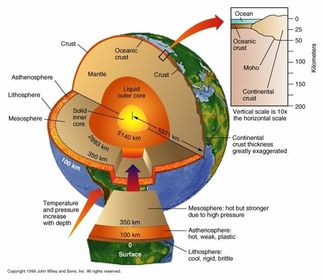
- Crust
- Oceanic
- Continential
- Mantle
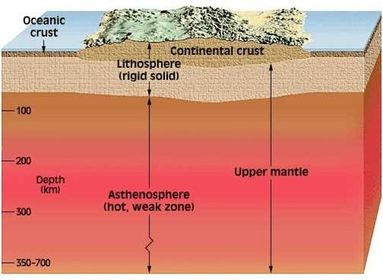
- Lithosphere- Rigid ,mechanically strong
- Athenosphere-plastic yet solid and weak mechanically
-
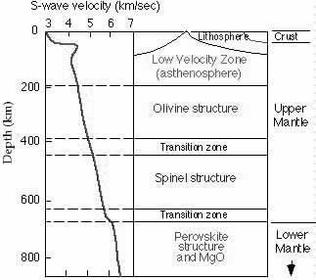
- Upper Mantle-
- Fe rich silicates-
- gradually compressed from lower density ,more open mineral structures to higher density more compacted mineral structures.
- Lower Mantle-
- Minerals structures are compacted in their dense forms.
- Upper Mantle- Open
-
- The speed of the waves depends upon the rigidity of the bonds between the molecules that make up the materials inside the Earth.
- Near the surface the bonds lengths are long and "loose" and the predominant materials (olivine and similar ferromagnesian silicates) have relatively low densities (3.5 to 4.5 tims the density of water, which is much less than the average density of the Earth)
- At greater depths the weight of the overlying material pushes the atoms closer together, making the bonds between them shorter and stiffer,
- As a results , if you increase the density of the material (since the atoms are closer together they take up less room),
- which (2) increases the melting temperature (shorter bonds are stiffer and harder to break, which is a requirement for melting the minerals),
- which increases seismic wave velocities (shorter, stiffer bonds cause the impulse received by one atom to be transferred to the next atom at a more rapid rate)
-
The boundary of crust and Mantle
- The rapid increase in wave
- velocities near the surface of the Earth caused by the compression of the rocks
- by the weight of the rocks above them. Close to the surface the difference
- between actual and melting temperatures is very large , and the increasing compression is the most significant
- factor in changing the wave velocity
- At deeper depths of thirty to
- fifty miles the rapidly increasing temperature gets and slowly increasing melt
- temperature are so similar that the
- bonds between the atoms, even though shorter than at lower depths, are
- "softer" and the rocks, although remaining solid, become relatively
- "soft", or less stiff. We see the effects of this in some rocks found
- at the surface of the Earth in which grains of individual minerals are
- stretched out into linear structures. The rocks, having been heated to nearly
- their melting temperature, can "flow", even though in the solid
- state, in the same way that hot metals can be squeezed between rollers, forming
- thin sheets (e.g., sheet metal and foils).
- The reduction in the stiffness
- of the bonds causes the wave velocities to drop sharply, "lithosphere"
- (rock sphere), for the stiffer, more brittle layers above, and
- "asthenosphere" (plastic sphere), for the softer, more pliable region
- caused by the small difference between the actual and melt temperatures.
- The boundary between the crust and mantle is
- defined by this low-velocity zone, called the Mohorovicic Discontinuity.
-
- Heat from the early accretion and differentiation of the Earth.
- Heat
- released by the breakdown of radioactive material
-
- The concentration of
- radioactive materials near the surface of the Earth when it melted and differentiated,
- during or very soon after its formation, 4.5 billion years ago. As the
- short-lived radioactive materials present at that time decayed and disappeared
- (that is, were transformed into other materials), the heating that caused the
- Earth to melt also disappeared, and the Earth began to resolidify. The crust
- cooled rapidly by radiating heat to space, forming a thin low-density, made
- primarily of silica and aluminosilicates; the deeper regions below, unable to
- radiate heat directly to space, cooled more slowly and remained hot for a much
- longer period of time (in fact the core is still extremely hot, partly as a
- result of the 1800 miles of solid rock insulating it from space, and partly
- because of heavy radioactive materials such as uranium which were dragged into
- the core as the heavy material sank to the center of the Earth).
- As the Earth cooled minerals
- and rocks began to form, even in the depths of the mantle. At great depth,
- because of the large weights compressing the material, only very dense
- structures could form. Large atoms of uranium can't fit into dense structures
- unless in a nearly pure form (although pure uranium metal is nearly twenty
- times denser than water, As a result most of the uranium atoms not dragged into
- the core were gradually forced toward the surface, where lower density minerals
- where forming; and most of the uranium in the mantle is believed to lie within
- a hundred miles of the surface, which means most of the heating due to its
- radioactive decay is concentrated near the surface. This is believed to be the
- cause of the rapid temperature rise near the surface. In the top few tens of
- miles heat slowly flows through the rocks and is equally slowly replaced by
- radioactive heating. Below that depth heat flow is much slower, because the
- heat source is the heat of the core, which is nearly two thousand miles further
- down, and the temperature rise is much lower.
- So although the
- uranium present in the mantle is probably concentrated near the surface of the
- planet, much (or even most) of the uranium in the Earth may be in the core.
-
- The weight of rocks compressing the rocks below
- increase as depth increases therefore the atoms are not only forced closer together they can also be forced into completely different arrangements which are even
- denser and stiffer than the rocks above.
- Example carbon:
- This is analogous to the difference between
- graphite, a pure carbon compound formed at low pressures which has large
- inter-atom distances and is relatively low in density; and diamond, a pure
- carbon compound formed at high pressures which has small inter-atom distances
- and is relatively high in density.
- Example Olivine:
- olivine and similar minerals
- are compressed more and more, for a while they remain the same minerals but in
- a denser state; but once the weight compressing them becomes too great they
- change to denser structures. This happens at two places inside the mantle. At a
- depth of about 400 km olivine change to spinel-like
- structures (not true spinel, which has a different chemical composition) and
- other denser, stiffer, higher-melting temperature minerals; and at a depth of
- about 660km those structures change to an even denser mixture of magnesium
- oxide and perovskite-like structures (not true perovskite, which has a
- different chemical composition).
-
- The overall composition of the
- three regions is believed to be about the same, but the structure of the
- minerals is different due to the extreme weight of the layers above compressing
- the less-dense minerals in the upper layers into the denser structures of the layer
- lowers.
- In
- that top 400 miles of mantle material the melting temperature, wave velocity
- and density all increase for the two reasons mentioned above -- the greater and
- greater weight of material above compressing the minerals and rocks more and more,
- and the occasional changes from one structure to a denser, stiffer, harder to
- melt structure. Below that depth, however, the materials are already in the
- densest possible form for materials of their overall composition, and
- regardless of how great a weight compresses them they will not change to still
- denser structures (or at least that is the conclusion drawn from laboratory
- experiments involving such materials). In the top 400 miles, with two separate
- factors at work, the density, wave velocity and melting temperatures of the
- mantle rocks rapidly increase, but below that, with no further structural changes,
- the rapid increase sloWS
-
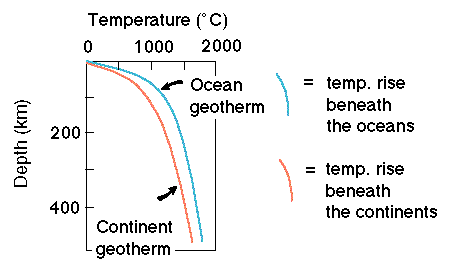
- Conduction - atoms vibrate against each other and these vibrations move from high temperature areas (rapid vibrations) to low temperature areas (slower vibrations).- Heat from Earth's interior moves through the solid crust by this mode of heat transfer.
- Convection - Heat moves with the material, thus the material must be able to move. The mantle of the Earth appears to transfer heat by this method, and heat is transferred in the atmosphere by this mode.
-
- This is because of a thicker lithosphere.
- It is much more concentrated
- in areas where thermal energy is transported toward the crust by convection
- such as along mid-ocean ridges and mantle plumes.
- The Earth's crust effectively acts as a thick insulating blanket
- which must be pierced by fluid conduits (of magma, water or other) in order to
- release the heat underneath.
- More of the heat in the Earth is lost through
- plate tectonics, by mantle upwelling associated with mid-ocean ridges.
- The
- final major mode of heat loss is by conduction through the lithosphere, the majority of which occurs in the oceans due
- to the crust there being much thinner and younger than under the continents.
-
Mineralogy of the upper mantle
- The main lithology is Peridotite
- Peridotite is made from >40% Olv + PYX +Aluminous phase(Plag,spinel,garnet)
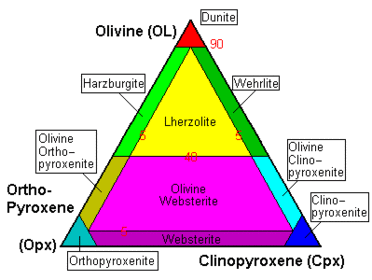
- Pie de imagen: Naming of Peridotite
-
- Thickness: Thicker =100-250km
- Lithology: Mainly Peridotite
- (harz>Iherz>ecologite)
- Domiant stable phase garnet
- Average Fertility : infertile (0-10%) because it is thicker further down in the mantle
- Age: old- 2 Billion years old on average
- Similarities: Spinel-garnet phase is at 70km in both
- Thinner (less than 100 km)
- Virtually entire Peridotite
- (Iharz)>>harz
- Dominant stable phase spinel bearing
- Moderately fertile (8-15%) cpx
- Young-80 Million on average
-
Meteorite evidence for mantle composition
- Chondrities- Leftover dust and condensed material from solar nebula,which collapsed to form a solar disk-Solar system.
- Consist of varying amounts of silicate minerals,sulfides,carbonaceous material + Fe alloy grains .
- The conc. of major oxides and trace elements in carbonaceous chondrite meteorites is nearly identical to the sun.
- Thus it can give you a estimate of of the composition of the bulk Earth
-
- The primitive mantle is, in geochemistry, a hypothetical reservoir with the composition of the Earth's crust and mantle taken together
- Primitive mantle-Depleted mantle+oceanic and Continental crust .
- The currently accepted scientific hypothesis is that the Earth formed by accretion of material with a chondritic composition. Still during the accretionary phase planetary differentiation started, giving rise to the Earth's core, where heavy metallic iron loving elements accumulated. Around it was a (in this stage) undifferentiated mantle, the primitive mantle. Further differentiation would take place later, creating the different chemical reservoirs of crust and mantle, with incompatible elements accumulating in the crust.
- Today differentiation still continues in the upper mantle. Reservoirs depleted in lithophile elements are called depleted, "fresh" undifferentiated parts of the mantle are calledenriched or primitive. The last name is confusing but derives from the fact that such reservoirs are comparable in composition to the primitive mantle. Volcanic rocks from hotspot areas often have a primitive composition. Because the magma at hotspots is supposed to have been taken to the surface from the deepest regions of the mantle by mantle plumes, geochemists assume there must be a relatively closed reservoir of very primitive composition somewhere in the lower mantle.
- Main idea: The determination of the bulk composition of the Earth,after removing most water and volatiles (atms-oceans) and most iron loving elements such as iron and nickel to the core
-
Mantle melting and Primary magma
- PM: A magma generated by partial melting of a source which is mantle peridotite that has undergone no subsequent differentation processes
- Melt composition is close to the eutectic of mantle composition at relevant pressure( equlibrium with ol,opx and cpx and gt)
- The composition and assemblage of phenocrysts in the most basalts differ from the mineral assemblage of mantle peridotite -This is because of melting occurs at high pressures while crystalllization occurs at low pressures for example garnet is stable at HP and at temps where feldspar crystallizes.
- Mantle and melt have differ composition as melt is mafic
-
- Fractional or equilibrium crystallization -A way to separate minerals from crystals
- Loss/accumulation of crystals -How are crystals are retained or lost in a close system.
- To understand partial melting and magma differentiation quantitatively we use three tools:
- Phase diagrams
- Major element variation diagrams
- Trace elements
-
- It the relative measure of the amount of partial melt that a part of the mantle can have at given temperature and pressures.
- Depends on cpx,as it is consumed the most during parial melting and minor amounts on OLV
-
- Equilibrium Crystallization
- Crystals formed remain in contact with the residual liquid after they form and continually react and equilibrate with the liquid.
- . In this case, the bulk composition of the final solids are the same as the original melt composition, and no mag-matic differentiation takes place
- Fractional Crystallization
- Crystals formed are immediately removed from contact with remaining melt ,only the last forming crystals are in equilibrium with melt.
- Crystals have a wide variety of composition this is because crystals do not have the same composition as the liquid and therefore the the removal of crystals changes the composition of the residual liquid.
-
Major element variation diagram
- Qualitatively:
- Show variation in composition among rocks of an :
- individual or group of volcanoes
- an igneous province e,g The Karoo igneous province
- a suite of similar igneous rocks e.g the Cape Granite Suite
- If the rocks have been produced from similar sources by similar processes -The chemical tends between the rocks samples will serve as a indicator of their petrogenesis.
- May be used for classification e.g Total alkali-silica diagram
-
- MgO-Fractionation index for mafic rocks
- SiO-Fractionation index for intermediate Felsic rocks
-
Limitations on major elements mod. of IP
- The composition of crystallizing/melting minerals fairly precisely
- The role of accessory phases are underestimated -they may affect one mineral significantly
- Constant sum effect becomes important once you near 100% crystallization
- Studies of crystallization are far more useful than partial melting
-
- Trace elements which are elements present at less than 0.1% are useful fingerprints of the origin of igneous rocks and igneous processes because they exhibit a range in concentration greater than for major elements. For example, in most igneous rocks, CaO varies between 0 and 10 weight percent.However, Sr, which behaves chemically much like Ca, may vary rom 10s o ppm to 1,000s o ppm in those same igne-ous rocks. Therefore , a process that affects the concentration of Ca may affect the concentration o Sr by a much greater magnitude, making it more likely that the process can be detected and identified by considering the Sr content.
- Because of their wide variations in abundance, trace elements can be used to identiy and quantiy processes of crystallization and partial melting
- No constant sum problem
- The behaviour of trace elements are controlled by -radius-charge-bonding preference
-
Types Of Trace Elements Behaviour
- Incomptabile
- Elements are not comptabile with the crystallizing phase
- Elements are retained in the melt
- Thus there abundance increases
- Tend to have either too long or short radii ,and not the correct (too high a )charge to occupy a site in the crystal.
- DMafic minerals
- Lithophile -
- Large ion lithophile-Rb,Sr
- High field strength-Zr,Hf
- REE-La,Ce
- Comptability
- Elements are comptabile with crystallizing minerals
- Elements are extracted from melt and abudance decreases
- E.g
- Ni is comp in OLV
- Cr is Comp in cpx and spinel
- D>1
-
- Elements are characterized by the number of protons in the nucleus; It is the variation of number of neutrons.Isotopes can be either stable or radioactive.
- Why do we study them???
- Geochronology-the age of igneous rocks
- Planetary differentiation-understanding long term geochemical evolution of the Earth crust and mantle
- Fingerprinting -the source of igneous rocks-do they come from melting of crustal or mantle sources,have they experienced crustal assimilation
- Examining the time of alteration- weathering and metamorphism
-
- The granitic parts of the continental crust contain relatively high amounts of Rb, but the mantle has comparatively little Rb.Over geologic timescales, this difference in abundances has produced a mantle with low 87 Sr/86 Sr
- of around 0.703,whereas the present-day continental crust contains rocksthat have average 87 Sr/86 Sr
- Sr of around 0.715. The isotopes of Sr (and Nd, f, and Pb) have relatively similar mass differences so they do not fractionate measurably during geologic processes. When a partial melt forms from a source region, the melt has exactly the same 87 Sr/86 Sr as its source region
- . Therefore a magma with 87 Sr/86 Sr of 0.720 can not have formed by partially melting the mantle but instead was generated somewhere
- in the crust. Measurements of potential source rocks narrow down the possible crustal.
-
Systematic Igneous Rock series
- A magma series is igneous rocks which compositional types are found in association with one another.
- 2 main magma series -1.Alkaline
- 2.Subalkaline -1.Tholeiitic basalt
- 2.Calc-alkaline basalt Both are rhyolite series
- Things to know:
- Sub alkaline - most voluminous accounts for nearly all magma generated at Mid oceanic ridges,volcanic arcs and large igneous provinces such as continential flood basalts and oceanic plateaux.
- All magma series ,Tholeiitic,calc-alkaline,Alkalic all start with basalt or gabbro whic must have plag
-
3 settings for Tholeiitic basalt
- 1.MOR-Extensional tectonic regime,Diveregent plate boundary.The mantle upwells ,decompression melting occurs and magma is emplacemened in a rift
- 2.Continenetial Flood basalt -Volcanic rocks found on the continents ,rocks are associated with extension and continental break up
- E.g Karoo
- Parana
- Deccan
- Fairly chemically uniform this is due CFB form from partial melting to produce picrities ,which pond at the base of crust and end up crystallizing olv+cpx+plag,the ramining liquid becomes buffered and uniformed in composition.
- CFB have higher Sr and lower Nd due to crustal contimaination
- MgO and Mg# to to low to be considered a PM
- 3.Volcanic arcs(island arcs)
- 3 Oceanic Islamd-Hawaii ,Iceland
-
- Ocean islands and oceanic plateau form above mantle plumes
- (“hot spots”). Basaltic magma forms by decompression • melting within rising
- mantle diapirs. The composition of the basalt magma varies depending on the
- depth and extent of partial melting and the composition of the mantle involved
- Volumetrically the
- most important environment is along mid-ocean ridges where new oceanic crust
- continually forms as tectonic plates diverge . The basalt erupted here is
- olivine and quartz-normative tholeiite; these basalts are called MORB
- MORB
- A significant volume of
- basaltic magma is also erupted from vents not located on ridges; this off-ridge magmatism
- occurs on ocean islands and oceanic plateau.The rocks erupted off-ridge are
- called ocean island basalts (OIB) , and they include both tholeiitic and alkali
- basalts.
- 6.3.1 Mid-ocean Ridge Basalt
- The fine-grained groundmass of MORB shows rapid cooling of magma extruded into a
- cold submarine envinronment. Phenocryst assemblages in glassy basalts indicatet
- the first minerals to crystallize are olivine + spinel. As the magma differentiates
- , plagioclase joins the crystallizing assemblage. Finally a groundmass
- consisting of plagioclase + Ca-rich clinopyroxene (augite) + olivine forms.
- Trace element
- characteristics of MORB suggest the type of mantle source rock from which
- partial melts are extracted is spinel or plagioclase lherzolite , rather than
- the high-pressure phase, garnet lherzolite.
-
- Flood
- basalt lavas typically are aphyric and phenocrystsare scarce. When phenocrysts are present, plagioclase is the most
- abundant mineral; it is accompanied by augite + pigeonite and Ti-magnetite and
- lesser amounts of olivine.
- This mineral assemblage is indicative of shallow-level crystallization.
- There are some distinct differences between
- continental flood
- basalts and MORB. In both rock
- types, plagioclase is the dominant phenocryst phase,
- in MORB, olivine and Mg-Cr spinel are very common, whereas in
- continental food basalts, augite and some-times
- pigeonite are the main ferromagnesian minerals.
-
- Magma series- A series of composition that describes the evoultion of mafic magma which is righ Fe,Mg and produces Basalts/Gabbro as it is fractional crystallize to become felsic magam which is low in Mg and fe -Rhyloites.
- What you need to know:
- Characteristic of destructive/convergent plate margins.
- Consist of lava and pyroclastic flow
- Characteristically porphyritic ,with plag the dominat phenocryst
- Contain hydrous minerals such amphibole and biotite
- OPX is common unless magma is most differentiated e. rhyolite
- Phenocryst show evidence for disequilibrium in magma for example Oscillatory zoning ,this serves as evidence of a complex history of magma evolution.
- In comparsion to tholeiitic series it has a higher Al2 O3 (>17%) content at given SiO2
- Broad range of composition -Dominated by intermediate compositions(andesites and dacites)
-
Island arcs vs Continental arc magmas
- Similarities:
- Derived from fluid-mediated melting of the mantle wedge beneath volcanic arcs.
- Mantle wedge has inputs from fluids derived from subducting slabs that supply mobile soluble elements such as Rb,Sr to the mantle wedge which is unable to carry it.
- Mantle wedge has inputs from fluids derived from subducting slabs that supply mobile soluble elements such as Rb,Sr to the mantle wedge which is unable to carry it.
- CA magma is dominant in both and arc magma is more differentiated
- Differences:
- CA- have thicker crust,lith. mantle which may be assimilated by Continental arc magma.
- Island arcs have a thin crust and no lith mantle so theses are less important to IA.
- CA are dominant , tholeiitic magma do occur in island arcs but not cont. arcs
- Island arc magma tends to be less differentiated-- thicker crust in cont.arcs as more time is required for magma to ascend through thicker cont.arc crust --acts a density filter
-
- Classification schemes :
- Occurence and absence of Magnetite-Fe (3+) present in oxidesed rocks and absent in reduced rocks.
- I-- iGNEOUS -granites thatare typically magnetite bearing. I-type granites areinerred to be produced by differentiation o andesiteor partial melting o an igneous source.
- Subduction zones or collisional setting
- SEDIMENTARY-THese peraluminous grantes are typically magnetite Free. THese are inferred to be produced by partial melting of pelitic rocks.Hence S-type granites are assumed to come from a sedimentary source.
- collisional setting
- ANORGENIC -These are granites not associated with an obvious penetrative contractional orogeny. They are compositionally distinct from I-type granites, being almost exclusively ferroan and higher in K, REEs, and Zr. They are inferred to be produced by partial melting or fractional crystallization of mafic rocks
-
- Aluminum saturation index
- (ASI) (molecular Al/((Ca-1.67*P)+Na+K): Tis index compares the amount of Al, Ca, Na, and K in the rock to the amounts needed to make feldspars. Phosphorous is included because small amounts o apatite are present in rocks and the calcium in apatite is not available for incorpo-ration into feldspars. Tis index determines whether arock ismetaluminous , in which case it has more Ca,Na, and K than feldspars consume, orperaluminous ,in which case the rock has excess Al. Peraluminous rocks contain aluminous minerals including musco- vite, garnet, sillimanite, and cordierite.
- Alkalinity Index
- (AI) (molecular Al – Na + K): Tisindex determines the balance between aluminumand alkalis (Na + K). A rock that contains excess Almay be metaluminous or peraluminous (see the ASIindex). A rock with excess Na + K isperalkaline and will contain Na-pyroxene and Na-amphibole.
-
- Some peraluminous leucogranitesgranites may also contain sillimanite, cordierite, or tour-maline as important phases. Peraluminous leucogranitesorm by decompression melting in a manner analogousto the process that orms basaltic melts at a spreadingcenter. In a mountain belt where the crust has been tec-tonically thickened, deeply buried rocks may get muchhotter than is necessary to melt water saturated granite(Figure 10.1). However, because high-grade metamorphism leaves rocks water undersaturated, little melt, i any,is produced when the water-saturated granite meltingcurve is crossed. However, above the temperature o thegranite solidus, several
- dehydration melting
- reactions can produce substantial amounts of granitic melt. If deep,relatively hot rocks are brought to shallower levels by tectonic activity, either by thrusting or extension, then thevrocks in the lower plate will experience rapid decompression (heavy arrow in Figure 10.1), causing the rocks toundergo one or two important melt-producing reactions:muscovite + plagioclase + quartz = sillimanite + K-spar +melt, and biotite + plagioclase + sillimanite + quartz = Keldspar + garnet + melt. This process of
- decompression melting
- is analogous to melting reactions at mid-oceanridges, although in crustal rocks decompression melt-ing involving rocks that contain muscovite, plagioclase,sillimanite, biotite, and quartz will take place at muchlower temperatures than melting o the mantle at a mid-
- ocean ridge
Información
- Descripción
- week 1 igneous petrology
- Creado por
- Shoneeze Simone Renga
- Visitas
- 119
- Etiquetas
- Valoración