
1_Study Techniques
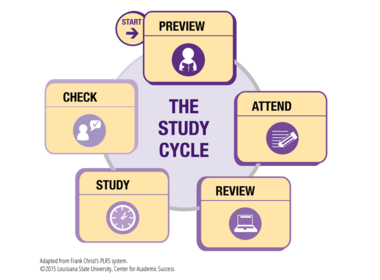
Diapositivas del conjunto (4)
-
Some techniques you can use...
- 1.
- Make time
- for study: Treat your study commitments as professional appointments. Don't let
- other concerns interrupt your study, don't let yourself fall into the habit of
- putting things off till tomorrow.
- 2.
- Be goal
- directed: Identify what you want to get out of your time at university. Then plan how to achieve your goals.
- 3.
- Keep your
- balance: Have a life. Studying is one part of who you are – that doesn't mean
- you have to forget about the other parts. Enjoy your friends and family, play
- sport, eat well, go outside, watch a movie, relax.
- 4.
- Participate
- in tutorials: This is your chance to ask questions, to clarify
- your ideas, to learn through dialogue - ultimately, to actively shape your
- learning.
- 5.
- Your place for study: Try to
- constantly use the same place for studying. If your study-area resembles your
- exam-room, even better! De-cluttering that
- area is key as well.
-
- 1. Take Regular Study Breaks: None of us are superhuman, so it’s
- important to realise that you can’t maintain an optimum level of
- concentration without giving yourself some time to recover. Taking
- regular short breaks not only help improve your focus, they can boost your
- productivity too.
- 2 Embrace New Technologies: Studying no longer means jotting things down with a pen on a
- scrap of paper. There are more options for personalising study that ever
- before. Whether it’s through online tools, social media, blogs, videos or
- mobile apps, learning has become more fluid and user-centred.
- 3.Find a Healthy Balance: Take this opportunity to evaluate yourself both physically and
- mentally. “I never get enough sleep” or “I’m eating too much convenience
- food” this is about taking control. Make the change and see how it
- positively affects your attitude and study routine. This should motivate you
- to maintain a healthy balance in the future.
-


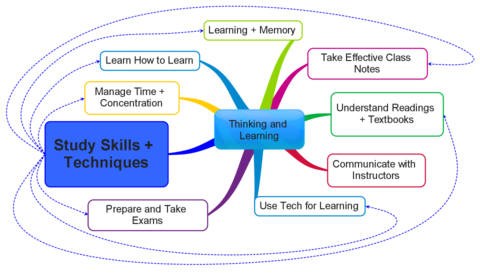
- Pie de imagen: my work schedule
-
- Is any learning technique that aids information retention in the human memory. Mnemonics aim to translate information into a form that the brain can retain better than its original form. Even the process of merely learning this conversion might already aid in the transfer of information to long-term memory. Commonly encountered mnemonics are often used for lists and in auditory form, such as short poems, , or memorable phrases, but mnemonics can also be used for other types of information and in visual orkinesthesic forms.
- Their use is based on the observation that the human mind more easily remembers spatial, personal, surprising, physical, sexual, humorous, or otherwise "relatable" information, rather than more abstract or impersonal forms of information.

- Pie de imagen: An example of what a Mnemoni technique is...
Información
- Descripción
- 3er parcial Ingles Diapositivas sobre 1_Study Techniques, creado por carlosuarez77 el 13/02/2016.
- Creado por
- carlosuarez77 · feb 2016
- Actualizado
- 25 ago 2016
- Visitas
- 3
- Historial
-
- Creado por carlosuarez77 · 13 feb 2016
- Copiado por carlosuarez77 · 13 feb 2016
- Valoración