
Fichas
chap 2 IB
Fichas del conjunto (38)
- 1Scarcitylimited source available to satisfy the unlimited wants and needs of ppl
- 2EconomicsStudy of how people choose to use limited resources to satisfy their unlimited needs and wants
-cope w/ scarcity by making decisions - 3The decision making process1. identify the problem
2. identify the alternatives
3. evaluate the alternatives
4. make a choice
5. take action on the choice
6. review the decision - 4Opportunity Cost-most attractive alternative given up when a choice is made
-generally benefits should be more valuable than opportunity cost - 5What does the price system do?a method of balancing unlimited needs & wants with limited resources --> supply & demand
- 6supplythe relationship b/w the amount of G/S that businesses are willing & able to make available & the price
- 7demandrelationships b/w amount of G/S that consumers are willing & able to purchase & the price
- 8Law of Demandas price declines, demand increases
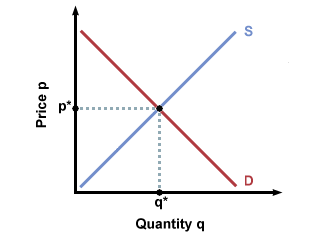
higher price = greater amount supplied - 9Market price/Equilibrium pricethe point at which supply & demand cross
- 10Market price is set by supply & demand
- 11Inflationan increase in the average prices of G/S in a country.
-allows people to buy fewer G/S
-an indication of the power of a country's monetary unit (U.S. dollar, British pound) - 122 basic causes of inflation1. demand-pull
2. cost-push - 131. Demand-pullwhen demand exceeds supply, prices go up
-people increase borrowing for spending
-can occur when gov. tries to solve economic problems by printing more $ - 142. Price-push-higher priced charged by a company (i.e. cost of salaries or raw materials)
NEGATIVE PUSH - 15Factors of production1. Natural resources (land)
2. Human resources (labour)
3. Capital resources - 161. Natural resources-raw materials that come from the earth, water, and air, gold, silver
-used in the production of G/S consumed by individuals, businesses & gov - 172. Human resources (labour)-people who work to create G/S
-technology eliminated certain tasks, but new jobs are being created - 183. Capital resources-buildings, money, equipment, and factories in the production process
-expensive & used several years by organizations - 19Economic System-method a country uses to answer the basic economic questions
-based on customs, political factors, and religious beliefs
-categorized based on OWNERSHIP of resources & gov. involvement - 203 types of economic systems1. command economies
2. market economies
3. mixed economy - 211. Commend economies-government regulates amount, distribution, & price of everything produce; also owns productive resources
-income is used to fund gov. activities
-COMMUNISM: single party controls the gov - Cuba - 222. Market Economies (free-enterprise system) i.e. Japan, Canada-based on force of supply & demand
-individual companies & consumers make the decisions about production
-CAPITALISM: market economy exists but has 3 characteristics: 1) private property 2)profit motive 3) free, competitive marketplace - 233. Mixed Economies France, Sweden-blend b/w government involvement & private ownership
-SOCIALISM: basic industries owned by gov but gov controlled by the ppl as a whole
-free to engage in and make buying choices - 24Privatizationchanging from commend to market, a country must sell government-owned industries to private companies
- 25Development Factors (3)1. literacy level
2. technology
3. agricultural dependency (large = no manufacturing base to provide high quality products) --> lower the better - 263 types of development (countries)1. Industrialized countries
2. less-developed countries
3. developing countries - 271. industrialized countries-strong business activity, advanced tech, highly educated
-large cities & suburbs > rural
-many large companies --> greater economic power
-infrastructure - 28Infastructure-nation's transportation, communication, utility systems --> the better the more prepared for IB
-industrialized countries are ACTIVELY INVOLVED in IB - 29Types of Infrastructure1. Physical - transportation, communication, utility systems
2. Natural - climate, waterways, farmland
3. Social - family relationships, labour, education - 303. Less developed countries-little economic wealth & emphasizes on mining & agriculture
-no tech to make use of resources
-low income = starvation poor heath care - 312. Developing countries-better than less developed countries
-evolving to industrialized
-improving education systems, tech, and industries
i.e. India, China - 32countries are INTERDEPENDENT with each otherso are their economies
- 33Absolute advantage (one of the economic principles)-when a country conduct a G/S at a lower cost than other countries
- 34Comparative advantage-a country specializes in the production of a G/S --> more efficient
-could be more than 1 area
i.e. both clothing & pc but world market for clothing is stronger --> produce more of pc - 35Measuring Economic Progress1. Measure of production
2. International trade activity
3. Other economic measurements - 361. Measure of productionGDP (gross domestic product):
-output of goods produced IN the country, includes foreign resources
GNP (gross national product): total value of citizens anywhere in the world
calculated in PER CAPITAL --> more efficient - 372. International trade activityBalance of trade: differences b/w country's exports & imports
Trade surplus: sells more than it buys --> favourable balance of trade
Trade deficit: buys more than sells --> unfavourable balance of trade
Foreign exchange rate: value of $ of country to value of $ to another
Foreign debt: $ a country owns to other countries --> must use future income to pay off, limits the funds to improve country - 383. Other economic measurements-consumer price index (CPI): inflation is measure
-helps consumer and businesses make buying decisions
Unemployment rate: cannot purchase G/S no income --> weaker economy
Información
- Descripción
- Fichas sobre chap 2 IB, creado por xoxo.lynn.8d el 28/01/2015.
- Creado por
- xoxo.lynn.8d
- Visitas
- 4
- Valoración