
Fichas
Marathon Running
Fichas del conjunto (46)
- 1What physiological functions increase during a marathon?locomotion
heart functions
respiration - 2What is energy supply dependent on?Blood Flow (Oxygen, Glucose, Fatty Acids, Efficient Removal of heat and metabolites)
- 3How does heat/ environmental conditions affect metabolic demands?Increases the need for sweat to lose excess heat but also has to maintain the balance in blood flow
- 4VO2Maximal oxygen consumption, function of time with units mg/kl/mins
- 5Key Physiological Responses at the Start of a race1) Autonomic Nervous System (flight or flight)
2) Energy Sources and mobilisation (use of different fuels for different needs i.e creatine/ ATP/ CHO)
3) Cardiovascular Adjustments (body anticipating the needs for increased contractions)
4) Respiratory Response (using reserve capacity)
5) Regulation of body temperature - 6What energy reserve is used during a sprint?CHO
- 7What main energy reserve is used during a marathon?Fats
- 8What happens to the ANS during a marathon?These are the effects of sympathetic NS
SA nodes increases HR
Ventricular Myocardium increases SV
The increase in HR & SV leads to an increase in CO leading to an overall increase in MAP
Pancreas increases glucagon secretions and decreases insulin leading to increase in BLOOD GLUCOSE - 9How are energy sources maintained throughout a marathon?Fuels used at the start are ATP & PCr (phosphocreatine) followed by anaerobic metabolism of glucose
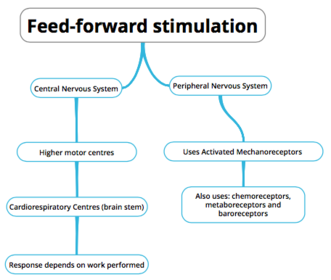
Anaerobic Metabolism is REQUIRED for the sustained activity - 10How does the cardiovascular system adjust during start of a marathon?CV and Respiratory Responses work hand in hand and increase immediately on onset of exercise via a FEED-FORWARD MECHANISM
- 11How do respiratory responses change?Feed-forward mechanisms maintain a normal arterial PO2 AND PCO2 which leads to:
Increased ventilation
Chemoreceptors have a feedback regulation that INHIBITS ventilation to avoid HYPERVENTILATION*
*hyperventilation is caused by CO2 washout - 12Describe the Feed-Forward Mechanism
- 13What do chemoreceptors detect?CO2, O2, ph
- 14What do metaboreceptors detect?K+, H+ and phosphate ions
- 15How does the respiration rate change during different intensities of excercise?Low to moderate intensity --> increased tidal volume
High intensity --> tidal volume will stabilise at 65% of vital capacity and there will be an increase in respiration rate - 16Blood Flow to Lungs during REST- 5mL/min flows through lungs
-1/3 of pulmonary capillaries conduct blood (more open capillaries at base compared to apex)
- There are physiological dead-space (alveoli) where NO gas exchange occurs - 17Blood flow to lungs during EXERCISE- increased cardiac output
-uses more capillaries to conduct blood --> increased gas exchange
- physiological dead space decreases - 18Body Temperature before MarathonAmbient temperature --> 20C
Body Temperature --> 37C
Leg Muscle Temperature --> 35C - 19Body Temperature during MarathonBody Temperature --> 38.5C
Leg Muscle Temperature --> 39C - 20Effects of Exercise on Pulmonary Blood FlowWhen CO is >15 L/min -->
reserve physiological capacity of dead space is exceeded --> increase in pulmonary pressure --> blood flowing faster through capillaries --> capillary reserves (2/3 length) gets used up --> increased gas exchange - 21How does the body regulate the change in temperature?Thermoregulation
INCREASE blood flow to the skin (0.15 L/min at rest - 7 L/min during exercise)
INCREASE sympathetically induced vasodilation (catelcholamines)
DECREASE sympathetically induced vasoconstriction (heat decreases sensitivity of adrenergic receptors) - 22Key Physiological Responses DURING the race1) Hormonal Controls of Energy Metabolism
2) CV controls influencing BP
3) Respiration
4) GI tract movement
5) Thermoregulation
6) Fluid Balance - 23Hormonal Changes
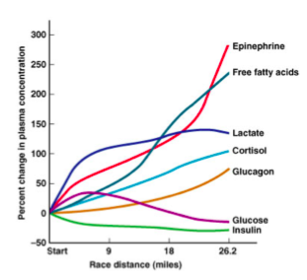
- 24Difference between use of energy source between the genders
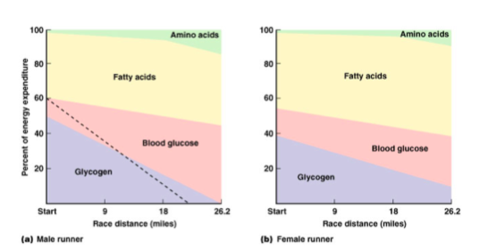
- 25How does the cardiovascular control the changes?MAP increases; BP increases to 'wash out' metabolites
Baroreceptors is not effective during exercise so -->
1) Metaboreceptors sends signals to Cardiovascular Control Centre
2) Central Command sends signals to Cardiovascular Control Center - 26How does Respiration Rates change during ExerciseIncreased ventilation during exercise --> increase activity of cardiac muscles (15% of CO is used by respiratory muscle)
Breathing requires decreased work (adrenaline causes bronchodilation --> coordinated skeletal muscle activity) - 27GI Functions during a marathonGI Functions decrease and blood flow is directed to other organs
Intrinsic GI motility decreased during exercise
Activity increases movement of contents in GI tract --> water absorption lagging --> diarrhoea - 28Importance of thermoregulation DURING the raceThermoregulation is important
At the latter stages if the ambient temperature is 30C then the ability to thermoregulate in decreased -->
INCREASED sweating, INCREASED blood flow to skin
There is now a competition between the organs for blood - 29Blood Flow distribution in different environmental conditions
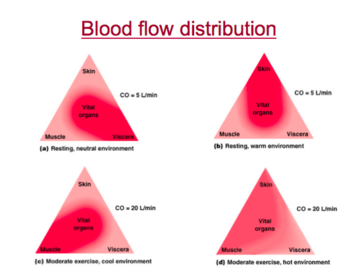
- 30How is fluid balance maintained throughout the race?There are limited water stores in body
During exercise, fluid is lost through sweat (10% is lost from plasma vol)
Counter methods --> decrease urine production --> decreased GFR --> increased water reabsorption - 31Role of ADH in maintaining fluid balanceINCREASED sympathetic nerve activity and DECREASED GFR stimulate renin release from juxtaglomerular cells -->
conversion of of angiotensinogen to angiotensin I -->
ACE converts angiotensin I into angiotensin II -->
aldosterone release by angiotensin II - 32Function of aldosteroneAldosterone stimulates sodium reabsorption independent of water
Water follows sodium so there is decreased urine - 33Role of ADH secretionSweat is hypo-osmotic
Loss of sweat leaves plasma hyper-osmotic which is detected by the osmoreceptors ---> increase ADH --> water reabsorption - 34How to replace lost fluid?Thirst response is inadequate (SHOULD always drink before feeling thirsty)
Sports drink is generally better because flavourings can increase consumption and glucose may/may not contribute to energy
Hypoosmotic drinks decrease water absorption across intestinal tract - 35Key Physiological Responses TOWARDS THE END of the race1) Protect the brain
2) Fatigue (warning sign)
3) Influences of fatigue
4) Conscious decision vs. autonomic control - 36How does fatigue occur?fatigue results from:
- intrinsic factors within muscle
- systemic factors influenced by metabolic and environmental stress
- psychological factors - 37What are the intrinsic factors of fatigue?- depletion of glycogen
- production of lactic acid (the hydrogen ions cause fatigue)
- accumulation of phosphate (inhibits glycogenesis)
- Ca accumulation in mitochondria (displaces Ca from troponin)
- increased plasma potassium levels - 38Mechanism of H+ ions in causing fatigueMuscle:
- displaces Ca from troponin
-inhibits phosphofructokinase
-stimulate nociceptors
Brain:
-causes pain and nausea
Adipose Tissue:
- interferes with hormone-sensitive lipase - 39What are the pH differences during exercise and marathon?During exercise:
- muscle pH decreases quickly as intensity increases
- arterial blood pH decreases slowly until high intensity exercise
Marathon:
- arterial blood pH decreases quickly but returns due to respiratory effects - 40Potential Problems that could occur after the marathon1) Syncope
2) Water intoxication
3) Post-exercise fever
4) Delayed Onset Muscle Soreness - 41How does syncope occur?Syncope - fainting
Skeletal muscle pump has stopped --> blood pooling in lower extremities --> DECREASED venous return and SV --> DECREASED CO and MAP - 42What are the benefits of syncope?- decreased competiton for blood --> decreased skeletal muscle activity and decreased heat production
- decreased effect of gravity on venous pooling --> greater venous return and CO - 43Effects of water intoxicationincreased inter-cranial pressure due to consumption of hypo-osmotic fluid
Occurs when replenishing lost fluids (water and electrolytes) with pure water --> decreased plasma osmolarity --> cells swelling --> brain cells in cranium swell against fixed volume --> increased inter-cranial pressure - 44Symptoms of Water IntoxicationHeadache
Vomiting
Convulsions - 45Post-exercise FeverElevated body temperature DURING exercise is known as hyperthermia
Elevated body temperature AFTER exercise causes FEVER
(feeling cold even when body temp if high) - 46DOMScauses damage to muscles
- sarcomere is damaged at Z-lines
- plasma membrane permeability increases --> creatine kinase enter plasma --> IC Ca concentration increase
REPAIR:
- macrophages by phagocytosis and cytokinesis
Información
- Descripción
- Fichas sobre Marathon Running, creado por aimanhasnan el 25/03/2015.
- Creado por
- aimanhasnan
- Visitas
- 1
- Valoración