
Fichas
PRC - Lecture 7
Fichas del conjunto (66)
- 1What is the MAIN reason for the immune system?Protection from danger i.e. bacteria, viruses, fungi and parasites.
- 2What are the 3 primary functions of the immune system?- Immunological recognition
- Immune effector function
- Immunological memory - 3What is meant by Immunological recognition?The ability of the immunity to distinguish invading pathogens from its own cells else it would end up attacking itself.
- 4What is meant by the immune system having 'effector function' ?The ability of the immune system to deal with the infection and IF possible, eliminate it without harming the body in the process.
*Sometimes for example, during inflammation, there may be local discomfort and damage to healthy tissue as a result of toxic products produced. - 5What is meant by 'immunological memory'?The adaptive immune system 'remembers' that it has encountered an invading organism before and reacts more rapidly on subsequent exposure to the same organism.
- 6What are PRRs and PAMPs and how does the innate immune system use them?PRRs = Pattern Recognition Receptors and are present on some immune cells whose function is to detect distinct evolutionary structures called PAMPs = Pathogen Associated Molecular Patterns present on the cell surface of some pathogens.
- 7List 7 different components which can be considered Pathogen-Associated Molecular Patterns/ PAMPs?- LPS (endotoxin)
- Techoic acid
- Peptidoglycan
- Mannose
- fMet
- (Me) CpG
- Ds RNA - 8How would you compare diversity between both the Innate and Adaptive Immune System?The innate immunity has a limited number of evolutionary conserved structures on its cell's surfaces (PRRs) whereas the Adaptive immunity has comprehensive and adaptable coverage for invading pathogens (in other words, virtually all of its proteins/ peptides can serve as sequence specific receptors).
- 9Compare the follow differences between the Innate Immune system and the Adaptive Immune system: - Speed - What type of pathogenic recognition - Effector function? - Memory?Innate Immune System = Rapid, pattern-specific recognition, effector functions BUT no memory.
Adaptive Immune System = Slower, sequence-specific pathogenic recognition, effector functions AND memory! - 10What does the phylogenetic tree show in terms of the Innate and Adaptive Immune Response?As you look further down the phylogenetic tree and organisms become more developed.... presence of both the Adaptive and Immune response fades in and the chances of survival INCREASE.
- 11What are the 5 main components of the Innate Immunity.- Physical barriers (skin, mucus)
- Enzymes
- Lectins
- Phagocytic cells
- Natural killer cells (anti-viral) - 12What are lectins (present in the Innate IS)?Lectins are proteins that bind to particular carbohydrates in the manner of an antibody.
- 13What are NK cells?Lymphocytes which are able to bind to certain tumour and virus-infected cells WITHOUT the stimulation of antigens and kill them by the insertion of granules containing perforin.
- 14What are 4 epithelial cell types which function as PHYSICAL BARRIERS of the innate immune system?- Skin
- Nasal and Airway mucosa (mucous membrane)
- Gut mucosa (lining of gastro-intestinal tract)
- Genitourinary tract mucosa - 15What is meant by MUCOUS which functions as a physical barrier of the innate immune system?A slimy substance secreted by mucous membranes/ mucosa for lubrication/ protection etc.
- 16Give 4 different kinds of chemical protection of the Innate immune system.- Fatty acids
- Low pH
- Enzymes
- Antibacterial peptides - 17How do polyunsaturated fatty acids function as CHEMICAL protection as part of the innate immune system?FA are present in HIGH amounts in immune cell membranes. They also produce prostaglandins which control cellular processes and regulate cytokines.
- 18How does a low pH play an important role in CHEMICAL protection as part of the innate immune system?A pH of less than 2 kills all microbes (this can be difficult to maintain however).
- 19How do enzymes function as CHEMICAL protection as part of the innate immune system? Give 2 examples.- Pepsin in the gut - A chief digestive enzyme in stomach which breaks down proteins into polypeptides.
- Lysozyme in tears and saliva - An enzyme which catalyses the destruction of the cell walls of certain bacteria (thus, prevents infection of the eye). - 20How do antibacterial peptides function as CHEMICAL protection as part of the innate immune system? Give 2 examples.These antibacterial peptides have been shown to kill both Gram -ve and Gram +ve bacteria, enveloped viruses, fungi and even transformed cancerous cells. Examples include cryptidins and denfensins.
- 21Define commensals... where can they be found?Commensals are normal, non-harmful bacteria found in our gut and on the skin.
- 22Which part of the immune system is SEQUENCE-SPECIFIC and which is PATTERN-SPECIFIC?Adaptive = Sequence-specific
Innate = Pattern-associated - 23What are the 2 main components of the Adaptive immune system?- Lymphocytes
- Antibodies - 24Give 2 examples of Lymphocytes and what type of receptors do they have on their cell surface?- B and T cells
- Both have sequence-specific receptors - 25Describe the morphology of a Lymphocyte. What area of the body is it normally found?- A small leucocyte
- Agranulocyte (one-lobed nucleus)
- The main type of cell found in the lymphatic system. - 26What is another way to describe the Innate IS working to help the Adaptive IS?The innate immune system PRIMES the adaptive immune system.
- 27Describe the following factors of both the Innate and Adaptive Immune System, linking back to how the Innate PRIMES the Adaptive: - Diversity in recognition/ amount of cells that recognise a given antigen - Restriction in the body - Speed of responseINNATE =
- LOW diversity in recognition (there are a lot of cells which can recognise a given antigen on a foreign invading cell).
- Innate immune cells are easily able to patrol the entire body.
- Very FAST response.
ADAPTIVE =
- A very high diversity in recognition (there is a very small amounts of cells that can recognise a given antigen of an invading pathogen).
- Adaptive immune cells are INITIALLY anatomically restricted.
- Adaptive immune cells require days of proliferation and differentiation before they can respond to pathogen - SLOW. - 28Describe the first stage of the Innate immune response.Pathogenic cells adhere to the epithelial layer.
- 29Describe how the epithelial layers function as chemical barriers as a part of the innate immune response.They act as a 1st line of defence and are extremely impermeable to most infectious agents.
- 30What chemical factors are present in both the skin and the normal flora of the gut to prevent breaching of the epithelial layer?- Local chemical factors in the skin i.e. sweat whose low pH inhibits growth of bacteria.
- Toxic chemical substances can be secreted by the normal gut flora to prevent bacterial growth. - 31How does the normal flora behave as a physical barrier to infection in the gut?It can compete with pathogenic bacteria for nutrients and also space for adhesion to gut epithelial cells.
- 32Describe the second early stage of infection by pathogens (mins up to one hour).If the physical epithelial barrier/ local chemical factors are ineffective at keeping out the pathogens (epithelial layer is breached), pathogens move through/ penetrate this layer and move deeper into tissues.
- 33If pathogens penetrate the epithelial layer, what 4 factors does the innate immune response draw in in an attempt to destroy invading organisms?- Antimicrobial peptides and proteins
- Phagocytes
- Complement
- Natural Killer cells - 34List 5 different phagocytic cells.- Neutrophils
- Monocytes
- Macrophages
- Mast cells
- Dendritic cells - 35Define opsonisation.Part of the complement system which enhances phagocytosis of antigens.
- 36Define chemotaxis.Part of the complement cascade which attracts macrophages and neutrophils.
- 37What happens during cell lysis of the complement cascade?Membrane rupturing of foreign cells.
- 38Define agglutination in the complement cascade.Clustering and binding together of pathogens.
- 39Describe the 3rd stage of infection of pathogens in the host.Once local infection has occurred, if pathogens are not destroyed... these foreign cells can penetrate further into the tissue - local infection of TISSUE - Presence of Dendritic cells take effect.
- 40Describe the purpose of Dendritic cells, as part of the innate immune response, in the early stages of infection by pathogens.Dendritic cells take up antigens and migrate to lymph nodes where they PRIME the adaptive immune system.
i.e. they are antigen-presenting cells who present antigen material to T cells. - 41Once antigens have been presented to the Adaptive immune system by dendritic cells... what takes place (normally days later)?T cells work to enhance macrophage function and B cells produce antibodies.
- The innate immune system is thus enhanced by the adaptive immune response. - 42What is the name of the cell made in the bone marrow which gives rise to all immune cells?Pluripotent haematopoietic stem cell.
- 43What is meant if a cell has the suffix of a 'progenitor' as part of its name?It is used to describe where the cell originated.
- 44What 2 types of cells can Pluripotent haemotopoeitic stem cells give rise to depending on where they develop?Common myeloid progenitor
Common lymphoid progenitor - 45What 2 cell types does the common myeloid progenitor cell give rise to?Granulocyte/ macrophage progenitor cell
Megakaryocyte/ erythrocyte progenitor cell - 46What 5 cells does the granulocyte/ macrophage progenitor cells give rise to?*Either granulocytes or polymorphonuclear leukocytes…*
- Neutrophil (granulocyte/ polymorphonuclear leukocyte)
- Eosinophyl (granulocyte/ polymorphonuclear leukocyte)
- Basophil (granulocyte/ polymorphonuclear leukocyte)
- Monocyte (just a granulocyte)
- ...and an unknown precursor of mast cells (just a granulocyte) - 47Define a Monocyte…A large phagocytic white blood cell with an oval nucleus and grey, grainy cytoplasm (granulocyte).
Gives rise to mast cells/ macrophages. - 48Define a Basophil…A granulocyte/ polymorphonuclear leukocyte with a 2-lobed nucleus. It is the least common granulocyte.
Gives rise to mast cells/ macrophages. - 49Define a Neutrophil…A granulocyte/ polymorphonuclear leukocyte with a multi-lobed nucleus. It is shortly lived and highly motile.
Gives rise to mast cells/ macrophage. - 50Define a mast cell…A cell filled with basophil granules which release histamine and other substances during inflammation and allergic reactions..
- 51Define a macrophage…A large phagocytic cell found in stationary form in the tissues at sites of infection.
- 52What cells do the common lymphoid progenitor cells give rise to?B cells
T cells
NK cells - 53Explain the pathway of a B cell during the Adaptive Immune Response.B cell moves from the blood into the lymph nodes.
B cells then move through the lymphatic system where they become effector cells.
These effector cells/ activated B cells then differentiate into plasma cells.
These plasma cells are fully differentiated - produce a highly specific antibody to fight against the antigen present at the site of infection. - 54Explain the pathway of a T cell during the Adaptive Immune Response.T cell moves from the blood into the lymph nodes.
T cell moves through the lymphatic system where it becomes an effector cell.
These activated T cells/ effector cells are then able to enhance the function of the macrophages present at the site of infection. - 55Common lymphoid progenitor cells give rise to T cells and B cells, but also one other types of cell which functions as part of the innate immune response rather than the adaptive immune response. What type of cell is it? Describe its pathway as part of the innate response.Natural killer cell.
NK cell moves from the blood into the lymph nodes.
NK cell then travels through the lymphatic system where it becomes an effector cell.
This activated NK cell/ effector cell can then go on to kill foreign invading cells via insertion of granules without the need for stimulation via antigens. - 56Describe how immature dendritic cells become activated and prime the adaptive immune response.Immature dendritic cell moves from the blood into the tissues.
The dendritic cell is then faced with a particular antigen in the infected tissues.
The dendritic cell then moves into the lymph nodes where it becomes mature and presents the antigen to the T cell of the adaptive immune system. - 57What is the thymus?A lymphoid organ situated in the neck of vertebrates which produces T lymphocytes for the immune system.
- 58Where is immune cell development anatomically restricted to?Bone marrow – production of common myeloid progenitor cells.
Thymus – production of common lymphoid progenitor cells. - 59What area of the body is critical for activation of the adaptive immune system?Regional lymphoid tissue i.e. lymph nodes and the spleen.
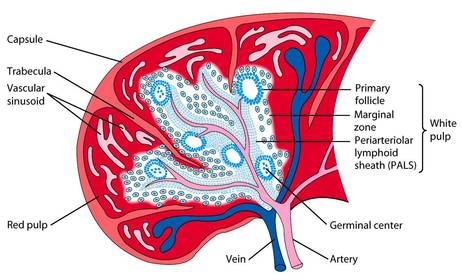
- 60What is the spleen?An abdominal lymphoid organ involved in the production of antibodies and the removal of antibody-coated bacteria.
- 61What allows free circulation of the component cells of the immune system in the body?The regional lymphoid tissue i.e. the lymph nodes, are connected by blood and the lymphatics.
- 62Define lymphatics/ lymph/ lymphatic system.Lymphatics are small, thin vessels which carry a clear fluid called ‘lymph’.
Lymph is formed when interstitial fluid enters the lymphatic system from the tissues.
Lymph nodes are located at different regions throughout the lymphatic system and are where lymph is filtered and lymphocytes are formed i.e. the thymus. - 63Describe the pathway of lymphocytes throughout the body during an immune response. (4)Naïve lymphocytes enter the lymphatic system from the blood and travel to the lymph nodes.
Antigens travel (via lymphatics) from sites of infection to reach lymph nodes.
Lymphocytes are activated in the lymph nodes in the lymphatic system.
Lymphocytes and lymph return to the blood (via the thoracic duct). - 64Define the thoracic duct.A main vessel of the lymphatic system – passing upwards in front of the spine and draining into the left innominate vein.
- 65Define: lymph node.A dedicated structure for the efficient activation of adaptive immune cells in response to tissue pathogens.
- 66Define the purpose of both red and white pulp of the spleen.Red pulp = Red blood cell disposal
White pulp = Contains germinal centres for the efficient activation of adaptive immune B cells in response to blood pathogens.
Información
- Descripción
- The Immune System 1 - Intro
- Creado por
- Afronewtzz · abr 2015
- Actualizado
- 19 feb 2016
- Visitas
- 16
- Valoración