
Fichas
Sin título
Fichas del conjunto (34)
- 1What is a fieldA model to describe the way things are or how things interact. Can be scalar or vector. Any property that depends on a position in space can be represented by a field.
- 2What are the arrows that represent Earths gravitational field?Each arrow is the force vector that describes the force of gravity of the earth on a "test mass".
- 3What does the length of the arrow around earth represent?Length of arrow indicates size of interaction (force) on test mass.
- 4Describe vector linesat each point in space I draw the vector that represents the magnitude and direction of the force at that point.
- 5Describe Field LinesLines drawn so as to be tangent to the direction of the force at each point in space. The density of field lines is proportional to the strength of the force.
- 6Describe Electric ChargeCharge comes in two types + and -. Unit of charge is the coulomb (C). Charge of one electron = 1.6x10⁻¹⁹C.
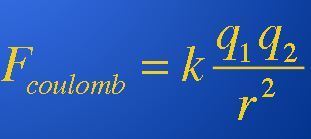
- 7What is Coulomb's Law?
- 8What is a test charge?a small positive charge (creates an electric field in the space around it)
- 9What is the equation of electric field?

- 10Where does the force vector point around a positive charge?Points away
- 11What the direction is the electric vector field around a negative charge?Toward the negative charge
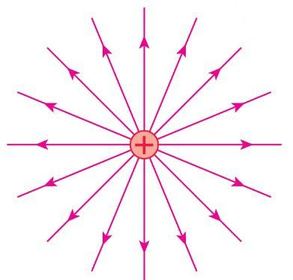
- 12Describe the electric field lines around a positive charge?They point away from the proton, closer together when they are close to the proton, farther away as they get further from the proton
- 13Draw the electric field lines around a positive charge?
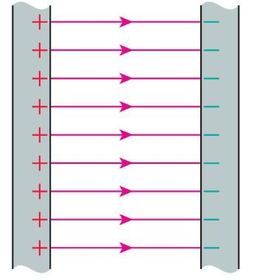
- 14Draw the electric field made by parallel plates.
- 15Draw the electric vector field around a dipole.
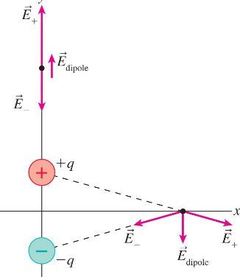
- 16Draw the electric vector field around a dipole
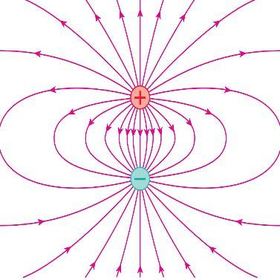
- 17What is the direction of the dipole moment?from - to +
- 18What do forces do?Push or pull
- 19What do forces acting on an object over a distance do?work (F times X)
- 20What does doing work on a system do?increases its energy
- 21What happens to a system doing work on an outside system?looses energy
- 22What happens if you add energy or do work to a system?You increase the potential energy
- 23Describe equipotentials and field linesEquipotentials are perpendicular to field lines
- 24Draw equipotentials at a parallel plate
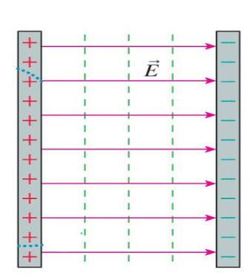
- 25Draw equipotentials around a positive charge (test charge)
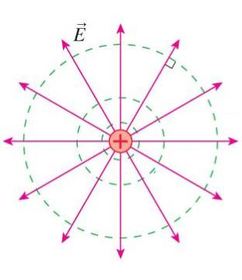
- 26What happens if you put a charge in a field?It has a potential energy due to the interaction with electric field.
- 27What happens if you move a charge to another location in the field?It will have different PE electric (unless both points are on an equipotential
- 28What is electric potential?the electric potential energy per charge
- 29Give the equation of electric potential (V)

- 30What are the units of potential?J/C or Volt (V)
- 31What do we actually measure?potential difference
- 32What happens when you separate + and - charges?you get a potential difference
- 33What does moving to a higher potential mean?it means a higher potential energy, it means you had to do work to get there, it means a force was applied, work was done.
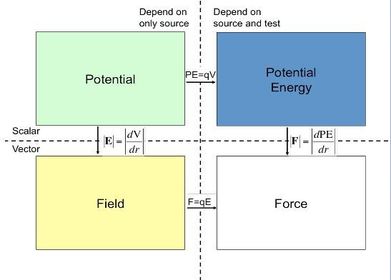
- 34What are the relations between potential, potential energy, field & force?
Información
- Descripción
- Fichas sobre Sin título, creado por patience.almazan el 21/05/2015.
- Creado por
- patience.almazan
- Visitas
- 0
- Valoración