
2808922
Descripción

Fichas por Taylor Smith, actualizado hace más de 1 año

|
Creado por Taylor Smith
hace más de 11 años
|
|
| Pregunta | Respuesta |
| Force | A push or a pull |
| Contact Force | A force that is exerted directly on an object. |
| When does friction occur? | When 2 surfaces are pushed against each other so that their particles are in close contact. |
| Effects of friction | - Friction causes heat - Moving objects are slowed down - Surfaces wear |
| Lubricant | A substance that reduces friction between 2 moving surfaces |
| Static friction | The opposite frictional force that is at its maximum value and before the object starts to move |
| Sliding friction | The opposing frictional force that is slightly less than the static friction and the object moves at a constant speed. |
| Newton's 3rd Law | The mutual similar forces of action and reaction between 2 bodies are equal, opposite and collinear. |
| Nature of Force | - Forces may be attractive or repulsive. - Forces have both magnitude and direction. |
| Forces having magnitude and direction (vector) | If more than 1 force is applied, the combined effect of all the forces may keep the object stationary if the forces are balanced, or move the object if unbalanced. |
| Resultant Force | The single force that has the combined effect if all the forces operating on a body. |
| Hooke's Law | The extension of a spiral spring is directly proportional to the stretching force, provided that the spring is not stretched beyond its elastic limit |
| Rotation | The effect of a force when it is applied to a body which is free to move around a point. |
| Fulcrum/Pivot | The point about which rotation occurs. |
| Moment | The product of the force and the perpendicular distance of the line of action of the force form the pivot. |
| Moment (Formula) | T = Fd (T (tau) = moment, F = force, d = perpendicular distance) |
| Law of Moments | For a lever in equilibrium, the sum of clockwise moments equals the sum of anticlockwise moments. |
| A body is in equilibrium when: | - The resultant force is 0. - The sum of clockwise moments equals the sum of anticlockwise moments. |
| Centre of mass/gravity | The point at which the whole weight of the body is considered to act. |
| Position of centre of gravity | - It determines whether a body topples or not. - A body topples when the vertical line through its centre of mass falls outside of its base and has a moment which topples the body. |
| Stability of an object is increased by: | 1. Lowering the centre of mass. 2. Increasing the are of the base. |
| Stable equilibrium | - The object returns to its initial position. - Centre of mass rises when displaced. - Weight has a moment around the point of contact (hence it rolling back). |
| Unstable equilibrium | - Object moves further away from its initial position when slightly displaced. - Centre of mass falls because it has a moment about the point of contact which increases displacement. |
| Neutral equilibrium | - The body remains in its new position after being displaced. - Weight acts through the point of contact, therefore, there is no moment to increase or decrease the displacement. |
| Lever | A device that can turn about a pivot. |
| Effort | The force applied to operate the lever. |
| Load | The resisting force. |
| 1st class lever | - A lever that has the fulcrum between the effort and the load (EFL) - E.g. Scissors, see-saw, pliers |
| 2nd class lever | - Load is between the effort and the fulcrum (ELF). - E.g. Wheelbarrow, nutcracker, bottle opener. |
| 3rd class lever | _ Effort is between the load and the fulcrum. - E.g. Elbow, sugar tongs. |
| Resultant of a number of vectors | The single vector that will have the same effect as all the original vectors acting together. |
| Equilibriant of a number of forces | - The single force that keeps all the other forces in equilibrium. - It's equal in magnitude but opposite direction to the resultant of the forces. |
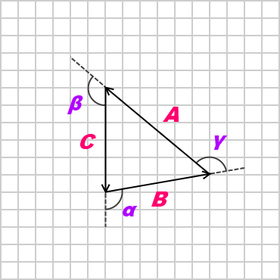
| Triangle Law | If 3 forces are in equilibrium, they van be represented in both magnitude and direction by 3 sides of a triangle taken in order. |
| Triangle Law | |
| Effect of force and mass on acceleration | Acceleration is: 1) Directly proportional to the resultant force for a fixed mass. 2) Indirectly proportional the mass for a constant force. - Therefore, F = ma |
| Newton's 2nd Law | When a resultant force is applied to a body, it produces an acceleration in the direction of the force that is directly proportional to the force and inversely proportional to the mass of the object. |
¿Quieres crear tus propias Fichas gratiscon GoConqr? Más información.