
Fichas
Sales Management: Organising the Salesforce
Fichas del conjunto (52)
- 1Optimal Sales Force Reward System- Provide an acceptable ratio of costs and sales force output in volume, profit and other objectives
- Encourages specific activities consistent with the firm's overall, marketing, and sales force objective and strategies
- Attracts and retains competent salespeople, enhancing longterm customer relationships
- Allow the kind of adjustments that facilitate administration of the reward system - 2Types of Sales Force RewardsIntrinsic & Extrinsic Rewards
(In between: Job Security) - 3Intrinsic RewardsSense of Accomplishment
Personal Growth Development - 4Extrinsic RewardsPay
Recognition
Promotion - 5Financial CompensationStraight Salary
Straight Commission
Performance Bonuses (Accelerators) - 6Straight Salary Advantages1. Easy to administer
2. Planned earning are easy to project
3. Allows easy control of sales force activities; thus, reassignments aren't troublesome
4. Useful when substantial development work is required - 7Straight Salary Disadvantages1. No incentive to improve performance
2. Represent a fixed overhead
3. Salary compression can be seen as inequity among experienced sales people - 8Straight Commission Advatanges1. Income is directly linked to desired results
2. Straight commission plans offer cost-control benefits - 9Straight Commission Disadvantages1. Straight commission plans contribute little company loyalty
2. Problems if commissions are not limited by an earnings cap - 10Straight Commission: Plan VariationCommission Base
Commission Rate
Commission Splits
Commission Payout Event - 11Commission BaseVolume or profitability
- 12Commission RateConstant, progressive or both
- 13Commission splitsBetween two or more salespeople
OR
Between salespeople and employer - 14Commission Payout EventsWhen the order is confirmed, shipped, billed, paid, or a combination of these events
- 15Performance Bonuses (Accelerators) Advantages1. Organisation can emphasise to what they see as important in the sales area
2. Useful for tying rewards to accomplishments of objectives - 16Performance Bonuses (Accelerators)1. If sales force don't fully support established objective, they won't exert any additional effort to accomplish it
2. Difficult to determine a formula for calculation bonuses objectively is they are in subjective terms - 17Non-financial CompensationSense of Accomplishment
Opportunity for Personal Growth
Job Security
Opportunity for Promotion
Recognition - 18Sense of Accomplishment- The internal sense of satisfaction from successful performance
- Sales managers should facilitate salespeople ability to feel it - 19Opportunity for Personal GrowthAccess to programs that allow personal growth
E.g. Tuition reimbursement, leadership development seminars - 20Job SecurityA sense of being a desired employee that comes from consistent exceptional performance
- 21Opportunity for PromotionThe ability to move up in an organisation along one or more career paths
- 22RecognitionThe informal or formal acknowledgement of a desired accomplishment
- 23The Sales ManagerUltimately responsible for the organisation's achieved sales and profit objective of the firm
- 243 Main Roles of Sales Manager1. People Management
2. Customer Management
3. Business Management
There needs to be a balance force, as there are often conflict between them - 25Sales Roles of Manager Percentage DistributionSalespeople 30% - 55%
Customers 25% - 40%
Company 20% - 35% - 26Typical Roles of Sales Manager: As a People Manager1. Recruitment - Selecting the team
2. Coaching - Building the team
3. Inspire - Leading the team
4. Manage the team
5. Motivate/Reward the team - 27Typical Roles of Sales Manager: As a Customer Manager1. Facilitate complex sales
2. Manage key relationships
3. Develop account plans
4. Guide opportunities
5. Assist with sales process - 28Typical Roles of Sales Manager: As a Business Manager (From company to field)1. Manage resources
2. Engage other company functions
3. Adapt strategy to local needs
4. Facilitate company culture and policies
5. Perform administration and logistics - 29Typical Roles as Sales Manager: As a Business Manager (From field to company)1. Share market share insights (for market planning and product development)
2. Report of field performance & activity
3. Perform administration & logistics - 30Importance of Planning- More effective
- Minimise environmental shock
- Avoid hasty decision-making
- Sense of direction and kept focused
- Improves morale to everyone involved
- Improves collaborates cooperation
- Sets standards - 31Levels of PlanningManagement<----------------------->Sales Force
1. Strategic planning
2. Tactical planning
3. Monthly & Weekly planning
4. Daily planning - 32Strategic Planning- Long term direction of the firm
- Using resources to achieve goals - 33Tactical PlanningShort term activities to achieve strategic plans
- 34Monthly & Weekly PlanningSales call cycles, budgets, developing prospects
- 35Daily planningSales calls, budgets, prospects
- 36Sales Force Manager should consider...Diagnoses
Prognosis
Objectives
Strategies
Tactics
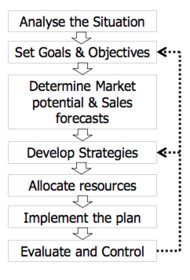
Control - 37Planning Process
- 38Analysing the SituationMarket characteristics
Competition
Sales, profits, costs
Benefits offered
Promotional mix
Distribution systems - 39Setting Goals & ObjectivesGoals - General
Objectives - More specific
(Expense budgets, number of new accounts, conversion rates) - 40Determine Market Potential & Sales ForecastMarket potential - max. sales of industry
Sales potential - max. sales of company
Sales forecast - define by unit measure (company, region, salesperson - what's realistic?) - 41What support sales forecast (sales budgets)?Resources (defined by unit of measure)
- Time
- Money
- Materials
- Equipment
- People - 42Evaluate & ControlESSENTIAL PART OF THE PLANNING PROCESS
- Sets transparent standards
- Sets benchmarks to assess performance
E.g. sales volume, selling costs, market share, customer service, customer satisfaction) - 43Territory AnalysisWho are the prospecting buyers?
Where are they located?
What and why do they buy?
Who has buying authority and what are the influences to decision?
What's the probability of selling this account?
What's the potential share of account? - 44Sales Organisation StructuresGeographic, Product, Function, Customer/Market
- 45Equalised Sales ForceBased on time and effort to service accounts
Variables: size of account, time required per account, geographic location, account potential - 46Incremental ProductivityBased on economic marginal analysis
Marginal revenue = Marginal costs
Variables: sales volume, COGS, gross profits - 47Advantages of Company RepresentativeSelling only company products
Greater attachment with company
Greater control over activities - 48Advantages of Independent Manufacturer RepresentativesEasier penetration to new markets
Predictable sales expenses
Greater territory coverage
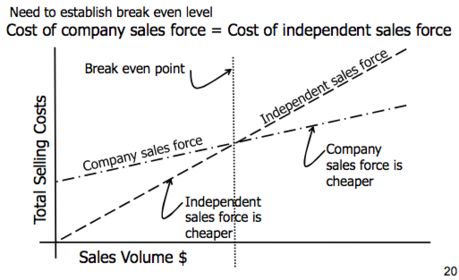
Improved Cash Flow - 49Independent or Company Salespeople Costs?
- 50Basic Category of RewardsCompensation & Non-Compensation Rewards
- 51Compensation RewardsThose given in return for acceptable performance or effort
- Can include non-financial compensations - 52Non-compensation RewardsBeneficial factors given to salespeople for work situation or well-being
Información
- Descripción
- Fichas sobre Sales Management: Organising the Salesforce, creado por Sarah Yuzaidi el 21/06/2015.
- Creado por
- Sarah Yuzaidi
- Visitas
- 43
- Valoración