
32560031


| Pregunta | Respuesta |
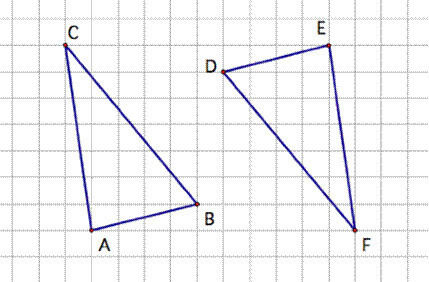
| congruent figures | figures that have the same size and shape |
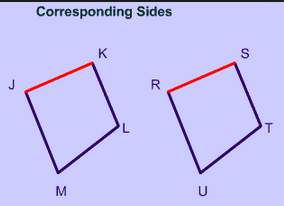
| corresponding sides | Matching sides of two congruent polygons. These sides are equal and have the same length |
| corresponding angles | Matching angles of two congruent polygons. These angles are equal and have the same degree measure. |
| plane | a flat surface that has no thickness and extends forever |
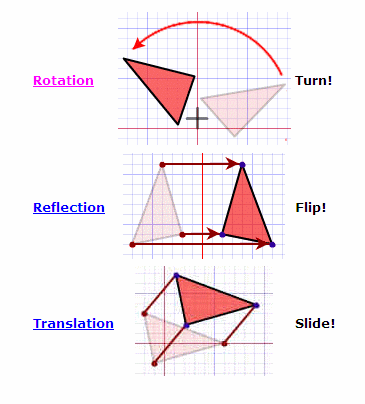
| transformation | Changing a shape using rotations, reflections, translations, and dilations. (Dilations will be covered in Unit 2, don't worry about it in Unit 1) |
| Rigid Motion | A movement that preserves the shape and the size of a figure. Rotations, Reflections, and Translations are rigid motions. |
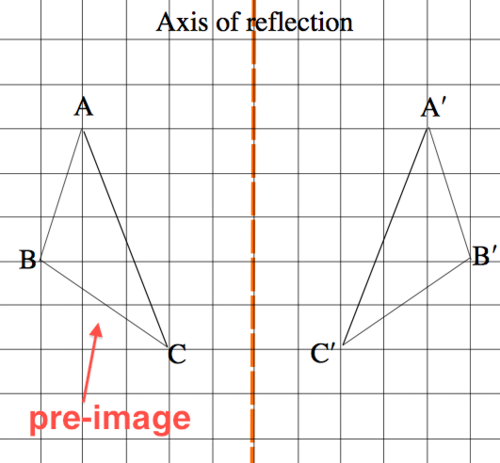
| pre-image | the original figure |
| image | The new figure formed by a transformation. Apostrophes ' are used to indicate the new images. |
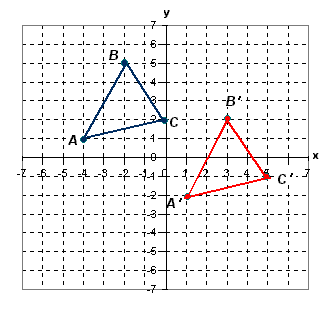
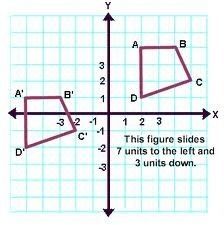
| translation | Sliding a figure. Moving it up, down, left, right, or diagonally without rotating or flipping it. This is a rigid motion transformation that preserves the figure's shape and size. |
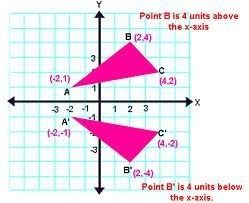
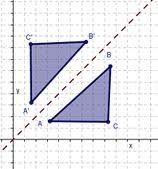
| reflection | Flipping a figure over a line of reflection, usually the x-axis or y-axis. This is s a rigid motion transformation that preserves the figure's shape and size. The figure will land an equal distance from the line of reflection but on the opposite side. |
| line of reflection | A line that a figure is flipped across to create a mirror image of the original figure. The figure will land an equal distance from the line of reflection but on the opposite side. |
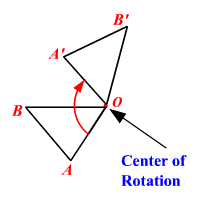
| rotation | Spinning/turning a figure around a point. To describe a rotation you need to provide: -the center of rotation, -the angle of rotation, and -the direction (clockwise or counterclockwise) it is rotated. |
| center of rotation | A fixed point around which shapes move in a circular motion to a new position. |
| angle of rotation | the number of degrees a figure rotates. For this schoolyear, it will either be 90 degrees or 180 degrees. |
| translation notation | (x,y) -> (x+a, y+b) x and y are all the coordinates in the figure. The value for "a" is how many units the figure moves left and right on the x-axis. The value for "b" is how many units the figure moves up or down on the y-axis. |
¿Quieres crear tus propias Fichas gratiscon GoConqr? Más información.