
Fichas
Quantum systems 1

Fichas del conjunto (40)
- 1Fine structure: Relativistic kin. correction
- 2Fine structure: Spin-orbit coupling

- 3Fine structure: Darwin termOnly impacts l=0 states due to δ(r=0)
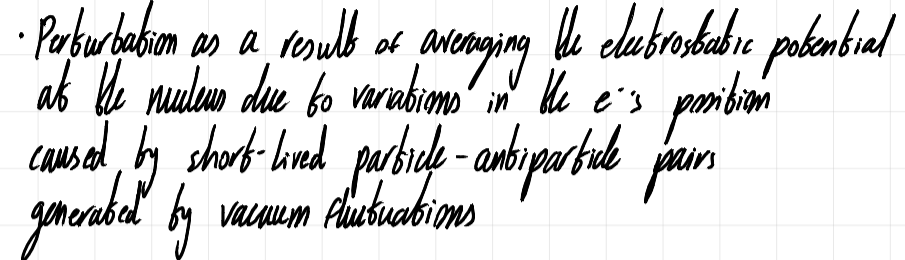
- 4Hyperfine structureShifts from interaction of nuclear magnetic moment I with magnetic field generated by orbiting electrons
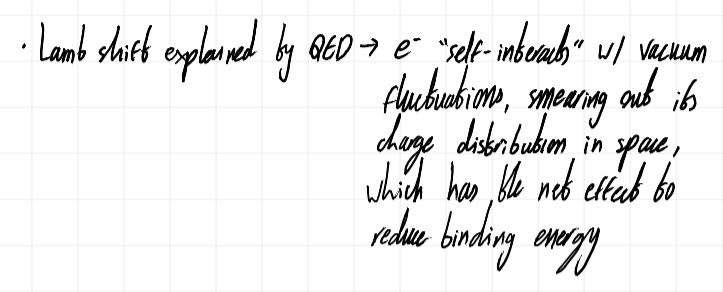
- 5Lamb shift
- 6Low-field Zeeman shift

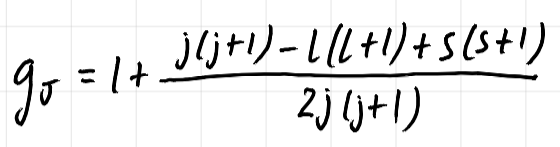
- 7Low-field Zeeman gyromagnetic ratio
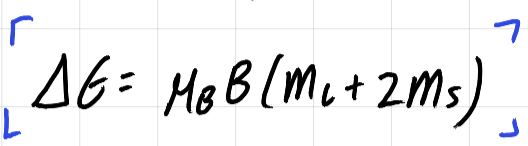
- 8High-field Zeeman shift
- 9Wigner-Eckart theorem

- 10Stark effect term- Non-degenerate states have zero first order shift, Stark shift is quadratic in E
- Degenerate states do have a linear Stark shift
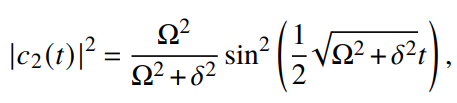
- 11Rabi flopping probability
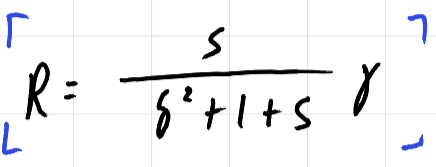
- 12Photon scattering rate
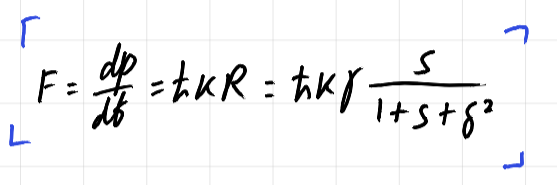
- 13Force from photon scattering
- 14Why don't atoms in Doppler cooling cool to zero temperature?Consider atom in MOT. Atom nearly at rest lacks Doppler shift and is equally likely to absorb photon from any laser, so atom undergoes random walk in momentum space. =0, but isn't zero, so the velocity variance (and hence temperature) never reaches zero
- 15How to measure temperature of an atom cloud- Turn off lasers and let atom cloud expand
- Atom number density is approximately Gaussian and has sigma^2 linear in t^2 with slope proportional to T
- Take pictures of expanding cloud and extract sigma^2 plot --> over t^2
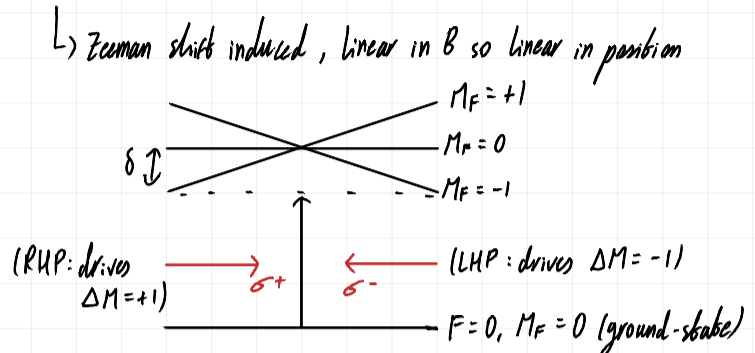
- Extract T from slope - 16Explain a MOT
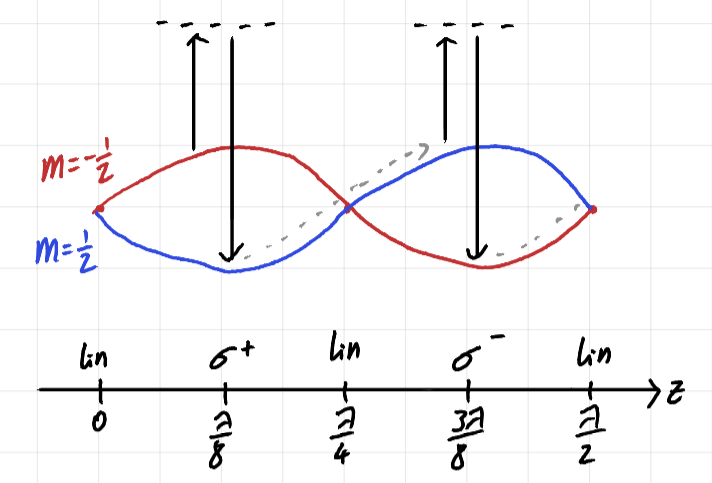
- 17Explain polarization gradient cooling
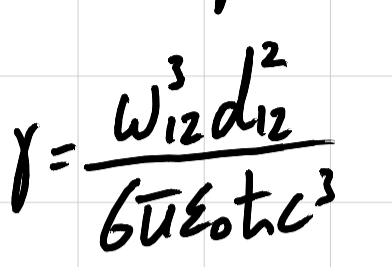
- 18Rate of spontaneous emission
- 19Low-field seeking stateStates with increasing potential energy w/ B (i.e., B and μ point in opposite directions)
- 20Adiabatic following & adiabatic condition in magnetic trapWant Zeeman shift to change slowly enough in time that so atom undergoes adiabatic following and stays in low-field seeking state, instead of transitioning to high-field seeking state and getting ejected from the trap. LHS typically of order of trap frequency ω_T
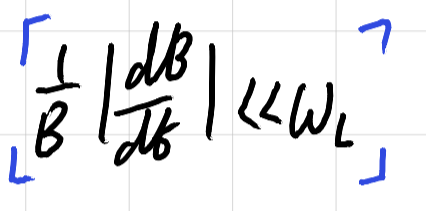
- 21Majorana / spin-flip transitionAdiabtic condition not satisfied as B->0 (since ω_L -> 0), atom transitions to high-field seeking state
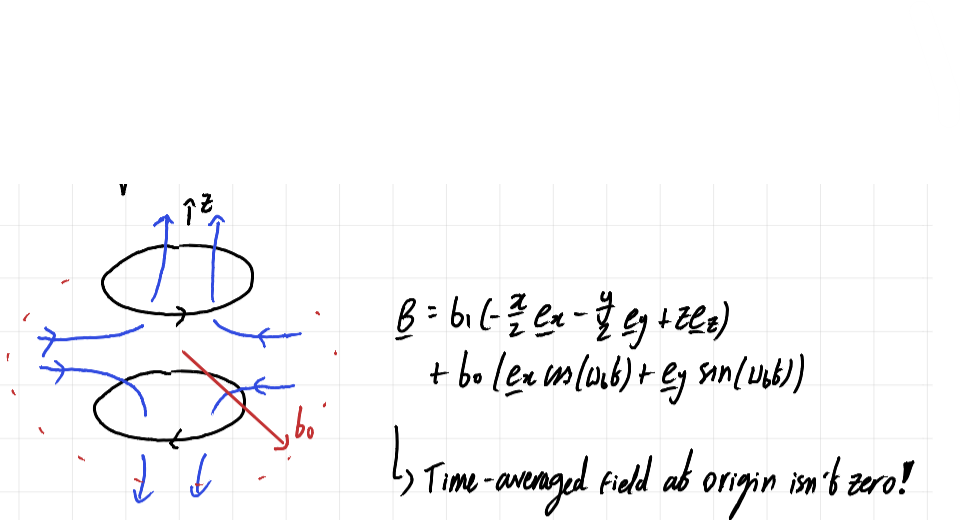
- 22Explain time-orbiting potential (TOP) trapomega_b << omega_T so atom sees time-averaged potential
- 23Phase-space density & BEC conditionBEC condition: ρ'=1
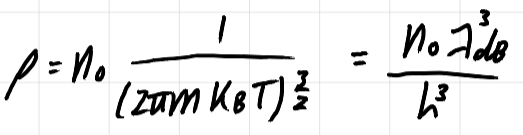
- 24Explain rf evaporation to perform evaporative cooling
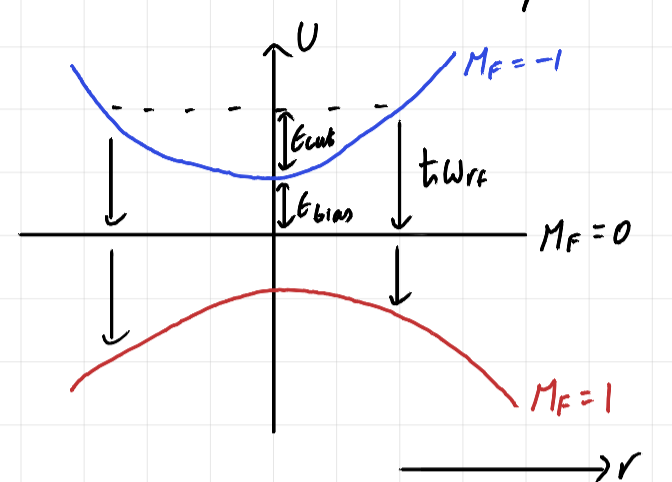
- 25Born-Oppenheimer approximationNuclei in molecule much more massive than electrons --> Nuclear and electronic wavefunctions are decoupled
- 26Molecular transition rules within electronic state: only rotationΔJ = +/-1, ΔM = 0, +/-1
- 27Molecular transition rules within electronic state: vibration and rotationΔv = +/-1,
ΔJ = +/-1, ΔM = 0, +/-1 - 28Transitions the change electronic stateVibrational branching depends on Franck-Condon factors
ΔJ = +/-1, ΔM = 0, +/-1 - 29Type-II transition in molecular laser cooling & dark states
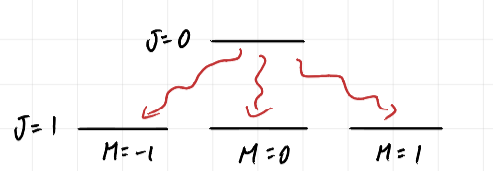
- 30Explain Feshbach resonance- Align E=0 state in aligned spin state with uppermost bound state in anti-aligned spin state
- Elastic collision cross-section inversely proportional to k, so want low T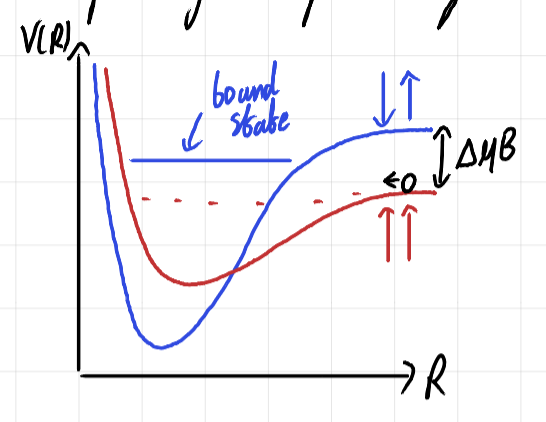
- 31Stark shift of a diatomic molecule2nd order perturbation theory term only significant if states only differ by rotation

- 32Explain Stark decelerator
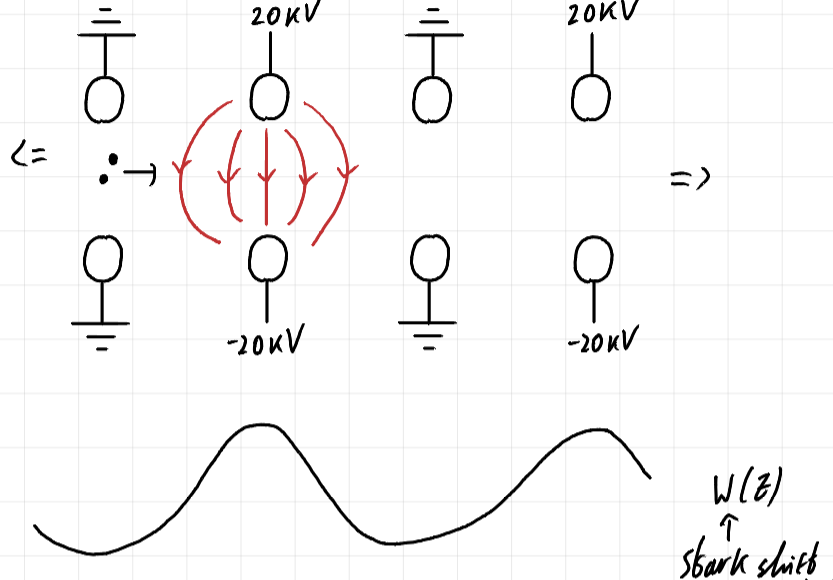
- 33Explain molecular electrostatic trap
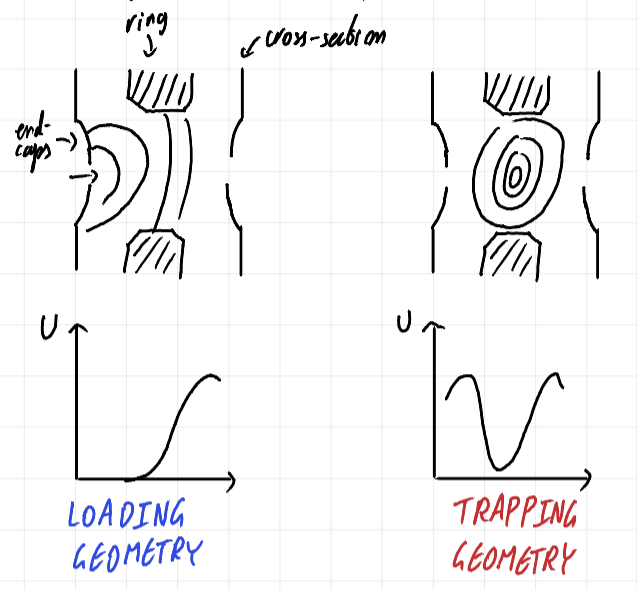
- 34Explain ion rf trap
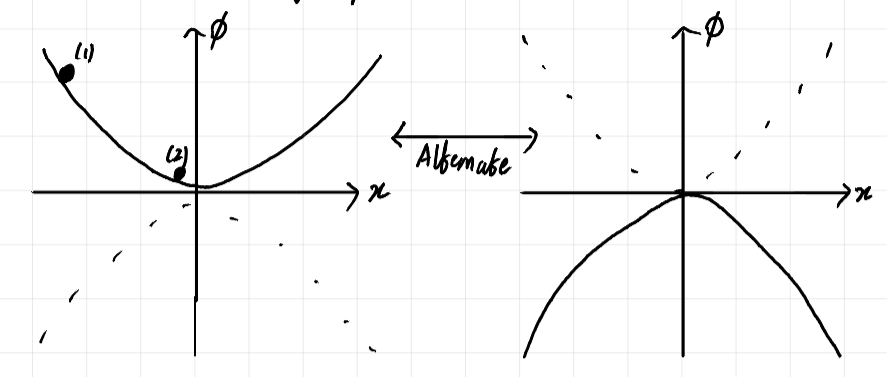
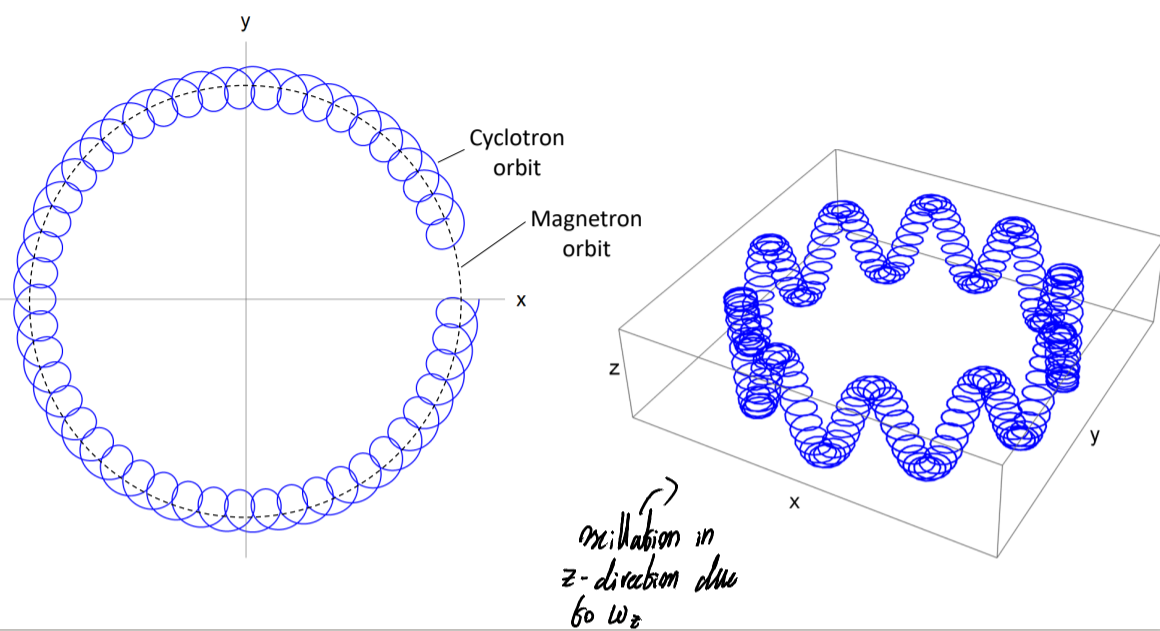
- 35Explain Penning trap
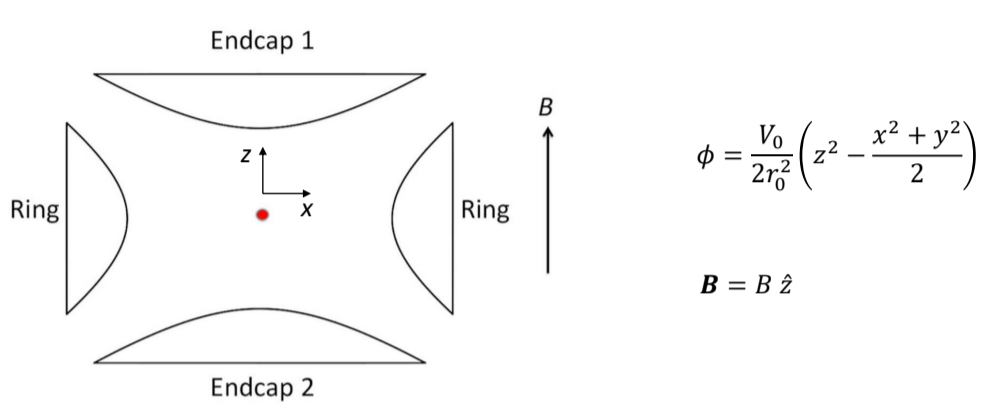
- 36Trajectories in a Penning trap
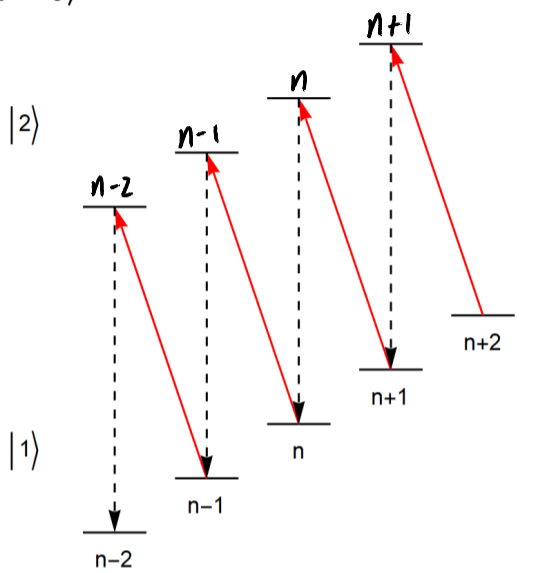
- 37Explain resolved sideband cooling
- 38Evolution of qubit under light field

- 39Conditions for resolved sideband cooling1. ω >> ω_z
2. ω_z >> laser linewidth - 40Rate equations w/ Einstein coefficients
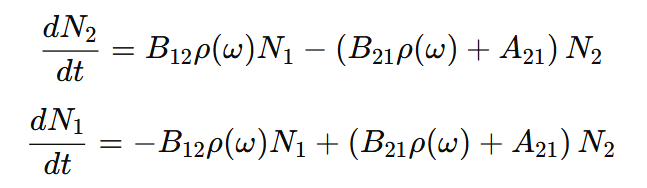
Información
- Descripción
- Fichas sobre Quantum systems 1, creado por Samuele Fossati el 11/04/2025.
- Creado por
- Samuele Fossati
- Visitas
- 0
- Valoración