
Fichas
Week 3 - Info Systems
Fichas del conjunto (65)
- 1Why do we need information?So managers at various levels within a business can make informed decisions.
- 2Information has to be accurate, timely (available), complete and relevant. If not?Then an organisation is at distinct disadvantage.
- 3So, what is relevant?- Depends on what organisation is trying to achieve (it's strategy)
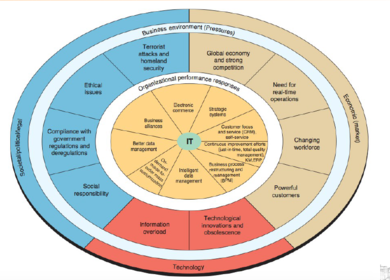
- And that depends on a number of things - 4Modern organisations compete in a challenging environment. To remain competitive, they must...React rapidly to problems and opportunities that arise from extremely dynamic conditions.
- 5A business environment is comprised of a number of factors in which businesses conduct their operations. These are:- Social
- Legal
- Economic
- Physical
- Political
*Significant changes in any of these factors are likely to create business pressures on organisations
*Organisations typically respond to these pressures with activities supported by IT. - 6Business Environments Map
- 7What are the 3 Major Business Pressures?- Market Pressures
- Technology Pressures
- Societal/Political/Legal Pressures - 8What are the 4 factors of Market Pressures?- Global Economy
- Intense Competition
- Changing nature of the workforce
- Powerful customers - 9What are 2 factors of Technology Pressures?- Technological Innovation
- Information Overload - 10What are 5 factors of Societal/Political/Legal Pressures?- Social Responsibility
- Government regulation/deregulation
- Spending for social programs
- Spending to protect against terrorism
- Ethics - 11Given all pressures placed on a business, what do they need to develop in order to survive and compete?An organisational strategy.
- 12Every organisation exists for some reason. Examples of this may be?- To make a profit is the most obvious
- But it may be to help its members (RACV) or provide humanitarian aid (CARE) or a charity. - 13An organisational strategy is developed by 2 factors, these are?Goals
Objectives - 14What is the aim of a organisational strategy through goals and objectives?- The aim is to create value
- By way of making money, helping members or providing aid - 15What does an organisational structure establish?The structure, features, and functions of Information Systems (IS) that will be used in an organisation.
- 16An IS must align with the goals of the organisation. Why is this?The technology, the computer and hardware, are not enough;
Even the people and the procedures are of little use unless they are used to support
the business objectives. - 17For a business to be successful, it must be:Competitive
- 18A competitive business strategy ensures that:The organisational goals and objectives and the organisational structure of a business is determined by its competitive strategy.
- 19How does an organisational strategy determine what information systems are used by an organisation? (chart)
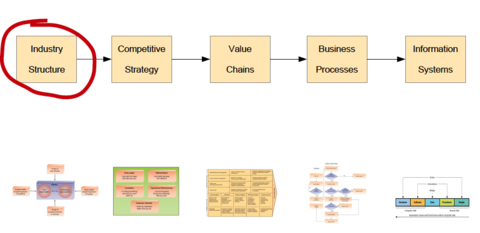
- 20In regards to Competitive Strategy, what its the best known framework for analysing competitiveness?Michael Porter's competitive forces model
- 21Why do companies use Porter's model?To develop strategies to increase their competitive edge.
- 22What does Porter's model demonstrate in regards to IT?How IT can make a company more competitive?
- 23How is the Web involved?- Although the web has changed the nature of competition, it has not changed Porter's 5 fundamental forces.
- Porter concludes that the overall impact of the Web is to increase competition, which generally diminishes a firm's profitability. - 24Porter’s model identifies five major forces that can endanger or enhance a company’s position in a given industry. These 5 forces model is:
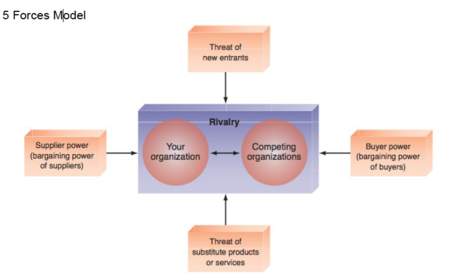
- 255 Forces Examples? (Table)
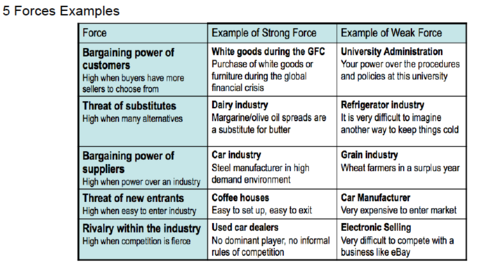
- 26When can an organisation decide where it wants to position itself within it's industry?When the organisation has assessed the competitive situation for their industry.
This determines its competitive strategy. - 27Organisations continually try to develop strategies to counter the five competitive forces identified by Porter. It is important to note that an organisation's choice of strategy involves what?Trade-offs
– A company that concentrates only on cost leadership might not have the
resources available for research and development
– A company that invests in customer happiness (customer-orientation strategy)
will experience increased costs - 28Companies must select a strategy and then stay with it. This is because:- A confused strategy cannot succeed.
- This selection, in turn, decides how a company will utilise its information systems. - 29After analysing industry structure, the organisation then determines the best competitive strategy. Which 4 factors has Porter identified must be consistent with strategy?- Goals
- Objectives
- Culture
- Activities - 30Porter identified 5 generic competitive strategies: (table)
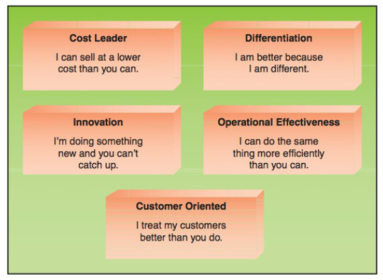
- 31We know that after analysing industry structure, the organisation then determines the best competitive strategy. They then need to:Organise and structure the business to implement that strategy.
- 322 Examples of this?- For example, if they are to be the cheapest in the industry then they have to
develop business activities that make them economically advantageous as
possible.
– It may be that the emphasis is on differentiation, say quality, then they have to develop business activities that ensure the highest quality of their products. - 33How is this done?By the Value Chain
- 34Organisations use the Porter's 5 Forces and Competitive Strategy Models to design general strategies. To identify specific activities where they can use competitive strategies for the greatest impact, they use:Porter's Value Chain Model
- 35What is a value chain?- A value chain is a sequence of activities through which an organisation's inputs and transformed into more valuable outputs.
- 36What does the value chain identify?Identifies points where an organisation can use information technology to achieve competitive advantage.
- 37If an organisation makes a change or introduces a new way of doing something that adds value, then is makes more money. (profit) this is done by:Changing something along the Value Chain.
- 38According to Porter’s value chain model, the activities conducted in any organization can be divided into two categories:- Primary Activities
- Support Activities - 39What are Primary Activities?- Relate to the production and distribution of the firm's products and services.
- These activities create value for which customers are willing to pay. - 40What are support activities?- The primary activities are buttressed by the support activities.
- Unlike primary activities, support activities do not add value directly to the firm's products or services.
- They contribute to the firm's competitive advantage by supporting the primary activities. - 41The Value chain (Chart)
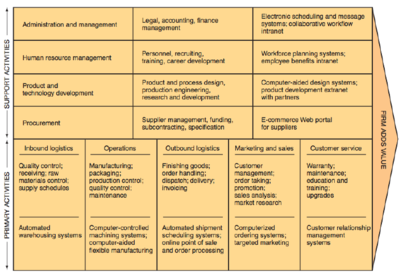
- 42Linkages - What was Porter's idea when creating the concept of Value Chains?- To create integrated, cross-departmental business systems
- Do not automate or improve existing systems
- Instead, create new processes to integrate activities of all departments across entire value chain - 43What is the 'holy grail' alignment of organisations?Business-Information technology alignment, or strategic alignment
- 44What is Business-information technology alignment?- The tight integration of the IT functions with the organisation's strategy, mission and goals
- The IT functions directly support the business objectives of the organisation - 45There are 6 characterises of excellent alignment:● Organizations view IT as an engine of innovation that continually transforms
the business, often creating new revenue streams
● Organizations view their internal and external customers and their customer
service func- tion as supremely important
● Organizations rotate business and IT professionals across departments and
job functions
● Organizations provide overarching goals that are completely clear to each IT
and business employee
● Organizations ensure that IT employees understand how the company
makes (or loses) money
● Organizations create a vibrant and inclusive company culture. - 46Many organisations fail to achieve close alignment. Given the importance of business-IT alignment, why do so many organisations fail to implement this policy? The major reasons are:– Business managers and IT managers have different objectives
– The business and IT departments are ignorant of the other group’s expertise
– A lack of communication. - 47One solution to this problem is:To map and improve business and IT business processes to achieve greater alignment.
- 48What is a Business Process?A business process is an ongoing collection of related activities that create a product or a service of value to the organisation, it's business partners, and/or it's customers.
- 49A process is comprised of 3 fundamental elements:– Inputs: Materials, services, and information that flow through and are transformed as a result of process activities.
– Resources: People and equipment that perform process activities.
– Outputs: The product or a service created by the process. - 50Why do Business Processes implement value chains or portions of value chains?- To add Value
- Thus each value chain activity consists of one or more business processes. - 51Successful organisations measure their process activities - why?To evaluate how well they are these executing processes.
- 52There are two fundamental metrics that organisations employ in assessing their processes. What are these and what do they focus on?Efficiency: focuses on doing things well in the process
Effectiveness: focuses on doing the things that matter; creating outputs of value to the process customer.
*Many processes cross functional areas in an organisation
*Other processes involve only a single functional area. - 53Business Processes (Table for example)
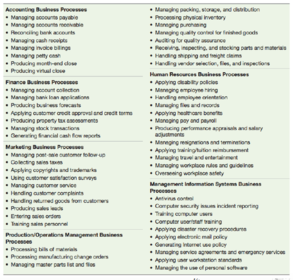
- 54Business Process Example (Ordering an ticket from an airline)
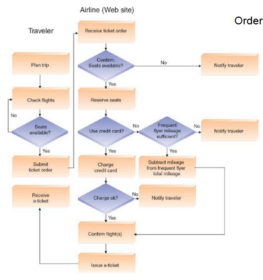
- 55How can an organisation use it's business processes to create a competitive advantage?- If they enable the company to innovate
- Or to execute more effectively and efficiently than its competitors
*Clearly, good business processes are vital to organizational success. - 56What are 2 steps in which organisations take that determine if their business processes are well designed?- The 1st step is to document the process by describing its steps, its inputs and outputs, and it's resources
- The organisation can then analyse the process and, if necessary, modify it to improve its performance
* This is called 'Business process reengineering'. - 57How can Business Processes be documented?By using formal techniques
- 58What is BPMN 2.0?An international standard developed by the OMG group for documenting Business Processes
- 594 ways why we document processes?- For understanding
- For analysis
- To research possibilities of Automation
- To look for possible efficiencies - 60BPMN 2.0 Example
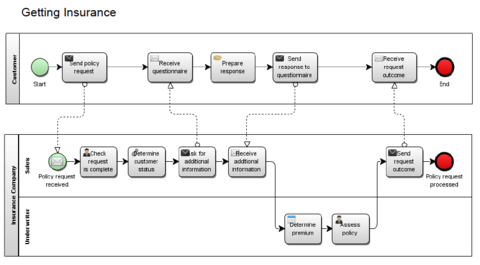
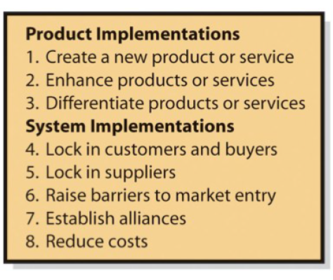
- 61We know now that a business process is supported by an Information System. Why is better information systems essential to the activities of a Value Chain?Better information systems help add value at various stages within the value chain, in either primary activities, support activities or in linkages.
- 62Information systems & Competitive advantage (List)
- 63An information system is a critical enabler of an organisation's business processes. 2 reasons why?- Information systems facilitate communication & coordination among different functional areas
- And allow easy exchange of, and access to, data across processes. - 64IS play a vital role in which 3 areas?- Executing the process
- Capturing and storing process data
- Monitoring process performance - 65Important notes to take from this topic:- IS have an important role to play in fulfilling an organisation's strategy
- However, they do not lead the strategy. They are only designed to FIT it (They must be appropriate)
- This is one reason why no single information system suits every organisation (because they have different strategies).
Información
- Descripción
- Organizational Strategy, Information Systems, and Competitive Advantage • How does Organisational Strategy determine Information Systems Structure? • What Forces determine Industry Structure? • What is Competitive Strategy? • What is a Value Chain? • How do Value Chains determine business processes? • How do information systems provide competitive advantages?
- Creado por
- jenniferelkhoury
- Visitas
- 94
- Valoración