
Fichas
Physics
Fichas del conjunto (59)
- 1Strain formulaStress = applied force∕cross - section area
σ = Nm⁻² - 2Strain formulastrain = extension∕original length
E= Δx∕x - 3Young modulus formulaYoung modulus = Stress∕strain
= applied force x original length∕cross sectional area x extension - 4Longitudinal wavesHave compressions and rarefactions
oscillate in the same direction of their propagation - 5Transverse wavesoscillate at right angles to their propagation
they can be polarised - 6Wave equationsV = fv
c = - 7in phaseThe crests / troughs of two waves occur at the same time
- 8anti phaseIf one crest of a wave coincides with the trough of another
- 9Constructive interferenceTwo waves that are in phase
Produce a wave with the same wavelength but with increased amplitude - 10Destructive interferenceWhen two waves that aren't in phase collide they combine to form a wave with lower amplitude.
anti phase = complete cancellation - 11Interference pattern?caused by two waves with a constant phase difference.
consists of areas of minima and maxima - 12Standing waves?Energy is stored within each vibrating particle
Have nodes and antinodes - 13Standing waves in a tube?Closed tube = displacement node
Open tube = displacement antinode - 14What are the equations for work doneWork done = Force x displacement
ΔW = FΔs
J = Nm - 15What is the equation for powerPower = Work done∕time
W= J∕s = Js⁻¹
W = Kgm²s⁻³ - 16Work done energy transferWork done with no opposition = energy transfered straight to kinetic energy
With opposition = part transfered as heat - 17Formula for kinetic energyKinetic energy = ½ x mass x (speed)²
Ek = ½mv²
J = Kgm²m⁻² - 18Conservation of EnergyEnergy cannot be created or destroyed meaning that the total energy at the beginning of a reaction is the same as at the end.
Energy is usually lost as heat or sound - 19Formula for gravitational potential energyChange in gravitational potential energy = weight x change in height
ΔEgrav = WΔh - 20Weight and gravity equations?Weight = Mass x Gravitational field strength
W = Mg
Gravitational field strength = Gravitational force/ mass - 21Formula for density + unitsDensity = mass∕Volume
- 22Laminar FlowOccurs at lower speed
occurs around streamlined objects
layers do not mix
layers are parallel
velocity is constant over time - 23Turbulent flowChaotic
Subject to sudden changes in velocity
whorls∕eddies
lots of mixing of layers - 24Laminar and turbulent flow
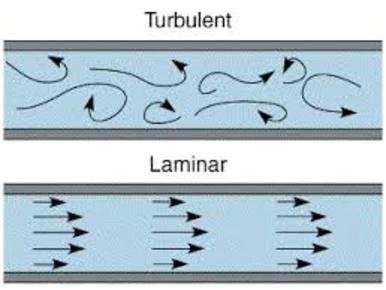
- 25Viscous dragCaused when solids and fluid move relative to one another
Layer of fluid next to the solid exerts a friction force
successive layers of fluid experience frictional forces between one another as well - 26ViscosityThe coefficient of viscosity is used to compare the viscous drag of substances
units = Kgm⁻¹s⁻¹, Nsm⁻², PaS - 27Stokes law formulaF = 6πη
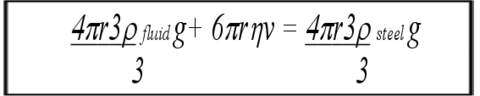
- 28Terminal velocity Formula
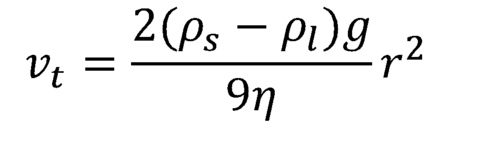
- 29velocity equation
- 30Hooke's lawF = KΔx
- 31Brittle MeaningMaterial breaks with little or no plastic deformation
- 32Malleable meaningCan be beaten into sheets; show large plastic deformation under compression
- 33Ductile MeaningCan be pulled into wires or threats; these materials show plastic deformation before failure under tension
- 34Hard MeaningMaterials resist plastic deformation by surface indentation or scratching
- 35Tough meaningCan withstand impact forces and absorb a lot of energy before breaking; large forces produces moderate deformation
- 36Plastic DeformationBeyond their elastic limit, materials no longer obey Hookes law.
This may cause permanent deformation if stretched any further. This is called plastic deformation - 37StrongHas a high ultimate tensile stress value
- 38Elastic strain energy formula½FΔx
Can also be calculated by the squares under the graph
ONLY WORKS WHEN HOOKS LAW APPLIES - 39Units for Mass, Energy, Power, VolumeMass: Kilograms (Kg)
Energy: Joules (J)
Power: Watts (W)
Volume: Meters³ (m³) - 40Combining VectorsMust be the same type of vector.
To find resultant force:
Same direction: Add vectors together
Opposite direction: Subtract vectors
Right angles: Pythagoras theorem - 41Resolving Vectors: Definition and processA single vector represented as a sum of two perpendicular angles (components)
Process: Fh = Cosθ x magnitude
Fv = Sinθ x magnitude
V = Vertical, H = Horizontal, F = Force - 42Combining multiple vectorsTip to tail method: Must be to scale
Resultant velocity is the final side - 43Newtons first LawEvery object continues in its state of rest or uniform motion in a straight line unless made to change by the total force acting on it
∑F = 0 Horizontal and vertical ∑F's are independent - 44Free - Body DiagramsClearly Represent forces acting on a body. Sometimes a dot is used to represent the center of mass
When acceleration is 0, all forces cancel out. (Newtons First Law) - 45Center of gravity & Center of massWe often draw gravity as acting through a single point. We assume that each particle has a particle the same distance from the center. This can be shown by balancing an object at its center.
- 46Finding center of massThe Center of mass is the interception point of the objects lines of symmetry
- 47Newtons second Law∑F = MA
N = Kgms⁻²
Resultant Force = Mass x Acceleration
If there is a change in resultant force there must be an acceleration (ie ΔV) - 48Newtons Third Law- Forces come in pairs
- If body A exerts a force on body B, Body B exerts a force of equal magnitude on body A but in the opposite direction - 49Newtons Third law and Free body diagramsFree - body diagrams only show one of a newtons law pair
This is because the forces act on different bodies - 50Projectile MotionWe assume that in horizontal motion that acceleration = 0 so the equation V=S/t is used.
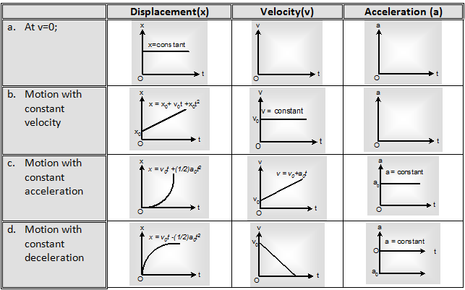
The acceleration for the vertical motion is Gravitational field strength (9.81) - 51Displacement/time Velocity/time Common seen trends?
- 52Scalar Definitions and examplesQuantities which only contain magnitude
Examples: Distance, Speed, Mass, Volume, Energy, Pwer - 53Vector Definition and examplesQuantities which contain both magnitude and direction
Examples: Displacement, Velocity, Acceleration, Force - 54Units for Displacement, Acceleration, Velocity, Distance, SpeedDisplacement & Distance: Meters (m)
Velocity & Speed: Meters per second (ms⁻¹)
Acceleration: Meters per Second per Second (ms⁻²) - 55What are the equations of motionv = u + at
s = ut = ½at²
v² = u² + 2as - 56What do S,U,V,A,T Stand for?S: Displacement
U: Initial Velocity
V: Final Velocity
A: Acceleration
T: Time taken - 57What is the gradient of a displacement/time graph? How would you find it?Velocity
straight line = Δs∕Δt
curve = tangent then Δs∕Δt - 58what is the area under a velocity/time graph and how would you find it?Displacement
Squares and triangles.
½b x h
b x h - 59What is the gradient of a velocity/time graph and how would you find it?Acceleration
Δv∕Δt
Información
- Descripción
- Fichas sobre Physics, creado por Loquacious Locus el 14/04/2013.
- Creado por
- Loquacious Locus · abr 2013
- Actualizado
- 7 may 2016
- Visitas
- 52
- Valoración