
5395369


| Pregunta | Respuesta |
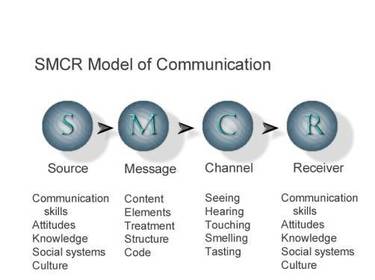
| Berlos' Model of Communication | |
| Putnam's 5 Rules for Crisis Communication | 1. Develop a detailed crisis management plan 2. Set specific objectives and principles 3. Establish a crisis control team 4. Speak with one voice 5. Train for a crisis |
| Public Speaking | 1. Know your audience 2. Know your capabilities 3. Keep It Simple |
| Questions Listeners Bring to Discussion | Do you know something I need to know? Can I trust you? Am I comfortable with you? How can you affect me? Are you reasonable? |
| Obstacles to Successful Communication | Stereotypes Prejudice Feelings Language Culture |
| Delivery Approaches | > Memorised > Manuscript > Impromptu > Extemporaneous |
| Essential Skills for Active Listening | Paraphrase others as they speak Reflect feelings Reflect meaning Reflect Conclusions Follow through |
| Guidelines for Constructive Feedback | * Give both positive and negative feedback * Understand the context * Use common language * Don't make assumptions * Focus on behaviour rather than people * Know when to give feedback |
| Providing Effective Feedback | ^ Be descriptive ^ Be objective ^ Don't use labels ^ Don't exaggerate ^ Don't be judgmental ^ Encourage people to change ^ Build trust ^ Help people accept compliments |
| Benefits of Better Listening | - Demonstrates acceptance of others' values - Promotes problem-solving ability - Increases receptiveness to ideas of others - Increases self-esteem of other person - Helps to overcome shyness or excessive talking - Creates empathy with other people |
| What is CONFLICT? | A strong disagreement or collision of values, interests or intentions among individuals, groups, organisations, communities and nations It is an integral part of human life |
| 3 Views on Conflict | Traditional View: it's bad, avoid it Human Relations View: it's natural, inevitable, and can be a benefit Interactionist (Modern View): it's not only Positive, but necessary for group to perform effectively |
| Functional and Dysfunctional Aspects of Conflict | + stimulant for change + creativity & innovation + group cohesion + Challenge - Employee turnover - tensions & dissatisfaction - creation of distrust |
| Sources of Conflict in Organisations | > Limited Resources > Goals & Priorities > Poorly defined expectations > Change > Human Drives for Success |
| Cultural Components of Conflict | * Values & Perceptions (e.g. task-oriented culture vs relationship-oriented) * Prejudices (religious, ethnic etc.) * Attitudes towards conflict (high-context culture where loss of face v serious) |
| Dealing with Conflict | Accept the inevitability of conflict Stay calm Don't avoid conflict Maintain the moral high ground Partner with HR Document meticulously Work towards 'resolving' rather than 'winning' |
| Conflict Resolution Methods | + Appeal to superordinate/common goals + Expand the resources available + Alter the people/environment + Change the reward systems + Use policies & procedures + Training in interpersonal skills |
| Benefits of dealing with conflict | > Stronger relationships > Increased self-respect > Personal growth & development > Improved efficiency & effectiveness > Creative thinking > Synergy & teamwork |
| 2 Types of Employee Conflict | INTERPERSONAL CONFLICT arises from personal incompatibilities that lead to animosity can damage harmony & productivity TASK CONFLICT arises from disagreements in viewpoints, ideas or opinions can be positive sharing perspectives |
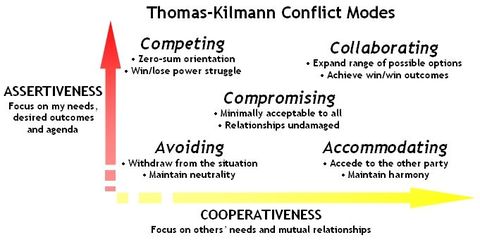
| Styles of conflict management | ^ Competing ^ Collaborating ^ Avoiding ^ Accommodating ^ Compromising |
| Assertiveness Vs Cooperativeness Thomas-Kilmann Conflict modes (1974) | |
| Negotiation is... | Negotiation involves two or more parties with competing or conflicting interests or needs, working towards an agreement on how they will cooperate. |
| Negotiation is... | Negotiation is a form of interpersonal communication |
| Negotiators | ...communicate their own interests, positions, and goals, and in turn, make sense of the interests, positions, and goals of the other party and of the negotiation as a whole. |
| Communication processes, both Verbal and Non-Verbal... | ...are critical to achieving negotiation goals and to resolving conflicts |
| What is communicated during negotiations? | * Offers and Counteroffers * Information about alternatives * Information about outcomes * Social accounts * Communication about process |
| Managing Negotiation Discussions | * Stay in Balance * Manage Appearances * Be Patient |
| Negotiation Language | Logical Level - (what) is said content of proposal/offer Pragmatic Level - (how) it is said semantics, syntax and style |
| Types of Questions During Negotiation | Manageable Questions Unmanageable Questions |
| Manageable Questions | Open-ended questions Leading questions Planned questions Treat questions |
| Unmanageable questions | Loaded questions Impulse questions Trick questions Close-out questions |
| Improving Communication | 1. Questions 2. Listening 3. Role Reversal |
| Distributive Bargaining | also called Competitive/Win-Lose bargaining Distributive bargaining is about WINNING Not a good option if long-term relationship desired |
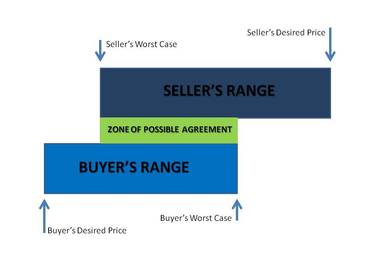
| The Bargaining Zone (ZOPA) for Negotiations | |
| BATNA | Best Alternative to a Negotiated Agreement |
¿Quieres crear tus propias Fichas gratiscon GoConqr? Más información.