
Fichas
Ice Cream Processing
Fichas del conjunto (18)
- 1Ingredients- Ice
- Cream
o Milk
o Protein – emulsifies oil, stabilises air, gives dairy flavours & textures
o Fat – stabilises bubbles, controls melting, gives creaminess and mouth coating as well as flavour delivery
- Flavours
- Sugar
o Controls amount of ice
o Gives sweetness and softness
- Air
o Particularly in cheaper ice cream
- De-emulsifier
o Controls stability of oil and its interaction with air phase
o Mouth coating and melting behaviour
- Stabilizer
o Helps product retain shape
o Slows melting
o Mouth coating - 2Proteins and de-emulsifiers:They are aerating and fat emulsifying agents.
Add milk fat to protein = protein coats oil droplets = emulsification = acts as interface to form stable oil droplets.
Add small molecules like emulsifier/de-emulsifier such as monoglycerides = highly surface active = displaces protein added at interface and adds to oil droplets.
Emulsifiers are easily displaced - 3What is partial coalescence?Partial coalescence = crystals of fat are created, sit at air crystals and stabilise them
- 4Ice cream ingredients:Protein 5-10%
Fat 5-10%
Emulsifier ~0.3%
Stabiliser ~0.2%
Sugar 15-25%
Water 60-70% - 5What is Ice-cream from a colloidal perspective?colloidal dispersion of foam (air stabilised by fat droplets), O/W emulsion, frozen ice crystals and matrix (dispersed phase sugar solution- sugar and protein)
Ice cream mix -> add monoglycerides to form partially coalesced droplets -> displaced as fat globules destabilise -> fat crystal structure created -> fat crystal structure sits at air bubbles - 6How do monoglycerides reduce stability of fat emulsion?by replace proteins on fat surface = thinner membrane formed which is more prone to partial coalescence during whipping.
Air cells are much bigger with mono&di-glycerides than without = air can escape system and volume can be lost. - 7How to create structure in which air can't escape?mono-&di-glycerides create crystals that sit at the interface and cause a degree of protein deorption and emulsion de-stabilisation. This promotes partial coalescence, enabling the formation of a fat network.
- 8AIR PHASEIf just pure protein at the surface = low surface viscoelasticity and poor stability
However – with protein & FAT at surface = pickering stabilisation takes place air is stabilised by fat crystals, meaning improved stability.
So, partially coalesced fat droplets at air phase. Air can still escape so need to freeze immediately to stop air bubbles moving and inhibiting mobility of fat particles around it.
• Air phase in ice cream is unstable
• Fat droplets adsorb to air cell and stabilise it
• Partially coalesced fat in continuous phase – formed by correct use of de-emulsifiers.
• Frozen environment created so particles cannot move. - 9Why is instability common in ice cream?components are not in thermodynamic equilibrium. Structure changes with change in temperature and pressure.
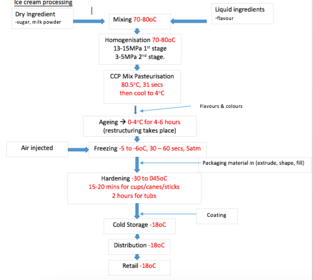
- 10ICE CREAM PROCESS FLOW
- 11What takes place in AGEING stage to make it the most important step?- Membrane rearrangement takes place.
- Emuslifiers adsorb to the surface and replace some milk proteins. Cooling helps monoglycerides to crystallise = more hydrophobic to attach to fat surface.
- Weaker membrane due to displacement of protein emulsion is unstable under shear.
- Fat crystallisation:
o Fat inside droplets begins to crystallise and protrude out, contributing to partial coalescence.
- Mix viscosity increases
o Full protein and stabiliser hydration = slight viscosity increase.
- Ageing time depends on emulsifier adsorption & fat crystallisation. - 12Ice cream freezing uses...? and how does it work?uses scaped surface heat exchanger (as in margarine)
- Simultaneous freezing, aearation and beating to form ice crystals, air bubbles and the matrix.
- Air injected through a system of filters
- Shear causes fat droplets to collide and coalesce
- Needle-like fat crystals puncture mixed protein-emulsifier layer which allows partial coalescence = fat clusters.
- Made of scraper blades- rotating stainless steel driven by electric motor-, annular space with refrigerant (liquid ammonia). Cylindrical carrel of Ni-Cr.
- Layers of ice crystals form on barrel and scrapers scrape it off. - 13Overrun = ?= Air incorporated into ice cream
- Overrun % =
((vol. ice cream produced – vol of mix used) /Vol of mix used) x 100
- More air used = cheaper and more ice crystals present. - 14What is HARDENING- Freezing at -5oC results in ice content being only half that of typical serving temp *-18oC) meaning the ice cream is very soft after freezing.
- Hardening takes place afterwards in hardening tunnel with cold air (-30 to -40oC) blown over ice cream
- = ice crystals grow by propagation and recrystallization
- For correct ice cream texture – many small crystals desired. Achieved by scraped surface heat exchanger. - 15Describe how ice cream microstructure formsUNHOMOGENISED PRE MIX
[Pasteurisation & Homogenisation]
HOMOGENISED MIX (by addition of protein)
[Ageing 4oC)
AGED MIX
[Freezing and aeration]
MICROSTRUCTURE
- Around -5oC, half of ice content
- Air bubble breaks up, ice forms
[Hardening step -30oC]
FULL FORMATION -30oC - 16INSTABILITY OF ICE CREAMShelf life around 18 months but purely depends on the temperature and pressure of storage. Always safe to eat, just texture that governs the shelf life.
Instability and microstructure changes:
- Temp fluctuations (-5 to -18oC) allow condensation of ice crystals
- = coarsening of all phases due to size of ice crystals increasing, air bubble size increasing and air escaping
- Ingredients redistributed
- Less creamy, less smooth
- Colder eating
- Poor visual quality
- Rapid melting - 17Foam instability due to temp cycle:Fresh ice cream with no de-emulsifier large bubbles
Temp-cycled ice cream with no de-emulsifier larger bubbles
Add emulsifiers:
Fresh ice cream very small bubbles
Temp-cycled ice cream medium bubbles as temp protected by emulsifier
(Very difficult to create clean label ice cream as emulsifiers add to product processing as well as create desired structure) - 18Foam instability due to pressure:Ice cream undergoes 5 bar pressure drop when in tub/wrapper/cone.
- Pressure is inversely proportional to vol -> if pressure decreases, volume increases.
- As vol increases = air bubbles grow and expand=coalesce
- = Shrinkage due to rupture of matrix layers and formation of channels
- Channelling leads to irreversible loss of air and collapse of structure.
- Ice cream can be made more resistant to pressure by adding gu,s/stabilisers/proteins to make matrix stronger and increase viscoelasticity of interface.
Información
- Descripción
- (14. Ice Cream Processing) 4 th yr Food Science SEM 1 Fichas sobre Ice Cream Processing, creado por Lizzy Cottam el 11/01/2017.
- Creado por
- Lizzy Cottam
- Visitas
- 2
- Valoración