
Fichas
AQA Unit One Physics
Fichas del conjunto (63)
- 1How can you insulate your house?-For the roof use loft insulation
-For the Windows use double glazing and curtains
-For the walls use cavity wall insulation
-For the floor use a carpet - 2Why is it useful that water has a high specific heat capacity?-Makes it a good coolant as it takes a lot of energy to heat it up
-The reverse (water can give away a lot of energy to cool down) is useful in heaters
(not exactly a spec point) - 3What do objects do with Infrared radiation?All objects emit and absorb infrared radiation
- 4What is the relationship between the heat of an object and the infrared radiation it radiates?The hotter an object is the more infrared radiation it radiates in a given time
- 5What surfaces are good and bad emitters of infrared?-Dark, matt surfaces are good absorbers and emitters of infrared radiation
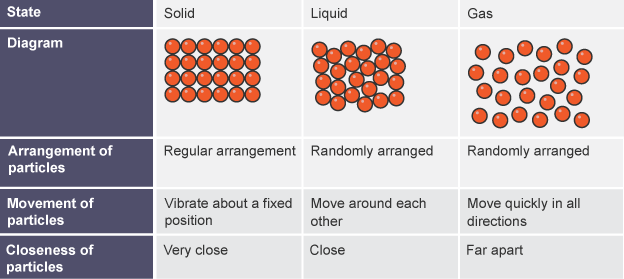
-Light, shiny surfaces are poor absorbers and poor emitters of infrared radiation, they are good reflectors - 6Draw the diagrams for solids, liquids and gases according to the kinetic theory
- 7What is the energy difference in solids, liquids and gases?particles in gases have the most energy (that's why they can move far apart from each other), those in solids have the least energy and particles in liquids are somewhere in the middle
- 8How is heat energy transferred by particles?-Conduction
-Convection
-Evaporation
-Condensation - 9Explain convection in air in terms of particles-Particles in the air gain energy and move faster
-This makes them move apart
-Makes the air less dense
-So the hot (air) rises
-Cooler air sinks to replace the hot air
-Continuous cycle - 10Explain conduction in a non-metal in terms of particles-Particles near the energy source gain energy
-start vibrating
-Bump into particles next to them and transfer some of this energy
-Eventually energy transferred through the entire non-metal - 11Explain the process of evaporation in terms of particles-Some particles have more energy than others
-If a particle has enough energy, is near enough to the surface and is travelling in the right direction it can break free of the liquid and become a gas
-This lowers the average energy of the rest of the liquid - 12Factors that affect the rate of evaporation and condensation-Humidity of the air
-Wind (carries away humidity)
-Surface area to Volume ratio
-Temperature of the air - 13What affects the rate at which an object transfers energy (by heating)-Surface area and volume
-The material of an object
-The nature of the surface with which the object is in contact - 14What increases the rate of (heat) energy transferThe bigger the temperature difference between an object and it's surroundings the faster the rate of (heat) energy transfer
- 15What does a U-value measure?U-values measure how effective a material is as an insulator. The lower the U-value, the better the material is as an insulator
- 16How do solar panels work?Solar panels contain water that is heated by radiation from the sun.
- 17What is the hot water used for?-Heat buildings
-Provide domestic hot water - 18What is the specific heat capacity of a substance?The amount of energy required to change the temperature of one kilogram of the substance by one degree celsius
- 19Specific heat capacity equationE = m x c x o
e - energy transferred in joules, J
m - mass in kilograms, kg
c - specific heat capacity in J/kgC
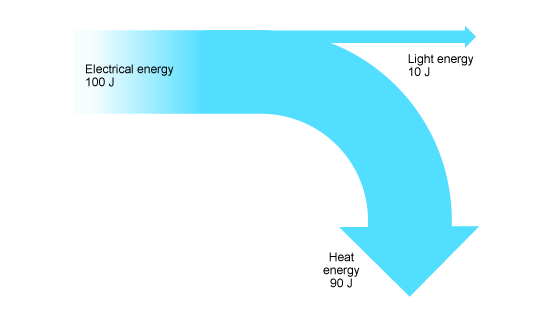
0 - temperature change in degrees Celsius, C - 20Describe a Sankey Diagram (e.g. for a normal light bulb)
- 21What can you do with energy?energy can be transferred usefully, stored or dissipated, but not created or destroyed
- 22What happens to transferred energy?Some of the energy usefully transferred, the rest is wasted
- 23What happens to wasted energy?Wasted energy is eventually transferred to the surroundings, which gradually becomes warmer. The wasted energy dissipates (becomes more spread out) and so becomes less useful
- 24What does the amount of energy transferred by a device depend on?-How long the appliance is switched on for
- it's power - 25Energy transfer equationE = P x T
E - energy in J or kWh
P - power in W or kW
T - time in s or h - 26What units is the cost for mains electricity given in?p per kWh
- 27What kind of power stations have the shortest start up timeFossil fuelled power stations, particularly gas
- 28What is useful about pumped storagepumped storage allows us to store energy for later use, allowing us to meet peak demand
- 29Advantages of overhead power lines-Easy to repair if damaged
-Less chance of electrocuting people as they are very high up
-Cheaper to maintain and set up
-Less energy lost as no good conductors around - 30Disadvantages of overhead power lines-Visual pollution
-Birds and Low-flying aircrafts can fly into them
-More susceptible to damage (e.g. vandalism) - 31How do most power stations work?-Energy source is used to heat water
-Steam is produced
-Steam turns a turbine
-Turbine is coupled to electric generator that produces electricity - 32What are the different kinds of energy sources used in this method of producing electricity?-Fossil fuels (coal, gas and oil) are burned to heat water
-Uranium and plutonium use nuclear fission to heat water
-Biofuels can also be burned to heat water - 33How can water and wind be used to generate electricity-Water includes waves, tides and falling water in a hydroelectric plant
-These directly turn the turbine - 34What other source can electricity be produced from?-Electricity can be produced directly from the suns radiation using solar cells
-Geothermal energy:
-In volcanic areas hot water and steam rise to the surface
-Steam can be trapped and used to drive turbines - 35Why and when can small-scale production of electricity be useful?-Hydroelectricity can be useful in remote areas
-Solar cells can be useful for road signs
-However, it's often uneconomic to connect this to the national grid - 36Advantages and disadvantages of solar cells-Renewable
-Low maintenance cost
-Dependant on weather
-Expensive - 37What are the affects of using different energy resources on the environment?-Release of substances into the atmosphere
-Production of waste material
-Noise and visual pollution
-Destruction of wildlife habitats - 38What is carbon capture?-A rapidly evolving new technology
-Separates carbon dioxide from other waste gases
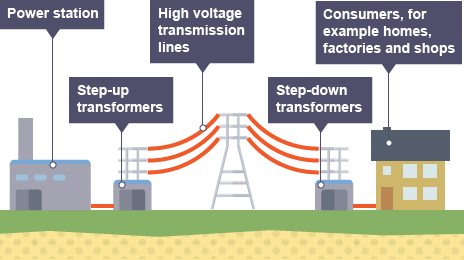
-Then stores the carbon dioxide, usually in old oil and gas fields like those under the north sea - 39What does the national grid do?-Distributes electricity from power stations to the consumers
- 40What happens to electricity in cables? How do we deal with this?-Some of the electricity is lost
-The higher the current the more energy is lost
-So cables transfer energy at high voltages and low currents
-That's why the national grid has step up and step down transformers - 41National grid diagram
- 42What do waves do? (at the most basic level)Waves transfer energy
- 43What types of waves are there?-Transverse
-Longitudinal - 44What are longitudinal waves?-A wave that oscillates parallel to the direction of energy transfer
-Sound and some mechanical waves are longitudinal
-They have areas of compression and rarefaction - 45What are transverse waves?-A wave that oscillates perpendicular to the direction of energy transfer
-Electromagnetic waves and some mechanical waves are transverse - 46What is the electromagnetic spectrum? What is the order of the waves?-Electromagnetic waves form a continuous spectrum
-Wavelengths vary from 10^-15 m to 10^4 m
- Radiowaves
-Microwaves
-Infrared Radiation
-Visible light
-Ultra violet
-X-ray
-Gamma ray - 47What can you do to waves?-Reflect them
-Refract them
-Diffract them - 48DiffractionSignificant diffraction only occurs when the gap and the wavelength are of the same order of magnitude
- 49Refraction-Waves change direction when they are refracted at an interface
-They are not refracted if they are travelling along the normal - 50FrequencyThe number waves per second
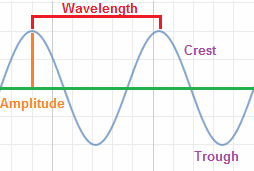
- 51WavelengthDistance from peak to peak or trough to trough
- 52AmplitudeThe maximum extent of vibrations of a wave
- 53Wave diagram
- 54What waves are used in communication? What are they used for?-Radiowaves (television, radio)
-Microwaves (mobile phones, satellite television)
-Infrared (remote controls)
-Visible light (photography) - 55Diffraction in radio waves-Long radio waves are not diffracted as much as short radio waves
-Because of diffraction radio signals can sometimes be received in the shadow of hills - 56Reflection-The normal is a construction line perpendicular to the reflecting surface at the point of incidence
-Angle of incidence is equal to the angle of reflection
-Image produced in a plane mirror is virtual - 57Reflection diagram
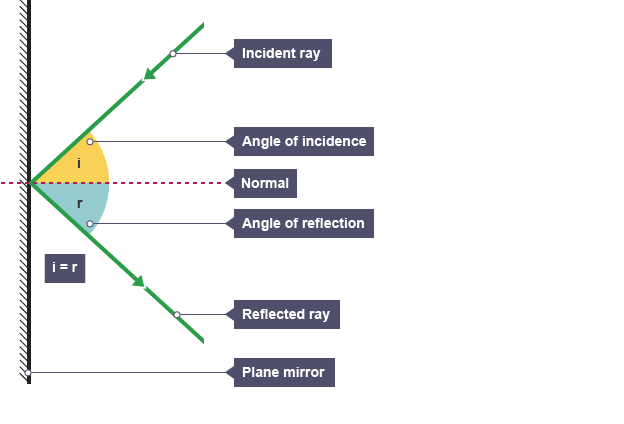
- 58Sound waves-Longitudinal waves that cause vibrations in a medium which is detected as sound
-Pitch of sound is determined by frequency
-Loudness is determined by amplitude - 59Doppler effectIf a wave source is moving relative to an observer there will be changes in the observed wavelength and therefore frequency
- 60Red shiftThere is an observed increase in the wavelengths from distant galaxies. The further away they are, the faster they are moving and the larger the observed increase of wavelength
- 61How does red shift provide evidence for the big bang-Big Bang is the theory that everything in the universe began from a very small initial point
-Red shift shows that the universe is expanding
-Big Bang theory is the only theory that explains the expanding universe - 62CMBR-Cosmic Microwave background Radiation
-Electromagnetic radiation that fills the universe
-Comes from radiation present shortly after the beginning of the universe
-Big Bang theory is the only theory at the moment that can explain CMBR - 63Useful links for P1-Primrose Kittens has done all of P1 in 39 minutes
https://www.youtube.com/watch?v=bR0boPq3v5Q
-AQA spesification
http://filestore.aqa.org.uk/subjects/AQA-PHYS-W-SP-14.PDF
Información
- Descripción
- Flashcards based of the spec, so it should be all that you need to know for AQA Physics unit 1
- Creado por
- Natalia Cliff
- Visitas
- 177
- Etiquetas
- Valoración