
Fichas
AQA Physics Unit 3
Fichas del conjunto (47)
- 1What are the Properties of X-rays?-X-rays are part of the electromagnetic spectrum that are ionising and have a very short wavelength
-They affect photographic film the same way as light (can use CCDs (charged coupled devices) though to form the image electronically)
-Are absorbed by metal and bone
-Are transmitted by soft tissue
-Their wavelength is of the same order of magnitude as the diameter of an atom - 2What are Medical Uses of X-rays?-X-rays can be used to diagnose and treat some medical conditions
-Used in CT scans (CT scans have more ionisation danger as the patient's entire body is exposed to X-rays, however it creates a better image)
-Used for bone fractures, dental problems and killing cancer cells
-Necessary precautions are taken, such as radiologists standing behind screens or wearing a lead apron for a dental x-ray - 3What are the Properties of Ultrasound?-Electronic systems can produce ultrasound waves that have a frequency higher than the human limit for hearing (human hearing is 20 Hz - 20 000 Hz)
-Ultrasound waves are partially reflected at a boundary between two different media
-The time taken for the reflections to reach a detector can be used to determine how far away such a boundary is
S=vt
S is distance in m - 4What are some Uses of Ultrasound?-Used in quality control, to spot thickness and/or gaps or folds in a material
-Medical uses include pre-natal scanning and removing kidney - 5What is Refraction?Refraction is the change of direction of light as it passes from one medium to another
- 6How does a Lens produce an Image?A lens forms an image by refracting light
- 7What is the Focal Length?-In a convex (converging) lens, parallel rays of light are brought to a focus at the principal focus
-The distance from the lens to the principal focus is called the focal length - 8How can you Calculate the Refractive Index of a Lens?refractive index = sin i / sin r
- 9What is the Nature of an Image determined by?-Its size compared to the object
-Whether it is upright or inverted relative to the object
-Whether it is real or virtual - 10Nature of Images Produced by a Converging LensThe nature of the image produced depends on the distance of the object from the lens
-Between the focal point and lens the image is virtual, upright and magnified
-At the focal point the lines are perfectly parallel so no image will be formed
-Further away from the lens than the focal point the image is inverted, real and magnified
-Further than twice the focal point away from the lens the image is inverted, real and diminished - 11What are converging lenses used for?Magnifying glasses
- 12Nature of Images Produced by Diverging (Concave) LensesThese images are always, upright,virtual and diminished
- 13How can you Calculate Magnification?magnification = image height / object height
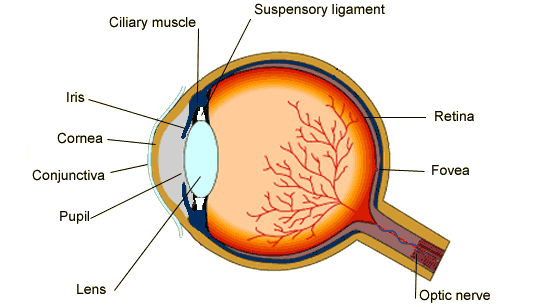
- 14Labelled Diagram of the Eye
- 15Purpose of Sections of the Eye-Lens focuses light onto the retina
-Iris controls how much light enters the pupil
-Retina contains the light receptors
-Cornea refracts light as it enters the eye
-Suspensory ligaments change the shape of the lens and hence its focal point
- - 16Correcting Vision-Long sight is caused by the eyeball being too short or the eye lens being unable to focus. The image is formed behind the retina and so can be corrected with a convex (converging) lens
-Short sight is caused by the eyeball being too long or the eye lens being unable to focus. The image if formed in front of the retina and so can be corrected with a concave (diverging) lens - 17What is your Range of Vision?The eye can focus on objects between the near point (25 cm) and far point (infinity)
- 18Structure of a Camera
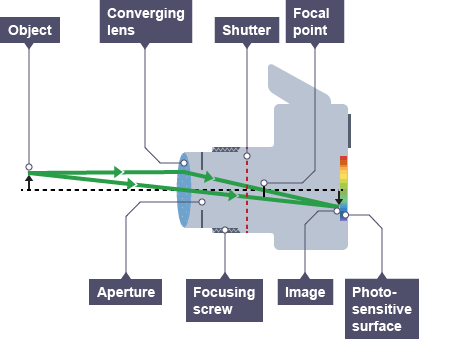
- 19Purpose of Sections of the Camera-Lens focuses light on the CCD (Lens in the eye)
-CCD (Charged Coupled Device) forms the image (Retina in the eye)
-Focusing screw allows the user to adjust the focus of the lens (suspensory muscles)
-Shutter allows the user to adjust the amount of time that liht enters the camera for - 20How can you Calculate the Power of a Lens?P=1/f
P is Power in dioptres, D
f is focal length in m - 21What Factors affect the Focal Length of a Lans?-The refractive index of the material from which the lens is made
-The curvature of the two surfaces of the lens
For a given focal length, the greater the refractive index, the flatter the lens. This means that lenses can be manufactured to be thinner - 22What is the Critical Angle?The angle of incidence beyond which rays of light passing from a denser medium to a less dense medium is no longer refracted but reflected internally
This results in total internal reflection
Refractive index =1 / sin c - 23Optical FibresVisible light can be sent along optical fibres through total internal refraction
- 24What is a Laser?-An energy source that is used for cutting. cauterising and burning
-It's used in eye surgery for changing the shape of the cornea by destroying part of it - 25What is the Centre of Mass of an Object?-The centre of mass of an object is that point at which the mass of an object may be thought to be concentrated
- 26Finding the Mass of an Irregular Sheet of Material-If freely suspended, an object will come to rest with it's centre of mass directly below the point of suspension
-So you can suspend a sheet from 2 points and hold a piece of string which is weighted from the same point of suspension and draw two streight lines down
-Where these lines cross is the center of mass - 27The Centre of Mass of a Symmetrical ObjectThe centre of mass of a symmetrical object is along the axis of symmetry
- 28Pendulum EquationT=1/f
T is periodic time in s
f is frequency in Hz - 29What does the Time Period Depend on?-The length of the pendulum
-NOT the mass - 30What is a Moment?The turning effect of a force
M=Fd - 31If an object is not turning....the total clockwise moment must be exactly balanced by the total anticlockwise moment about any pivot
- 32What are Levers used as?Force multipliers
- 33Stability of Objects-If the line of action of the weight of an object lies outside of the base of the object there will be a resultant force and the object will topple
-Hence objects with a wide base and low center of mass are more stable - 34Pressure in LiquidsLiquids are virtually incompressible, and so the pressure in a liquid is transmitted equally in all directions
- 35How can Hydraulic Systems be used as Force Multipliers?Using different cross sectional areas on the effort and load side of a hydraulic system allows it to be used as a force multiplier
P=F/A - 36Acceleration of an Object Moving in a CirlcleWhen an object moves in a circle it continually accelerates towards the center of the circle. This acceleration changes the direction, not the speed
- 37What Resultant Force causes this Acceleration-The force that causes the acceleration of an object moving in a circle is called the centripetal force
-It always acts toward the center of the circle
-It is caused by gravitational force, friction or tension - 38What Increases the Size of the Centripetal force?-Increasing the mass of the object
-Increasing the speed of the object
-Decreasing the radius of the circle - 39What happens when a current flows through a wire?When a current flows through a wire a magnetic field is produced around the wire
- 40The Motor effect
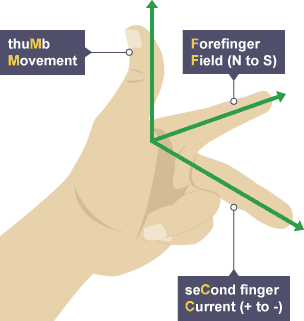
- 41How can the size of the force be increased?-Increasing the strength of the magnetic field
-Increasing the size of the current - 42When a conductor crosses ("cuts")magnetic field lines......a current is induced. Hence there is no current if the conductor is moving parallel to the field lines
- 43Structure of a transformer
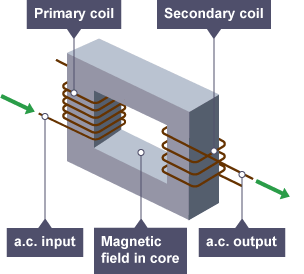
- 44How do transformers work?-An alternating current in the primary coil creates a changing (fluctuating) magnetic field in the iron core (iron used because it can be magnetised easily)
-These magnetic field lines 'cut' the secondary coil, inducing a current
-This causes an AC potential difference in the secondary coil - 45Difference in Transformers-Step up transformers have a higher potential difference across the secondary coil than the primary coil
-Step down transformers have a higher potential difference across the primary coil than the secondary coil - 46Equation for Calculating Potential Difference Change in the CoilsV(p) / V(s) = N(p) / N(s)
n is the number of coils - 47Switch Mode Transformers-Are much lighter and smaller than traditional transformers
-Work from a 50 Hz mains supply
-Makes them useful for things like mobile phone chargers
-Use very little power when they are switched on but no load is applied
Información
- Descripción
- Taken from the specification, so contains all you need to know for AQA Physics unit 3. Good luck =)
- Creado por
- Natalia Cliff
- Visitas
- 30
- Etiquetas
- Valoración