
Fichas
Week 3
Fichas del conjunto (23)
- 1What enzymes regulate: glycolysis gluconeogenesis?6-phosphofructokinase
Fructose 1,6- bisphosphate - 2What happens when ATP is low/high?Low- 6-phosphofructokinase and glycolysis are switched on to generate ATP
High- 6-phosphofructokinase is switched off. Fructose 1,6-bisphosphate is switched on which uses ATP in gluconeogenesis - 3Define: substrate level phosphorylation oxidative phosphorylationTransfer of phosphate from a substrate to ADP/GDP to form ATP/GTP.
Formation of ATP coupled to oxidation of NADH or FADH2 by oxygen. - 4Where does the TCA cycle occur? What is needed for the cycle to occur?In the mitochondrial matrix
Oxygen even though it is not directly involved. It is the final electron acceptor in the ETC - 5What is produced in the TCA cycle per acetyl CoA molecule?2 x CO2
CoA
3 x NADH
FADH2
GTP - 6What is the structure of the mitochondrial ETC?4 membrane-bound complexes linked together:
2 mobile e- carriers: Coenzyme Q (hydrophobic) and Cytochrome C (soluble) - 7Summary of ETC? How many ATPs are produced in aerobic respiration?1) NADH and FADH2 transfer high energy electrons to the ECT
2) As electrons pass through, they fall to a lower energy state
3) Energy released is used to drive protons from the matrix to the inter membrane space (movement generated energy in the form of ATP)
4) Electrons are added to oxygen and combine with protons forming water (by-product)
36 ATP (2 from glycolysis) - 8What does each complex do in the ETC?Complex I/II: removes electrons from NADH/FADH2 respectively which pushes protons across. The electrons join onto CoQ
Complex III: electrons are released from CoQ and protons are pushed across. The electrons are then picked up by Cyt C
Complex IV: electrons are released and more protons are pushed across. 4 H+ are linked with oxygen and electrons forming water - 9How do protons get back into the matrix for the ETC to continue?The electrochemical gradient formed is used to drive the synthesis of ATP via conformational change in ATP synthase.
Protons flow through this enzyme back into the matrix. - 10Purpose of the Glycerol Phosphate Shuttle (GPS)?-Allows the NADH synthesised in the cytosol by glycolysis to be used in oxidative phosphorylation in the mitochondria
-The inner mitochondrial membrane has low permeability for NADH - 11What transports glucose into cells?GLUT receptors.
There are many different types for each tissue type and they can increase in number with training - 12Do organs use the same Acetyl CoA precursers?No they use different ones.
- 13What are the different stages in differentiation?1) Stem cells from blastocysts. They divide to produce more stem cells.
2) The stem cell commits due to an extracellular signal and then starts to specialise.
3) There is a change in gene expression. Some genes are switched on/off. The cell multiplies
4) A terminally differentiated cell is produced where only some genes are switched on. - 14Define potency How does potency change?A measure of a power of a cell to create other cells
As commitment ensues, potency is restricted ie. it cannot become a stem cell anymore.
A stem cell is pluripotent. Progenitors are multipotent eg. a blood cell. A terminally differentiated cell is unipotent eg. a mast cell - 15What makes cell different from each other?-Distinct functional roles
-Different proteins (associated with functions) - 16What are housekeeping genes?Genes that are always on regardless of the cell type
- 17Difference between enhancers and promoters?Enhancers are transcription factors that are elsewhere in the DNA sequence
Promoters are transcription factors next to the DNA - 18What happens when transcription factors bind to DNA?-TF binds to the binding site for activator
-DNA binding domain is formed
-Activation domain (elsewhere on the TF) interacts with RNA polymerase - 19Does 1 TF control all genes/differentiation stages?No.
Different transcription factors control different steps of differentiation.
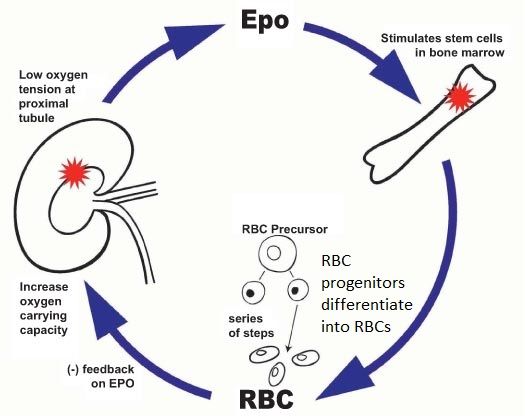
They can turn on many genes at once - 20Describe the Epo cycle
- 21How does Epo regulate red-cell specific genes?1) Epo binds to its receptor in the CSM
2) Gene regulatory protein is activated (TF) and binds to regulatory DNA
3) Another gene is activated to produce another protein that binds to other regulatory regions
4) The response is amplified and more red blood cells are produced. - 22When is cell differentiation essential?-During development
-Continuously as an adult - 233 main stages of a cell?1) Stem cell
2) Intermediate progenitors
3) Fully mature cell
Información
- Descripción
- Metabolism and its control 2 Control of cell differentiation
- Creado por
- Dolu Falowo
- Visitas
- 5
- Valoración