
Fichas
Chapter 15 (pgs. 490-507) SHOCK
Fichas del conjunto (47)
- 1What is shock? Symptoms?Shock is defined as inadequate tissue perfusion.
Often referred to as hypoperfusion.
Symptoms of shock :
restlessness (due to hypoxia), color changes (skin), temperature changes (cool, clammy, moist) - 21. Container (closed system-circulatory system) 2. Volume (Blood) 3. Pump (Heart) When one of the above fails, the body will try to maintain what two things?Cardiac Output and Blood Pressure
CO = HR * SV
BP= CO * SVR
or
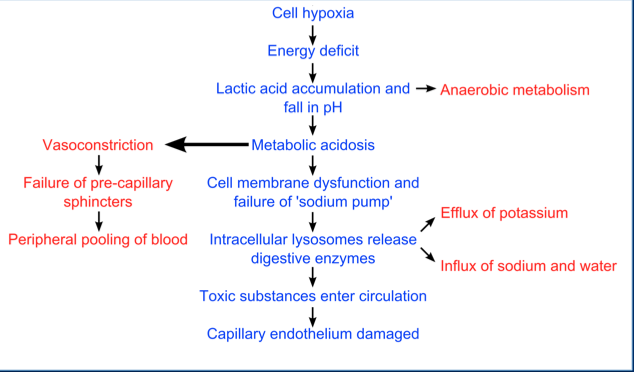
BP = HR * SV * SVR - 3What constitutes inadequate perfusion?During a shock state, inadequate amounts of oxygen and glucose are delivered to the cells. The inadequacy is defined as an amount of oxygen delivered to the cells that is less than the amount required for metabolism. In addition, an impaired elimination of CO2 and other waste products occurs.
- 4What happens during anaerobic metabolism?When there is a lack of O2 available, anaerobic metabolism take place that results in a drastically lower production of ATP and the creation of LACTIC ACID as a by-product.
- 5What normally occurs during aerobic respiration?Glucose molecule is broken down in the presence of O2 yielding a large amount of ATP (for energy production) along with WATER and CO2 as by-products.
- 6What is required to maintain the sodium-potassium pump?Energy (ATP)
- 7What occurs of the sodium-potassium pump fails?Sodium is no longer removed from the cell in exchange for potassium. Potassium and lactic acid leave the cell, collecting in the interstitial fluid, and eventually entering the blood.
The sodium collects inside the cell and attracts water. As a result, the cell swells and eventually ruptures and dies. - 8Adequate perfusion requires which of the following five things?Adequate concentration of O2 in air
O2 diffuses across capillaries in the alveoli
Adequate red blood cells to bind to O2
Enough blood volume and pressure
O2 can move across cell membrane into cell - 9Pathophysiology of Shock
- 10There are four major types of shock : 1. Hypovolemic shockHypovolemic shock—
the result of a decrease in the volume of blood available for perfusion of the body’s organs. The loss of blood in the circulatory system is caused either by external or internal bleeding. It may also result from a profound fluid loss from injury or illness, such as plasma loss due to burns or dehydration due to diarrhea, vomiting, or excessive urination. The most common type of hypovolemic shock is hemorrhagic shock, which results from blood loss. - 11There are four major types of shock : 2. Obstructive shockObstructive shock—
is caused by usually a mechanical obstruction or compression that prevents blood from reaching the heart. Common causes are pulmonary embolism (blood clot), tension pneumothorax (air leak from the lung into the chest), or cardiac tamponade (fluid leaking in the sac surrounding the heart). - 12There are four major types of shock : 3. Distributive shockDistributive shock—
is caused by an abnormal distribution of blood in the vessels or throughout the body which causes an insufficient amount of blood return to the heart. This usually results from massive dilation of vessels or leakage of fluid from the capillaries. - 13Types of Distributive shock are : (3 types)Vasogenic or neurogenic shock : which is usually the result of a spinal cord or head injury, which causes the nervous system to lose control over the vascular system. Blood vessels dilate, causing blood to pool in the periphery (outer areas of the body away from the vital organs) and blood pressure decreases.
Anaphylactic shock : is a result of the body’s abnormal reaction to a foreign protein from a source such as a bee sting, food, or certain medications. The body reacts to the foreign substance by releasing chemicals that cause blood vessels to dilate and leak and the bronchioles to constrict. This reaction may have a rapid and severe onset. Without immediate emergency medical care, the patient may die.
Septic shock : is a result of the toxins produced by a severe infection (usually bacterial in nature). The toxins cause a reaction that dilates the blood vessels and allows blood to pool in the extremities and fluid to leak from the blood vessels into the surrounding tissue. - 14There are four major types of shock : 4. Cardiogenic ShockCardiogenic shock—
a result of inadequate pumping of the heart. Conditions that cause this include coronary artery disease, myocardial infarction (heart attack), and heart valve disease. - 15Categories of Shock
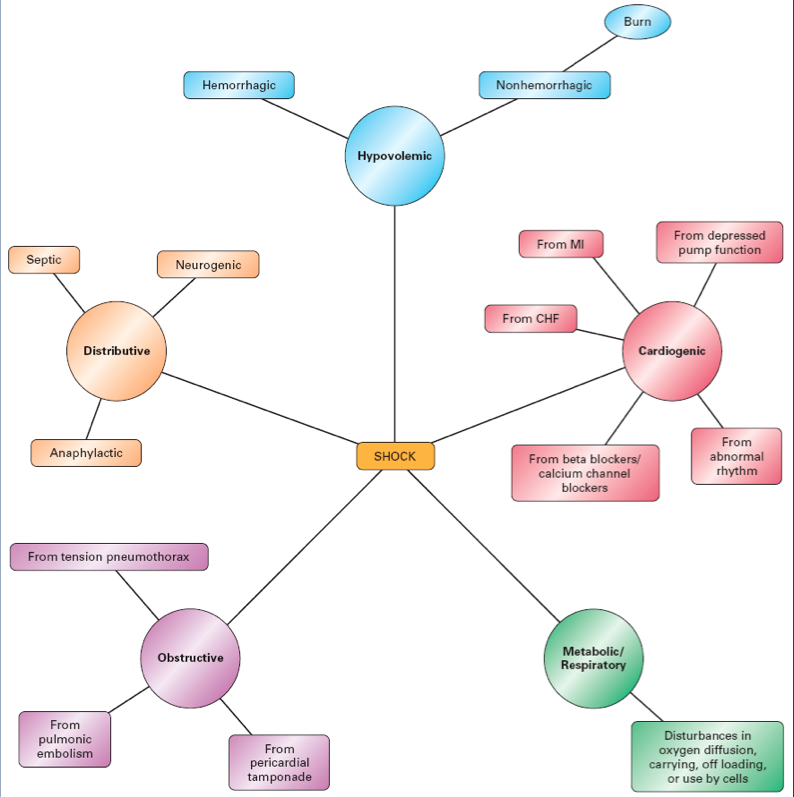
- 16Etiologies of Shock 1. Inadequate volume How to treat?A decrease in systolic blood pressure can result in inadequate tissue perfusion.
Decrease in blood volume or plasma volume
Diarrhea, burns, excess urination, increased capillary leakage, vomiting
Results in decreased preload, stroke volume, and cardiac output
Treatment:
The patient who is in shock from inadequate blood volume obviously needs an increase in blood volume to restore adequate perfusion.
A patient who is in shock from fluid depletion resulting from excessive diarrhea needs fluid but not whole blood. - 17Etiologies of Shock 2. Inadequate Pump Treatment?If the pump fails, regardless of the blood volume, the delivery of oxygen and glucose to cells will be decreased.
Heart cannot generate strong enough contraction to move blood
Results from damage to heart or mechanical obstruction
Treatment:
A patient with pump failure has not lost any blood volume. Administering fluids will not improve the condition and may actually worsen it.
The patient requires the improvement of pump function to eliminate the shock state. - 18Etiologies of Shock 3. Inadequate Vessel Tone Treatment?Tone = systemic vascular resistance
Vessel size increases, reducing resistance and DROPPING blood pressure
The sympathetic nervous system provides tone by keeping the vessel size regulated to a certain size to maintain the resistance and pressure.
Loss of sympathetic nervous system stimulation
Chemical mediators which cause vasodilation
Treatment:
focuses on decreasing vessel size or adding more volume
An EMT may contact an advanced life support unit that has medications, intravenous fluids, and procedures and that can restore the pressure, perfusion, cellular oxygenation, and delivery of glucose to cells. - 19Hypovolemic shockshock due to low blood volume
MOST COMMON form of shock.
It can be due to blood loss or loss of some other fluid.
The most common cause of hypovolemic shock is HEMORRHAGE.
Nonhemorrhagic forms of hypovolemia are associated with fluid loss from BURNS and DEHYDRATION. - 20Hypovolemic shockDecrease in overall blood volume
Loss of blood or plasma fluid
Most common is hemorrhagic shock
Internal or external bleeding
Fluid loss from injury or illness
Plasma loss from burns
Dehydration from vomiting, diarrhea, or excessive urination - 21Hypovolemic Shock HEMORRHAGIC SHOCKLoss of whole blood from the intravascular space.
Traumatic injury or medical illness
Perfusion decreases from a reduction in pressure
O2 - carrying capability of the blood decreases from loss of red blood cells and hemoglobin
HIGH PRIORITY:
Stop the bleeding! (1st step in managing pt)
Often requires whole blood in ER
Immediate transport! - 22Hypovolemic Shock (nonhemorrhagic) BURN SHOCKCapillaries and vessels leak plasma and plasma proteins
Leads to edema in interstitial space & swelling
May result in compartment syndrome
Shock results from inadequate intravascular volume
Takes several hours to develop
Fluid is pulled from the vascular space to the interstitial space, causing hypovolemia.
Treatment:
For the burn patient, establish and maintain an adequate airway, ventilation, and oxygenation. Prevent further contamination of the burn injury. - 23Distributive shockAbnormal distribution of blood in the vessels throughout the body causing insufficient blood return to the heart
Results from massive DILATION of vessels or leakage of fluid from capillaries
3 types of distributive shock :
1. Vasogenic or neurogenic
2. Anaphylactic
3. Septic - 24Distributive shock NEUROGENIC SHOCKSpinal cord injury
Nervous system loses control over the vascular system
Blood vessels DILATE, blood pools in extremities (periphery)
Decreased venous return and cardiac output leads to bradycardia (slow HR) and hypotension (low BP)
Container is too big! - 25Distributive shock ANAPHYLACTIC SHOCKResults from body’s abnormal reaction to a foreign protein (severe allergic reaction)
EX: Bee stings, food, medications
Body releases chemicals (histamines) causing blood vessels to DILATE and leak; bronchioles constrict, swelling, nausea
HIGH PRIORITY:
May have rapid and severe onset
Can result in rapid death
Vasodilation moves blood from the central core to the periphery, causing distributive shock. - 26Distributive shock. : ANAPHYLACTIC SHOCK (2)Anaphylactic shock is a type of distributive shock.
Chemical mediators released in the anaphylactic reaction cause massive and systemic VASODILATION.
Use EPINEPHRINE for the anaphylactic shock patient.
Epinephrine contains alpha properties that cause systemic VASOCONSTRICTION. The vasoconstriction reduces the vessel size and increases the resistance, resulting in an increase in blood pressure and perfusion.
In addition, the vasoconstriction tightens the capillaries and lessens the fluid leakage.
Airway management, ventilation, and oxygenation are also key components of the emergency care of the anaphylactic reaction patient. - 27Distributive shock. : SEPTIC SHOCKCaused by an infection that releases bacteria or toxins throughout the body cause the blood vessels to DILATE and to become permeable.
Toxins cause:
-dilation of blood vessels
-pooling of blood in extremities
-fluid to leak into surrounding tissues (toxins break down tissues)
HIGH PRIORITY:
ALS for IV Fluids
The shock state is created by the massive vasodilation, which reduces the systemic vascular resistance, blood pressure, and perfusion.
Also, the loss of fluid reduces the intravascular volume and decreases the preload, stroke volume, cardiac output, systolic blood pressure, and perfusion. - 28CARDIOGENIC SHOCK (both a category and a type of shock)Heart can’t contract effectively.
Adequate blood volume and vessel tone
>40% of the left ventricle has been lost
Results in a reduction in stroke volume, cardiac output, and systolic blood pressure, leading to poor tissue perfusion. - 29Causes of CARDIOGENIC shockOften due to:
Acute MI
CHF
Dysrhythmia
Drug overdose on medications that reduce pumping function
Depressed pump function reduces the force of the left ventricular contraction, stroke volume, cardiac output, systolic blood pressure, and perfusion. - 30Obstructive ShockMechanical obstruction or compression that prevents blood from reaching the heart
Blood volume is normal
Heart pump is normal
If obstruction resolved perfusion returns to normal - 31Common causes of Obstructive ShockALS for chest needle decompression
Diesel therapy!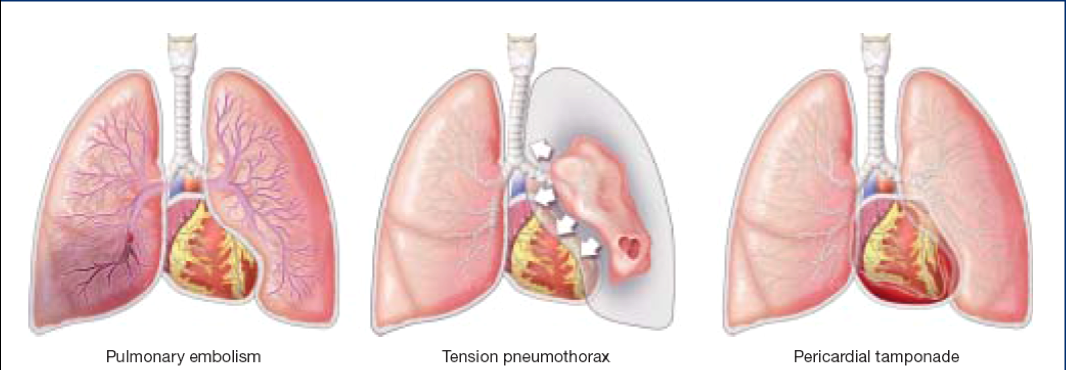
- 32Metabolic or Respiratory ShockInability of the body to use, transport, and/or offload oxygen
O2 Dysfunction:
-Can’t diffuse into blood
-Be carried by hemoglobin
-Offload at the cell
-Can’t be used for metabolism (ex: cyanide)
Common Causes:
Carbon monoxide
Cyanide
Treatment (HIGH priority):
OXYGEN!!!! - 33The Body's Response to Shock Something has failed in one of the following areas: 1. Container (closed system-circulatory system) 2. Volume (Blood) 3. Pump (Heart) What are the two major pathways for compensatory mechanisms?When shock occurs, the body attempts to compensate for the disturbance.
Many signs and symptoms the patient exhibits while in shock are related to the COMPENSATORY mechanisms.
The sympathetic nervous system plays a significant role in trying to restore a normal BLOOD PRESSURE and reverse the shock state.
The compensatory mechanisms associated with shock are initiated and maintained through two major pathways: direct sympathetic NERVE STIMULATION and the release of HORMONES.
Symptoms of shock :
restlessness (due to hypoxia), color changes (skin), temperature changes (cool, clammy, moist) - 34The Body's Response to Shock 1. Sympathetic nervous system kicks in 2. Endocrine response: Catecholomines (epinephrine) Renin-angiotensin activation RESULTS IN (5 things)?Results in:
Increased heart rate
Increased myocardial contractility
Increased VASOCONSTRICTION
Kidneys retain fluid
Increased blood pressure - 35The Body's Response to Shock Sympathetic nervous system: stimulates primarily the vessels and the heart in an attempt to restore the blood pressure in the arteries.The effects of the sympathetic stimulation, which occur immediately, are:
– Increased heart rate
– Increased contractile force (stroke volume)
– Vasoconstriction
– Stimulation of the release of epinephrine and norepinephrine from the adrenal gland (some of which causes the symptoms of shock)
If the cardiac output improves and/or vasoconstriction increases the systemic vascular resistance, the systolic blood pressure increases. - 36The Body's Response to Shock Hormone ReleaseCentral portion of kidneys release these hormones:
NOREPINEPHRINE stimulates ALPHA receptors in peripheral blood vessels, returning blood to the central core.
EPINEPHRINE stimulates BETA receptors causing increase in heart rate and contractility.
Many of the body’s responses to the stimulation or hormones produce the signs and symptoms seen in the shock patient. - 37The Body's Response to Shock Which organs are extremely sensitive to diminished blood flow?Organ failure will lead to death!
Since these important organs are located in the head and trunk, peripheral perfusion (to the extremities) and perfusion of the skin, for example, are drastically reduced.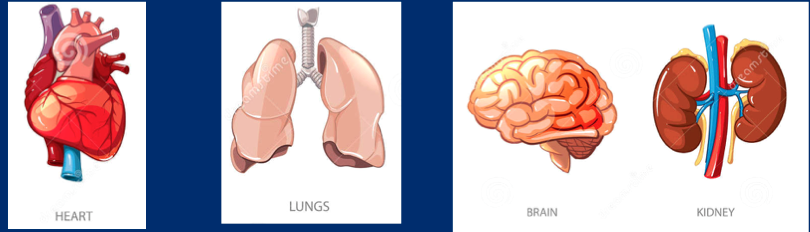
- 38Stages of Shock 1. Compensatory shockCompensatory shock or compensated shock, is a stage of shock in which the body is able to maintain a near normal blood pressure and perfusion of the vital organs.
Body uses normal defense mechanisms to maintain perfusion and function
Body can correct itself if bleeding stopped and may replenish lost volume within 24 hours - 39Early signs of Compensatory shock Include:A patient’s medications or age and the particular type of shock can influence the body’s ability to compensate and the signs and symptoms of shock.
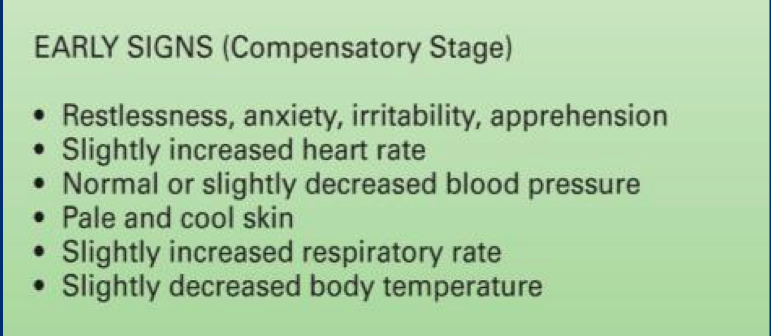
- 40Stages of Shock Decompensated Shock (1st phase)Signs and Symptoms – EARLY phase:
Slight decrease in systolic pressure
Peripheral pulses become very weak or absent
Thirst develops
Anxiety and agitation increase as brain becomes more hypoxic - 41Stages of Shock Decompensated Shock (2nd phase)Signs and Symptoms – LATE Phase:
Significant drop in blood pressure (<90 mmHg)
Peripheral pulses become absent
Significant tachycardia (>120 bpm)
Unresponsive
Extreme pale, cold, clammy skin with waxy appearance
Body cannot correct itself without outside intervention - 42Stages of Shock IRREVERSIBLE Shock and DEATHCompensatory mechanisms exhausted
Multisystem organ damage may produce signs and symptoms for several days after injury/illness
Death results even with treatment - 43Stages of Shock IRREVERSIBLE Shock and DEATHCompensates by:
-Mechanisms fail
-Highly acidic, cold, sludged blood dumps into core circulation
Signs and symptoms:
-Barely palpable central pulses (femoral or carotid)
-Extreme tachycardia which slows to 0
-Rapid, shallow, ineffective respiration
-Extremely low or no obtainable BP
-Mottling of skin
-Unresponsiveness
-Bleeding may occur from every orifice and leak from once controlled wounds - 44Shock Assessment HISTORYPay particular attention to chief complaint and SAMPLE
Some medications may prevent compensation - 45Shock Assessment PHYSICAL EXAMThe following are signs of poor perfusion:
– Altered mental status
– Pale, cool, and clammy skin
– Delayed capillary refill
– Decreased urine output
– Weak or absent peripheral pulses
Vital sign assessment must include the following:
– Blood pressure (both systolic and diastolic)
– Heart rate
– Pulse character
– Respiratory rate and tidal volume
– Skin color, temperature, and condition
– Pulse oximeter reading
*The vital signs may vary, depending on the type of shock.
Narrowing pulse pressure = good sign that pt is in shock
Body tries to maintain systolic and diastolic rises due to VASOCONSTRICTION. - 46Age considerations in ShockElderly persons and newborns do not compensate well for shock.
Medications and advanced age decrease compensation ability.
Children compensate well and then suddenly decompensate. - 47General Goals of Prehospital Management of ShockAIRWAY AND VENTILATION:
-Secure and maintain an airway
-Assure adequate ventilation
-Provide high-flow, high-concentration oxygen
-Avoid hyperventilation
MAINTAIN CIRCULATION:
-Stop any external bleeding
-Splint fractures to reduce bleeding
-Leave impaled objects in place
-Keep the patient WARM
-Apply PASG if indicated and local protocol allows
Call for ALS!
IV Fluid administration (increase volume)
Dopamine infusion (decreases size of container)
RAPID Transport