
Fichas
Solids, Liquids and Gases Done
Fichas del conjunto (22)
- 1What is densityDensity is how many particles are in a certain volume the denser the object the heavier it is.
- 2Density EquationDensity = Mass / Volume
special p = m / V
p = kg/ m^3
m = kg
V = m^3 - 3How to measure the density of irregular shapes.Archimedes Principle:
1.Start with an Archimedes Cup and fill it until it reaches the bottom of the spout
2.Then you weigh the object with a weighing scale and then convert it into Kg and record it.
3.You then place a measuring cylinder below the end of the spout and then gently place the object into the Archimedes Cup and wait until all water has been displaced into the measuring cylinder.
4. Then you read and record the volume displaced in the measuring cylinder. 5.Then you divide the mass by the volume to find out the density of your object. - 4Pressure EquationPressure = Force / area
Pressure: Pa
Force: N
Area: m^2 - 5Pressure in LiquidsPressure applied to any part of a confined fluid transmits to every other part with no loss. The pressure acts with equal force on all areas of the space. This is the basic principle for any hydraulic system
- 6Height and PressureThe pressure increases as the depth increases, this is because the force acted upon at the bottom of the spouting can is greater than above as their is more water weighing on it.
- 7Height and Pressure EquationPressure = Density x Gravitational Field Strength x height
Pressure: Pa
Density: Special P
GFS:N
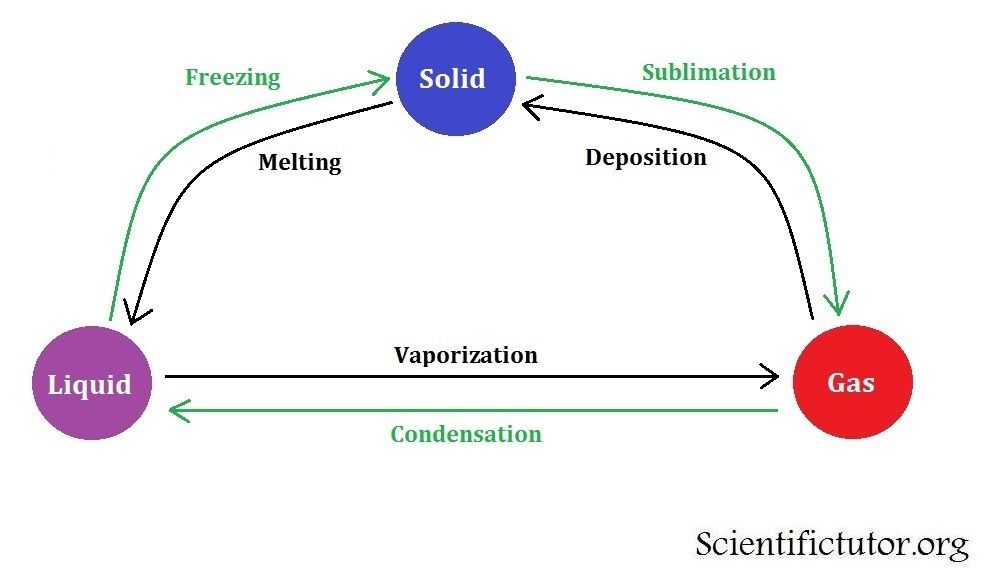
Height: m - 8State Changes
- 9Describe a SolidTightly Compacted
In uniform order
Vibrating slightly
Strong Bonds - 10Describe a LiquidLess Tightly Compacted
Not as uniform as a solid
Weak bonds
Vibrating more - 11Describe a GasNo bonds
A lot of energy
Moving very fast
Far from each other. - 12Ethanol DemoEthanol has a low Boiling Point meaning when you blow on it you are giving energy to it causing it to evaporate. When it evaporates it takes all the heat with it leaving just a cold temperature on your hand. It is taking energy from your hand.
- 13Temperature Time GraphsTemperature time graphs shows at what time a specific compound melts, boils and evaporates. Flat areas of the line indicate that the energy is breaking the bonds thus changing state.
- 14Specific Heat Capacity EquationChange in thermal energy = mass x specific heat capacity x change in temperature
Delta Q ( J )
m ( KG)
Specific Heat Capacity or c (J/KG)
Delta T ( °C or K ) - 15What is Specific Heat CapacitySpecific Heat Capacity is how much energy it takes to heat up a substance of 1KG by 1°C
- 16Investigating Specific Heat CapacityPower = Energy Transferred / time taken
P = E /t
E = Pt
E = m x c x delta T
Pt = m x c x delta T
c= Pt/m x delta T - 17What is KelvinA temperature scale which has an absolute zero, temperature below this cannot exist
- 18What is Absolute ZeroThe lowest temperature that is theoretically possible ( at this temperature particles would stop vibrating and have zero pressure)
- 19The Pressure Temperature LawThe temperature increases, this causes the speed of the air molecules to increase. This increases the rate of collision with the wall which increases the force. This then makes the pressure increase as pressure = force / area, increasing the force would increase the pressure.
- 20How much is Atmospheric Pressure101,500 pa
- 21The pressure temperature law states thatIf you divide one pressure by the temperature you recorded it in it should get the same result if you divide another pressure by the temperature it was recorded in.
P1/ T1 = P2/T2 - 22Boyles LawThe pressure of a gas is inversely proportional to its volume at a constant temperature.
P1 = (P2 x V2) / V1
P2 = (P1 x V1) / V2
V1 = (P2 x V2) / P1
V2 = (P1 x V1) / P2
Información
- Descripción
- Yr 10 (Solids, Liquids and Gases) Physics Fichas sobre Solids, Liquids and Gases Done, creado por Maxime PANS el 05/04/2018.
- Creado por
- Maxime PANS
- Visitas
- 19
- Etiquetas
- Valoración