
Fichas
Macromolecules and Enzymes
Fichas del conjunto (20)
- 1Which group of molecules contains triglycerides and functions in energy storageLipids
- 2Why do animals need a regular supply of CarbohydratesCarbohydrates are broken down into sugars. Sugars are broken down in cellular respiration to provide energy.
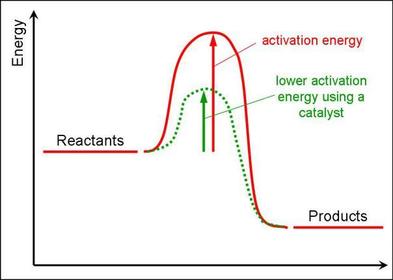
- 3Enzymes are catalysts that speed up chemical reactions. How do they do this?a. They lower the Energy of Activation
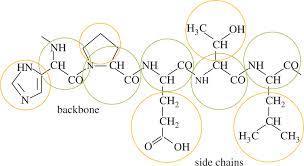
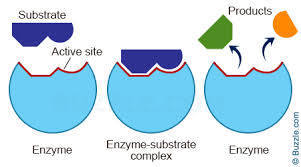
b. They provide an active site where the substrate reacts and becomes a new product (s) - 4What macromolecule is made up of Amino acids chained together and has the following structureProteins
- 5Which macromolecules is the main component of cell membranes and is good for cushioning organs and insulating the bodyLipids
- 6Identify this macromolecule and 3 of its main functions ?PROTEIN
1. Building and Repairing Cells
2. Make up Enzymes
3. Make up Antibodies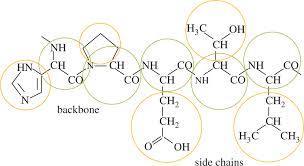
- 7What is this macromolecule and what is its function?This Macromolecule is DNA
Stores and transmits Genetic Information. It is made up of nucleotides chained together.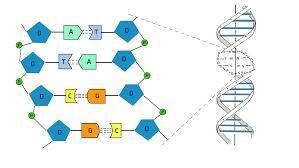
- 8How can one enzyme of catalase breakdown up to 40 milliion molecules of hydrogen peroxide into water and oxygen every second. How?An enzyme returns to its origninal state after a chemical reaction. After binding to a substrate it converts it into products. The enzyme is then ready to react again and again.
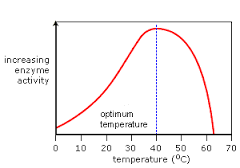
- 9Look at this graph What happens to the rate of reaction if the temperature gets too high? WHY?The rate of reaction slows down because the enzyme denatures and loses its shape and can therefore not bind as effectively with the substrate.
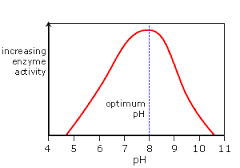
- 10Interpret the graph: What happens to the rate of reaction if the pH gets too high or too low? WHY?The rate of reaction slows down because the enzyme denatures and loses its shape and can therefore not bind as effectively with the substrate.
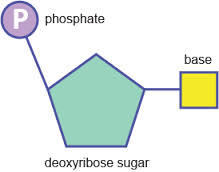
- 11What macromolecule is made up of nucleotides chained together?Nucleic Acids
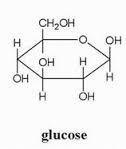
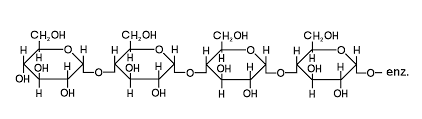
- 12What macromolecule does this monomer chain up to become?Glucose molecules bind together to make up Carbohydrates
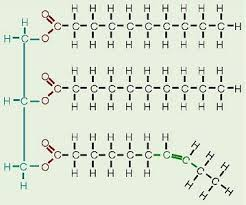
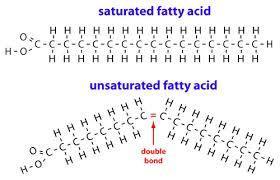
- 13What is a similarity and difference between these two molecules?They both are lipids. The unsaturated fatty acid has a Carbon to Carbon double bond which bends the chain. The saturated fatty acid has no Carbon to Carbon double bond.
- 14What does the active site of an enzyme do?a. The active site of an enzyme binds to a SPECIFIC substrate. b. The substrate reacts and c. the enzyme releases the new product (s).
- 15What is this graph showing?THat an enzyme speeds up a reaction by lowering the activation energy which is the minimum energy needed to start a given reaction.
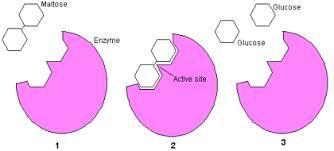
- 16Why can't the enzyme maltase shown break down Maltose but cannot break down Sucrose?Enzymes have Active sites with very specific shapes that match the substrate. The substrate fits in the active site like a key in a lock. Each enzyme can therefore only react with one SPECIFIC substrate.
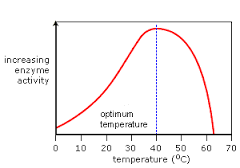
- 17Look at this graph What happens to the rate of reaction if the temperature gets too low?The enzyme and the substrate move really slow and so do not find each other as quickly to react. The rate of reaction decreases as a result.
- 18What does the phrase "rate of reaction" mean?How fast a reaction is taking place.
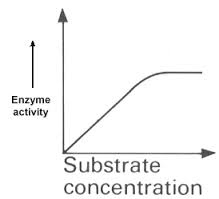
- 19Why is the rate of a reaction really low at low substrate concentrationAt low substrate concentrations the enzyme cannot find the substrate fast enough to break it down.
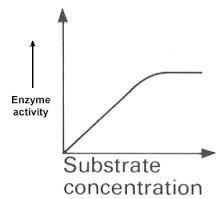
- 20Why does the rate of a reaction increase but then levels out as you increase substrate concentration?The rate of the reaction increases as substrate concentration increasess because the enzyme is finding substrate in less time. At some point the reaction rate levels out because the enzyme cannot find substrate any faster.
Información
- Descripción
- Fichas sobre Macromolecules and Enzymes, creado por Trevor Kagochi el 09/12/2014.
- Creado por
- Trevor Kagochi
- Visitas
- 485
- Valoración