
Fichas
GCSE History B: Warfare in Britain PART 3: 1750 --> 1900
Fichas del conjunto (33)
- 1Fill in the missing gaps: __________ guns were now used. They were much _________ and ________ ___ _____ ________ the battlefield.Artillery
Lighter
Easier to move around - 2What colour uniforms did soldiers wear?Bright red
- 3What was still being used to support infantry?Cavalry charges
- 4The Battle of Waterloo - Part 1: What year did the battle of Waterloo take place?1815
- 5The Battle of Waterloo - Part 2: How many soldiers were in: - Wellington's army? - Prussian army? - Napoleon's army?- Wellington's army = 68 000
- Prussian army = 30 000
- Napoleon's army = 100 000 (70 000 to fight at Waterloo, and 30 000 to chase after the Prussians) - 6The Battle of Waterloo - Part 3: TRUE OR FALSE: The general standard of recruits was high.FALSE
The general standard of recruits was low.
In fact, Wellington referred to his own men as 'the scum of the Earth'. - 7The Battle of Waterloo - Part 4: What was discipline like?HARSH!
Men were flogged, and even hanged or shot! - 8The Battle of Waterloo - Part 5: Where did Wellington position his troops?(The 3 positions)On the reverse side of the ridge.
As well as two defensive positions in front of the ridge. One in a Chateau, and the other in a farmhouse. - 9The Battle of Waterloo - Part 5: What mistakes/problems did Napoleon make/have?- Napoleon had Piles and Stomach cancer, meaning he had trouble concentrating.
- Napoleon sent Grouchy and 30 000 troops after Blücher and the Prussians, but Blücher used some men to confront Grouchy, so his men were wasted.
- Napoleons cannonballs were absorbed by the wet ground.
- Napoleon didn't take the opportunity to kill the Prussians before the battle.
- Two main generals loathed each other! - 10The Battle of Waterloo - Part 6: Fill in the missing gaps: Wellington used __________ _________ for defense, these were reinforced at the corners with ________.Infantry Squares
Cannons - 11The Battle of Waterloo - Part 7: What else did Wellington do with his infantry?Hid it behind a hedge, which blasted Napoleon's infantry column as it tried unsuccessfully to advance.
- 12The Battle of Waterloo - Part 8: What happened when Napoleon tried a diversionary attack on the chateau on the morning of the attack?Napoleon suffered heavy losses, and used up 1/4 of his infantry.
- 13The Battle of Waterloo - Part 9: What happened when the French under Ney captured the farmhouse.They asked for extra troops, but this was refused. Wellington led his troops to the heart of Ney's assault and held the French up, long enough for the Prussians to arrive.
- 14What was medical care like for soldiers at Waterloo?Extremely poor. Men slept in open air in the rain. They woke up cold and wet. They had not eaten for 2 days.
Some regiments only had 3 surgeons! - 15What did the Bessemer process allow?The cheap production of steel.
- 16How long did it take to transport men and Supplies 4,000 miles by sea from London to the Crimea?3 Weeks
- 17What new type of bullet gave the British and French an advantage?Minie bullet
(No I haven't spelt that wrong!) - 18How were soldiers recruited in the 19th century?Permanent army
Local militia
Prisoners - 19Fill in the missing gaps: _________ lines and _________ charges were still used.Infantry (Lines)
Cavalry (Charges) - 20What was medical care like for soldiers at the Crimea?Still very poor.
Army camps were overcrowded, and there was epidemics of cholera and typhoid.
The tents that were used, were the same ones from Waterloo! - 21Fill in the missing gaps: The Crimean war, was the first war with a ____ _____________. ________ _________ worked for ____ ________ and sent ________ back by ____________ to _________.The Crimean war, was the first war with a WAR CORRESPONDENT. WILLIAM RUSSELL worked for THE TIMES and sent REPORTS back by TELEGRAPH to LONDON.
- 22Who improved the conditions of hospitals greatly?Florence Nightingale + Mary Seacole
- 23What was Florence Nightingale also known as?The Lady with the Lamp
- 24What did Florence Nightingale decrease the death rate from infection to?40% down to 2%
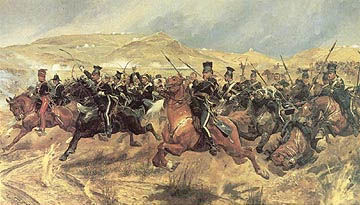
- 25In the Crimean War, what event highlighted the futility of Cavalry?The Charge of the Light Brigade
- 26Describe the events of the Charge of the Light Brigade...Lord Raglan wanted to follow the enemy with his cavalry and try to prevent the enemy from carrying away the guns.
The order became misconstrued, and Cardigan led a charge of 673 soldiers up the length of a valley, between two rows of Russian artillery. They were bombarded from all sides and suffered heavy casualties.
They were eventually saved by French cavalry. - 27Who was the Crimean war between? (The two sides)

- 28When did the Crimean War start?1853
- 29What happened at the Battle of Alma?It saw the combined British and French armies attack a Russian force that was occupying high land above the River Alma.
To drive forward the advance to Sevastapol, it was necessary for the allies to cross the River Alma and then attack well positions on higher ground.
The French's first attack failed, but the British attack with the second and light divisions forced the Russians back. - 30What did the battle of Balaclava involve?An attempt to take control of the town of Sevastapol from the Russians.
- 31What was the main place that the British/French forces wanted to take control of?Sevastopol
- 32How many soldiers did the Russians lose in a frontal attack at Inkerman in 1854? Why did this happen?12 000 men.
The opposition had rifles with a longer attack range. - 33Finish the following sentence (HINT: It isn't just one word) At Sevastopol, shelling was so severe, that troops...Sheltered in trenches.
(Similar to those that would shape warfare in WW1)
Información
- Descripción
- GCSE (Nature of Warfare AD50 - Present Day) Edexcel History B Fichas sobre GCSE History B: Warfare in Britain PART 3: 1750 --> 1900, creado por James Jolliffe el 31/03/2015.
- Creado por
- James Jolliffe
- Visitas
- 46
- Valoración