
Fichas
Zoology Midterm
Fichas del conjunto (86)
- 1Homologycharacteristics share common ancestry
- 2Analogysame function, different ancestry
- 3Characteristics of Chordates (5)Notochord at some stage, dorsal hollow nerve chord, pharynx, posterial tail, Endostyle/thyroid gland
- 4Chordate Origin Hypotheses (3)From inverted annelid/arthropod, from echinoderm larva, body axis inversion of deuterostome prechordate
- 5Major Vertebrate Innovations (5)Vertebral Column, Head, Jaws, Limbs, Cleidoic Egg
- 6Components of vertebral column (4)backbone, centrum (encloses/replaces notochord), dorsal neural arch, ventral hemal arch (blood vessels)
- 7Extant Classes of Vertebrae (7)Agnatha, Chondrichthyes, Osteichthys, Amphibian, Reptilian, aves, mammalia
- 8Radiation/Diversificationrapid expansion of a clade - adaptive radiation implies particular adaptation driving radiation
- 9Allometryall parts of body do not grow at same rate (ex. lobster claw vs. body)
- 10Isometryproportional growth in all structures
- 11geometric vs. arithmetic growthgeometric = x, arithmetic = +
- 12Components of biological design (6)size, shape, environment, strength of materials, force, stability
- 13Steps of early Chordate development (3)cleavage - zygote to multicellular, Gastrulation and neurolation - formation of germ layers, differentiation and organogenesis - germ layers to organs
- 143 paths of maturationjuvenile to adult, larva-metamorphosis-adult, reproduction as larva
- 15Heterochromychange in timing of developmental events across generations
- 16Paedomorphosismaintenance of juvenile traits in adults of descendants (3 types)
- 17ProgenesisHypomorphosis - somatic development ceases before metamorphic threshold
- 18Neotenydeceleration - development proceeds slower, maturation reached before metamorphic threshold
- 19postdisplacementdevelopment initiation at later ontogenetic age
- 20Peramorphosisexaggeration of ancestral adult traits in descendant adults
- 21Homeotic Hox Gene functionregulate genes involved in formation of body parts
- 22Agnathan groups (3, "4" groups)Hagfish, Lampreys, Conodonts (extinct), "ostracoderms"
- 23major groups of Ostracoderms (4)Pteraspidomorpha, Anaspids, Thelodants, Osteostracans
- 24New Mouth Hypothesisrespiratory demands of active lifestyle = driving force, addition of inhalation muscles, modification of first arch into feeding jaws
- 25Characteristics of Placoderms (5)heavy head and thoracic armour, jaws with beak like plates, paired pectoral and pelvic fins, neck joint, flattened bottom
- 26Chondrichthyan characteristics (4)placoid scales, calcified skeleton, internal fertilization, spiracle
- 27Holocephelan modifications (4)no scales, large tapered caudal fin, upper jaw fused to brain case, long spine in front of dorsal fin
- 28Characteristics of Osteichthyes (3)more bone in endoskeleton, swim bladder, strengthened fins
- 29Actinopterygian characteristics (4)large eye and two nostrils/side, teeth on maxilla/premaxilla/dentary, small overlapping scales, kinetic head skeleton
- 30Teleost characteristics (4)ossified vertebrae, homocercal tail, circular scales, skull allowing jaw mobility
- 31Sarcopterygian characteristics (4)appendages with internal bones and muscles, fins still end with rays, cosmoid scales, doubal dorsal fin in early forms
- 32Rhipidistian characteristics (6)ossified vertebral elements, articulated brain case, labryinthodont teeth, internal nostril (choanae), eyes move upward, skull flattened (later forms)
- 33significance of Tiktaalikintermediate characteristics between fish and tetrapods - "fishapod", ribs, limb-like fins, neck, no bony gill covering
- 34hydroxyapatitecollagen fibre matrix + calcium phosphate crystals in bone
- 35bone functions (4)support weight, protect soft parts, anchor muscles, store minerals (calcium)
- 36main skeletal components (3)skull (cranium), axial (vertebral column, ribs, sternum), appendicular (limbs and fins)
- 373 components of the head skeletonChondrocranium (neurocranium), splanchnocranium, dermatocranium
- 386 series of bone elements in dermatiocraniumfacial (marginal jaw), orbital, vault (roofing bones), temporal, palatal, mandibular
- 39Teleost Skull trendsincreased # of skull bones (liberation between elements), narrow mouth, hinge moved forward, jaws move independently of brain case
- 40Euautostylic Jaw suspensionupper jaw braced against brain case, hyomandibula not involved (lungfish)
- 41Amphistylic Jaw Suspensionupper jaw supported by hyomandibula, connection with brain case (cartilaginous and bony fish)
- 42Hyostylycontact with chondrocranium throuhg hyomandibula, palatoquadrate can slide forward
- 43Autostylyquadrate attaches chondrocranium and jaw directly, hyomandibula becomes invovled in hearing
- 44Characteristics of fish Axial Skeletons (5)fixed link between first vetebrae and skull (no neck), amphicoelous (concave) centra, only trunk/caudal regional differentiation, notochord or centra, movement by lateral undulation
- 45Types of fins (3)Lobe fins(teleost and lungish)/fin fold fins (cartilaginous)/ray fins (bony fish), median fins (dorsal and anal), caudal fin
- 46Types of fin raysceratotrichia - keratinized rods (elasmobranchs), lepidotrichia - bone/cartilage elements, actinotrichia - keratinized tips
- 47Basic structure of fish integumentepidermis (outside)→ basement membrane→ dermis→ hypodermis? (inside)
- 48Epidermismultiple layers of cells with stratum germinatium at base and progressive flattening (squamous) towards surface)
- 49Dermisnetwork of fibres (mostly collagenous, some elastic) that provide structure
- 50Function of integument (4)physical barrier, respiration/excretion/osmotic regulation, thermoregulation, odours and colours in courtship/defence
- 51Stratum corneum function and derivativesprotection against desiccation: scales, feathers hair and claws
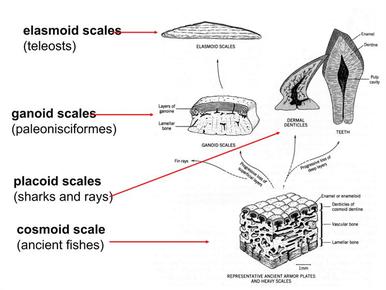
- 52Types of dermal scales (4)
- 53Characteristics of fish gills (4)lamellae for surface area, counter current exchange, thin water-blood barrier, gill rakers
- 54types of internal gills (3)pouched gills (lamprey), septal gill (shark), opercular gills (teleosts)
- 55Trends in evolution of gillsreduction in # of gill bars and chambers, loss of spiracle and septa
- 56Gas Bladdersingle elongated sac dorsal to gut
- 57types of gas bladders (2)physostomous - pneumatic duct connects to pharynx, physoclistous - no connection to pharynx
- 58renal portal veinblood from tail region to kidneys
- 59hepatic portal veindigestive system to liver
- 60Basic structure of fish heart
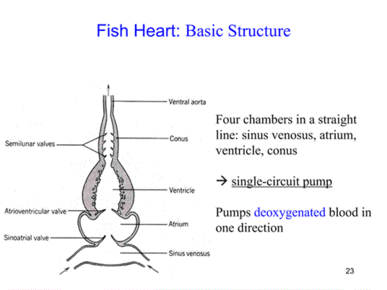
- 61bulbous carterioususreplaces conus in teleost hearts - passively evens fluid pressure generated by beating heart
- 62Early tetrapod theories (4)crossopterygii = sister group, lungfishes and coelacanths = sister, osteolipiformes = sister, lungfishes more closely related to tetrapods than coelacanth
- 63Chiridiummuscular limb with well-defined joints and digits
- 64Aconthostega characteristicsvertebrae around notochord, limbs have 8 digits, girdles designed to bear weight, tail with fin rays, internal gills
- 65Ichtyostega characteristicsrobust, lack internal gills, 7 toes
- 66Temnospondyl characteristicsrobust bodies, flat skulls
- 67Anthracosaur characteristicsmedium to large, reptile like, semi aquatic/terrestrial predator, robust skull, seymouriamorpoh larvae with external gills
- 68Tetrapod locomotion possibilities (3)Trot - opposing limbs contact ground, tripodal - third point of support (belly or tail), lateral sequence - always 3 limbs contacting ground
- 69Ghost Rangerange in fossil record where you know there should be an animal/link but no supporting fossils found
- 70Changes from fish to tetrapod (7)Fin→ chiridium, fused shoulder→ true neck, reinforced vertebral column and girdles, back part of skull is shortened and hyomandibula loses attachment to otic capsule, snout elongates and eyse move on top of head, reduction of bone pattern in front of skull, dermal scales modified into scutes or gastralia (found only on belly)
- 71musclescollection of modified cells that generate force along axis of their fibres (contractile)
- 72ways of classifying muscles (3)by location, method of nervous control, microscopic appearance
- 733 Major Muscle GroupsPostcranial, Cranial, Heart and Gut
- 74Types of Cranial Muscles (3)branchiomeric, hypobranchial, extrinsic eye
- 75Postcranial Muscles (2)Trunk (axial), appendicular
- 76role of axial muscles in tetrapods (4)Flexion of vertebral column, movement of rib cage, weight support, movement of head
- 77epaxial muscles in amniotes (3)transversopsinal, longissmus dorsi, iliocostalis
- 78hypaxial muscles (4)dorsomedial, medial, lateral, ventral
- 79appendicular muscles in fish (2)posterodorsal to fin, anteroventral to fin
- 806 trends in muscles between fish and tetrapodsaxial diminished/limb more complex, flexible axial function, loss of segmentation, axial associated with girdles, new structures with new muscles, some loss of muscles
- 81Fate of mesoderm divisions (4)myotome - postcranial/some cranial, somitomere - cranial, hypomere - gut and heart, mesenchyme - limb/smooth
- 82Adaptations to reduce drag (4)slime, scales, finlets, keels
- 83Tesseraecartilage mineralized with calcified blocks on surface (seen in sharks)
- 844 primary tissue typesepithelium, muscle, connective tissue, nervous tissue
- 85batoidimorph characteristics (4)bottom dwelling, enlarged pectoral fin fused to head, tail with sharp spine, some with electric organ
- 86Bones of the pectoral and pelvic girdles (3 each)pectoral - clavicle, cleithrum, scapulocoracoid, pelvic - ilium, ischium, pubis
Información
- Descripción
- (Fall 2013) Fichas sobre Zoology Midterm, creado por j_sunga el 10/10/2013.
- Creado por
- j_sunga
- Visitas
- 197
- Etiquetas
- Valoración