
Fichas
Nature of Light

Fichas del conjunto (11)
- 1Physics Unit 2 Nature of LightKey Topics
- light: a wavicle?
- photoelectric effect
- spectra
- energy levels
- radiation flux and solar cells - 2Wave or Particle? Light shows both wave (it reflects, refracts and diffracts) and particle behaviour (it consists of photons, small packets of energy), so it can be called a wavicle. Einstein discovered the photoelectric effect, which opened up the whole new world of quantum physicsEinstein's Discovery
Einstein found that metal surfaces become positively charged when illuminated by UV light, and concluded that electrons acquire energy and are ejected when UV light shines onto the metal - 3The Photoelectric effect When UV light increases in intensity, so does the current. However, when light intensity is constant, but the frequency is varied, the current does not increase. No photons are emitted beneath a certain frequency.In theory, all that should be needed to eject electrons is a brighter light or a longer time period. Neither really apply, as the threshold frequency must be reached for photons to be emitted
- 4Key definitions: Threshold Frequency: the minimum frequency of light required for photons to be emitted Work Function (⍉): the minimum energy required to release the photoelectron from the metalE = hf = ⍉
hf = ⍉ + 1/2 mv^2
1/2 mv^2 = eV(s)
E = energy h = Planck's constant
F = frequency ⍉ = work function
m = mass v = velocity eV = electronVolt - 5—The gold leaf electroscope demonstrates the photoelectric effect. When UV light is shone on the zinc, it and the gold foil leaves become negatively charged, and so repel each other, resulting in the gold leaf moving away
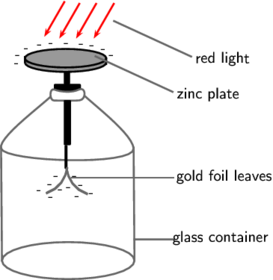
- 6The photoelectric effect supports the particle model for light: - light is made of photons - a photon collides with a single electron, giving it the energy needed for it to emit - electron is emitted immediately - increased intensity = increased photons - increased intensity doesn't change max K.E. of electronsThe photoelectric effect disproves the wave model of light:
- energy carried by wave depends on light intensity
- the electrons should continuously gain energy and eventually escape from the surface, but this is not the case (and gives no explanation for the threshold frequency)
- 'the more intense the light, the more K.E. electrons should have' - but this is not the case, the K.E. depends on frequency
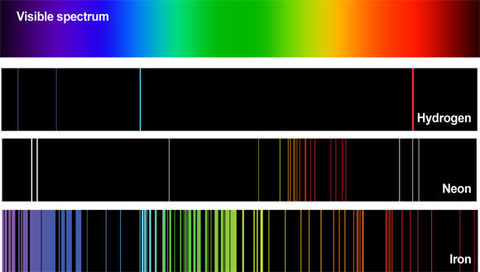
- should be a delay before the electron is released, as the energy builds up - but the electron is emitted immediately - 7Line spectra: Emission When light is spread into its seperate colours, it forms a spectrum. Each line in an emission spectrum arises when an atom drops an energy level. As each material has a unique set of electronic energy levels, each emission spectra is different, allowing us to identify the materialLine spectra: absorption
The principle is exactly the same, but the dark lines appear when an atom absorbs energy, and so moves to a higher energy level. Again, the energy levels are unique, and so so are the absorption spectra - 8—

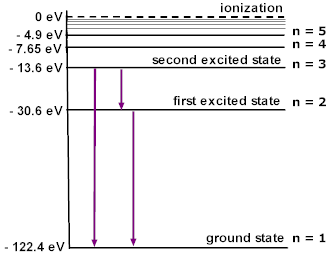
- 9Energy levels show the ground state of atom, which is where it has the least energy. The highest frequency of radiation which could be emitted corresponds to the most energetic photon that could be released.
- 10Solar cells transform light energy into electrical energy Radiation Flux: the rate at which a beam of light supplies energy to a particular area F = P/A F = radiation flux, (Wm^-2) P = power (W) A = area (m^2)Solar cells are not 100% efficient.
efficiency = useful power output x 100
total power output
Considering the use of solar cells:
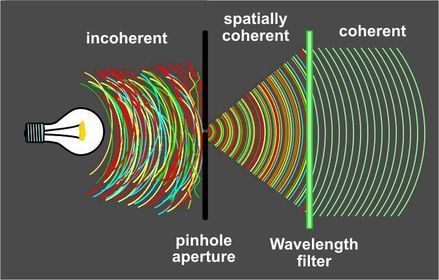
efficiency? cost? availability? energy prices? impact of continuing use of fossil fuels? - 11Laser light is an intense beam, and so it is often used at concerts. The beam is intense because the waves are coherent, and so the photons emitted stimulate other photons, resulting in laser light as the atoms emit photons together
Información
- Descripción
- Cue cards on Edexcel Unit 2: Nature of Light
- Creado por
- Niamh Walsh
- Visitas
- 59
- Etiquetas
- Valoración