
Fichas
Waves and light
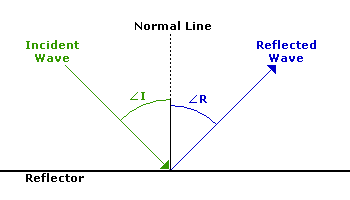
Fichas del conjunto (30)
- 1angle of incidence = angle of reflection
- 21/di +1/do = 1/f m = di/do = hi/hoimage distance + = image real
image distance - = image virtual
image enraged or diminished - 3Concave mirror produces...real image when rays converge (can be focused)
virtual image when rays diverge (can't be projected) - 4Convex mirror always produces...image that is
- virtual
- behind mirror
- between F and mirror
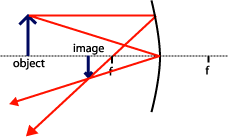
(diverging mirror - focal point is ALWAYS NEGATIVE) - 5Concave mirror O - center O - c O - parallel O - axis O - centre - under O
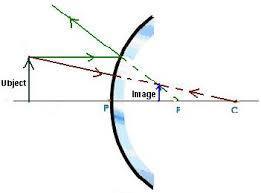
- 6Convex mirror O - parallel - F O - C
- 7Refraction - bending of light as passes from materials into anotherLRI into HRI - bends towards normal
HRI into LRI - bends away from normal - 8Light travels at different speeds in different mediums 1n2 = C1/C2C1 = light speed in m1
C2 = light speed in m2
1n2 = refractive index for light traveling from m1 to m2 - 9In vacuum - no air - n = 1 1n2 = n2/n11n2 = refractive index for light traveling from m1 to m2
n2 = m light traveling into
n1 = m light traveling out of - 10Snells Law sinθ1/sinθ2 = 1n2 or sinθ1/sinθ2 = n2/n1 or n1sinθ1 = n2sinθ2θ1 = angle of incidence
θ2 = angle of refraction
1n2 - refractive index for light traveling from m1 to m2 - 11Total internal reflection Past the critical angle, all light reflects off the boundary (from dense to less dense medium) θc = sin-1(n2/n1)Critical angle angle of incidence which provides an angle of refraction of 90°
θc = critical angle
n2 = m light traveling into
n1 - m travling out of - 12Convex lenses outside focal point (real and inverted image) O - P - f O - C O - F - P
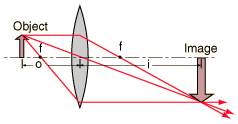
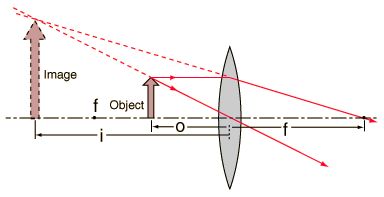
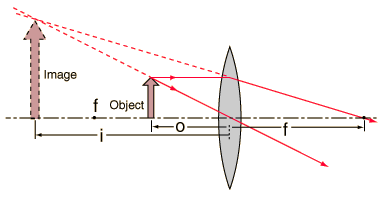
- 13Convex lenses inside focal point (virtual and upright image) P - f O - c
- 14Concave lenses (virtual, upright, diminished) O - P - F O - C
- 15Waves V = F λλ = Wavelength = distance between crests
V = wave velocity ms-1
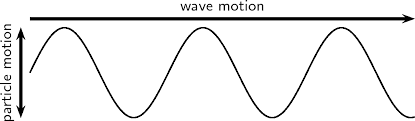
F = frequency (Hz) = waves per second - 16Transverse - vibrate at right angles to direction of wave movement (water waves)
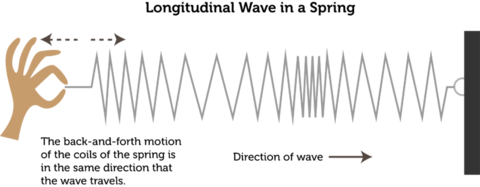
- 17Longitudinal - vibrate in same direction as direction of wave movement (sound waves)
- 18Pulse of string Fixed boundary - inverted, same amplitudeloose boundary - upright, same amplitude
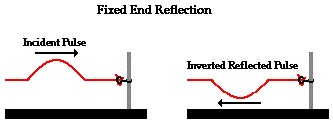
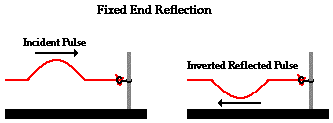
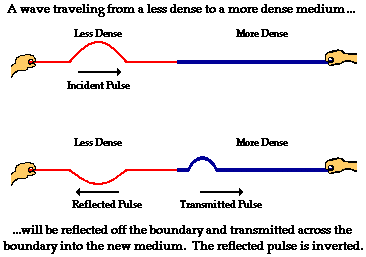
- 19Pulse enters denser/slower medium Reflected pulse - inverted, smaller amplitude, same wave length Transmitted pulse - smaller amplitude, shorter wavelength
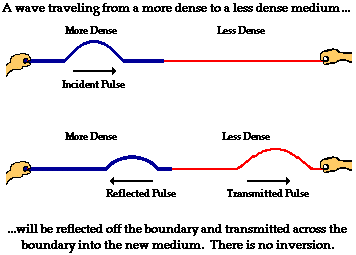
- 20Pulse enters less dense/ faster medium Reflected pulse - upright, smaller amplitude, same wavelength Transmitted pulse - bigger amplitude, longer wavelength
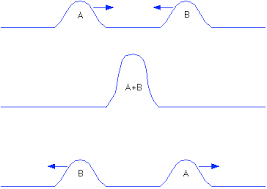
- 21Constructive interference crest meets crest trough meets trough forms double amplitude
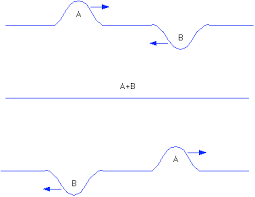
- 22Deconstructive interference crest meets trough (of equal amplitude) two waves cancel each other out
- 23Waves from point move outwards in circles waves from a straight line move away in straight linesthe wave front is perpendicular to the direction of traveling wave
- 24Water waves - deep to shallow - shorter wavelength and slower velocity sinθ1/sinθ1 = V1/V2 = λ1/λ2 = n1/n2Shallow to deep: direction of wave movement will bend towards boundary (away from normal)
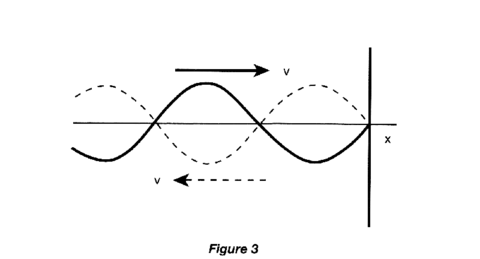
Deep to shallow: direction bend towards normal - 25Standing waves - series of incident waves interact. Reflecting wave off closed boundaryBoth waves travel in opposite direction at same speed and wavelength
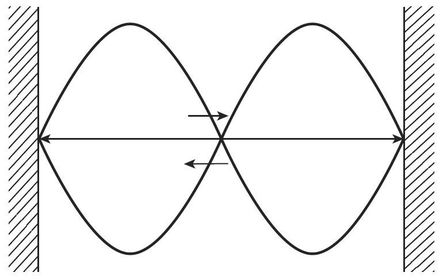
- 26anti node & anti nodal lines = crest + trough arrive in phase & constructive interferenceNode & nodal lines = crest + crest = trough + trough
arrive out of phase & destructive interference - 27Diffraction - bending of waves around the edges of an objectlower frequency or long wavelength diffract best
sound = longer wavelength and lower frequency than light so diffracts better - 28Diffraction through slitWaves diffract best when gap = same distance or smaller than wavelength
High frequency/short wavelength don't diffract much
Low frequency/long wavelength diffract more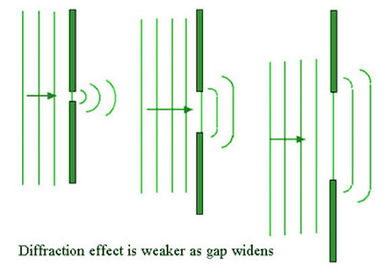
- 29Wave interference - waves from 2 sources add together to form interference pattern of nodes and antinodesAnti nodal lines are numbered
Central line: n = 0
increasing spacing between sources, anti nodal line increase & spacing decrease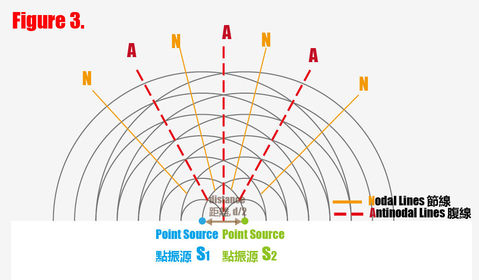
- 30Path difference difference of the distance a point is away from source 1 and source 2Relate this to numb of wavelength sad the antipodal line number
A point on anti nodal line n=0, distance to each source is same
A point on anti nodal like n=1, path difference is 1 wavelength
Información
- Descripción
- Fichas sobre Waves and light , creado por laura.scottt el 24/08/2015.
- Creado por
- laura.scottt
- Visitas
- 71
- Etiquetas
- Valoración