
Fichas
Fish form and function and ocean zones
Fichas del conjunto (99)
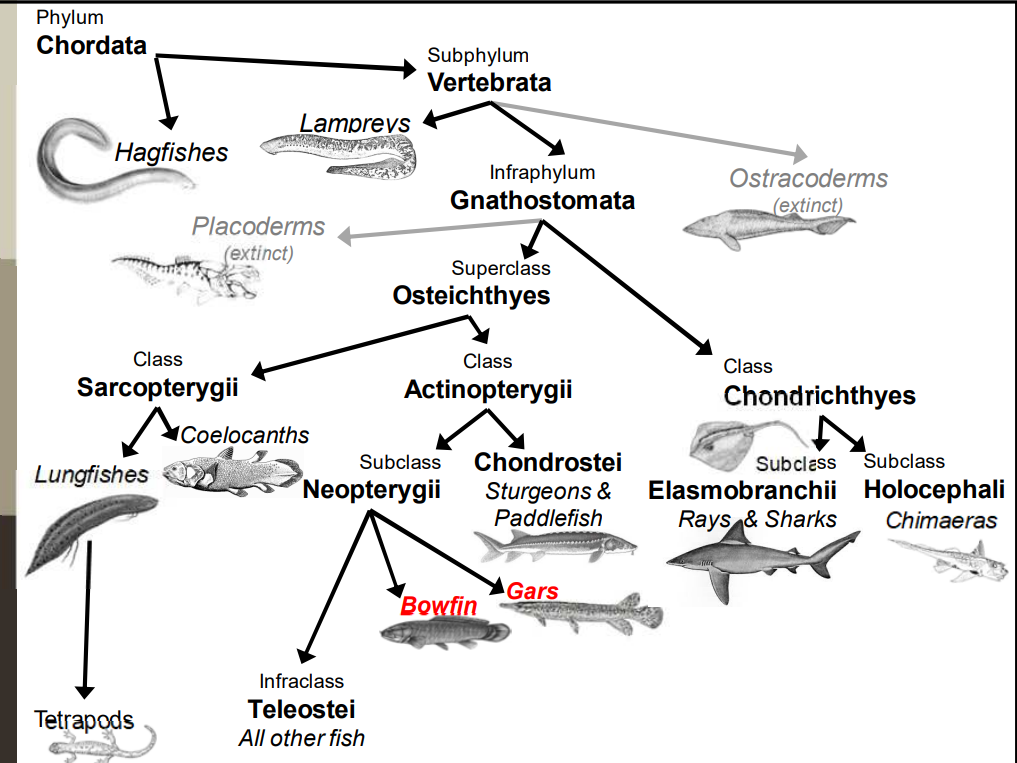
- 1Phylum chordatahagfishes; have a dorsal nerve cord
not yet vertebrates - 2Hagfishmost primitive fish
jawless - 3Subphylum: vertebrataLamprey; has a backbone
- 4lampreymost primitive vertebrate, jawless, some are parastitic
- 5agnathaprimitive, jawless fishes
contains hagfish and lampreys - 6class: chondrichthyescartilaginous fishes
includes; chimaeras, sharks, skates, and rays - 7subclass: Elasmobranchiisharks, skates, rays, cartilaginous
- 8superclass: osteichthyesbony fishes
contains any fish with a bony skeleton - 9class: actinopterygiiray-finned bony fishes
contains most fishes - 10class: sarcopterygiilobe-fined bony fishes
contains; lungfish and coelacanths
only 8 surviving fish; not that common - 11lungfishgave rise to tetrapods
humans closest relative
breaths air; specialized respiratory system - 12coelacanthslazarus species; living fossil
were known only through fossils until 1938 - 13subclass: chondrosteigrouping of primitive bony fish with skeletons that are only partly ossified
contains: bichirs, sturgeons, and paddlefish - 14subclass: neopterygiicontains bowfin and gar
- 15bowfinprimitive fish
sole surviving fish of entire order - 16garprimitive bony fishes
- 17infraclass; teleosteiadvanced bony fishes
contains most fish species - 18teleosts: order anguilliformes"true eels"
elongated body, catadromous
ex. american eel - 19teleosts; order esociformeselongated, torpedo-shaped body
freshwater predators
ex. pike - 20teleosts: order gadiformes(cods)
marine groundfish, important food fish
3 dorsal fins
ex. atlantic cod - 21teleosts: family Salmonidaesalmon and trout
adipose fin
many are andromous
ex. rainbow trout - 22teleosts: family cyprinidaecarps
no stomachs
ex. common carp - 23teleosts; family leuciscidaetrue minnows
no stomachs
ex. FHM, creek chub - 24teleosts; family catostomadaesuckers
ex. hogsucker - 25teleosts; famliy ictaluridaen. american catfish
barbels
spines on dorsal and pectoral fins - 26teleosts; family moronidaetemperate basses
freshwater, marine, or anadromous
ex. striped bass - 27teleosts; family centrarchidaesunfish and bass
freshwater
ex. bluegill, lmb - 28teleosts; family percidaeperches
freshwater
ex. yellow perch, walleye, darter - 29teleosts; family scaenidaedrums
marine or freshwater
ex. red drum and Atlantic croacker - 30teleosts; family cichlidaecichlids
divers, largely tropical group
knonw for having evolved rapidly into diverse species in the African Great Lakes
ex. nile tilapia - 31teleosts; fmaily scombridaetuna and mackerel
marine, active swimmers
lunate tails
ex. yellowfin tuna - 32family paralichthyidaeflounders
marine
both eyes on same side of head - 33family molidaemarine
heaviest bony fish
ex. mola mola (ocean sunfish) - 34taxonomy
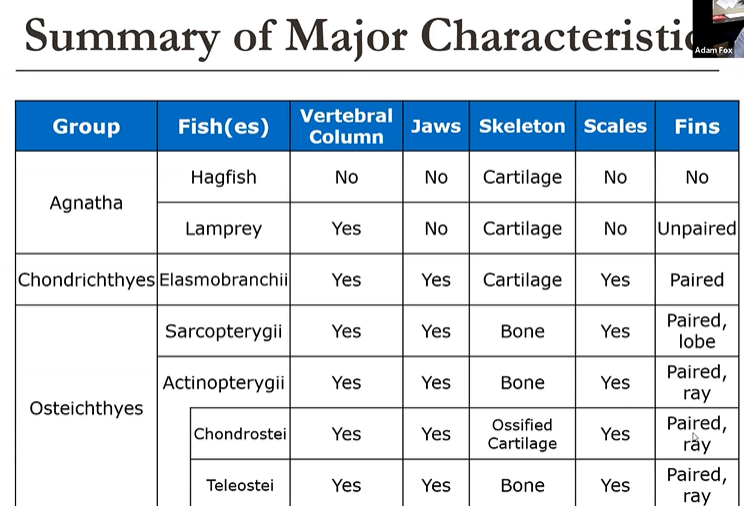
- 35summary of major group characteristics
- 36Fusiform body shape (photo)
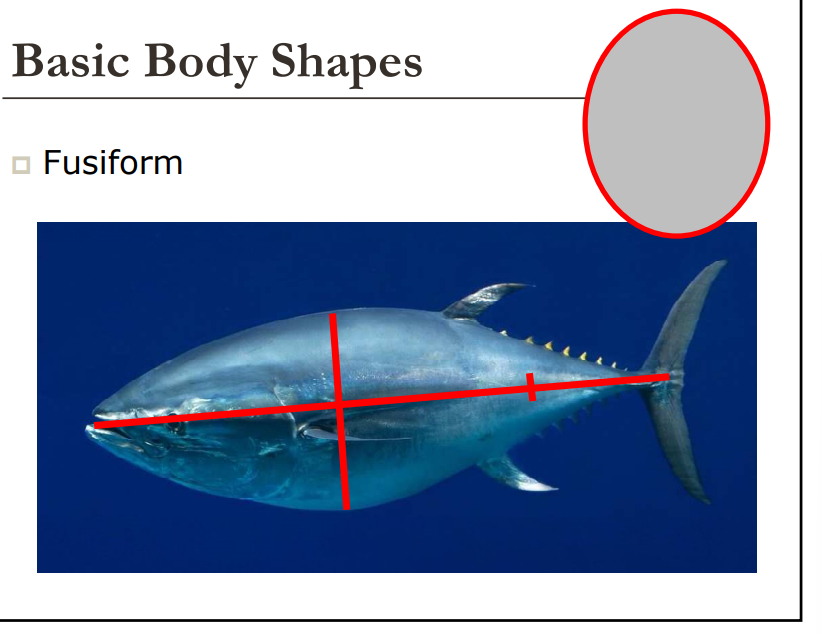
- 37Fusiform body shapestreamlined fish that has a
pointed head and narrow caudal peduncle (back)
-deepest/widest part is about 1/3 back from head
-slightly compressed sides
-fast swimming/cruising fish - 38compressiform (photo)
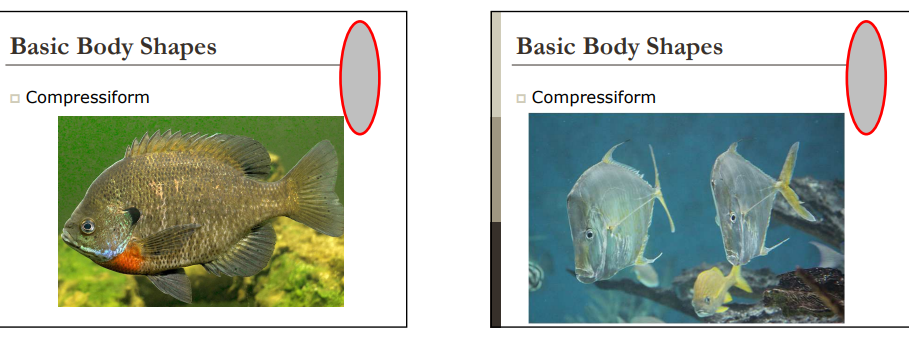
- 39compressiformlaterally flattened body shape
-squeezed from teh sides
-tall
-most fish are this form - 40depressiform (photo)
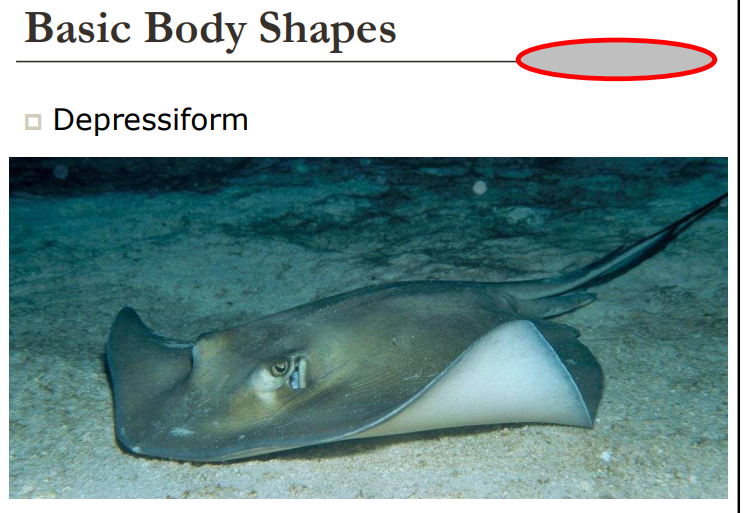
- 41depressiformdorso-ventrally flattened body shape
-pancake fish
-specialization for benthic feeding - 42anguiliformeel-like body shape with a round cross-section
-often a specialization for benthic life
-not good at sustained swimming but good at hiding - 43globiforma spherical shaped body (much like a globe)
-not efficient swimming but very maneuverable
-shape part of defense - 44scalationscale size, number, and arrangement depend on the ecology of the fish
- 45placoidancestral fish scales
tiny tooth like structures sometimes called dermal denticles
ex. elasmobranchs - 46ganoidancestral fish scales
thick, jointed
large diamond-shaped scales that don't overlap
ex. gars - 47"naked" fishno scales at all but protected by mucus
- 48cycloidleptoid fish scales
round, flat, thin scales
overlapping
pretty good armor but fish is more flexible due to overlap
ex. troug minows herrings - 49leptoid scalesthe light, overlapping scales fo teleost fishes
- 50Ctenoidleptoid fish scales
spiny-finned teleosts
similar to cycloid scales but with small comb-like projections - 51scutesnot sclaes
bony external plates
not flexible, but provide armor-like protection
-slow swimming fish - 52scales tell us about fishfast fish don't have visible scales; don't need protection because they can swim away and scales would slow them down
- 53Key functions of finspropulsion, maneuvering, stabilization, courtship displays, protection, specialized functions (fanning eggs, digging)
- 54Fin placement photo
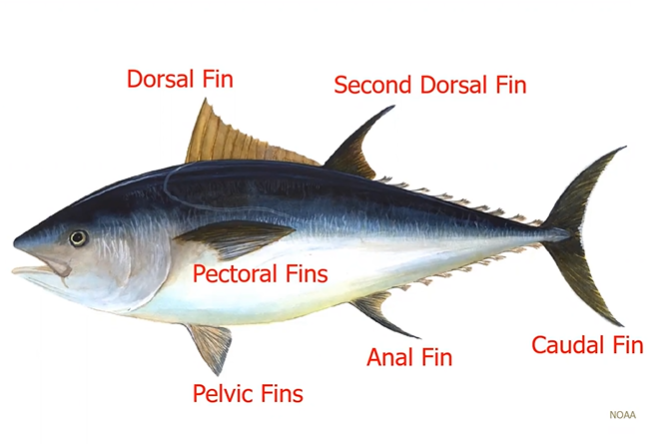
- 55Ceratotrichia finsstiff plate like features, no branching, no segmentation
ex. Chondrichthyes (elasmobrachs) - 56Lepidotrichia fins (soft fin ray)anchored to bones that project into fish; flexible, branching, segmented
ex. bony fish - 57fine Spines (hard fin ray)bony fish may have these
hard and pointed, unsegmented and unbranched fin ray - 58Paired fins -pelvicsthoracic, jugular, abdominal
- 59thoracic paired pelivic finsdirectly below pectoral fins; help with manuevering
- 60jugular paired pelvic finsin front of pectoral fins
- 61abdominal pelvic finsfins somewhere behind pectoral fin; often used for stabilization
- 62Paired fins - pectorals pt 1shape either elongated or broad, lots of variation and specialization
-sharks use their pectorals to generate lift, some use it to glide - 63Paired fins - pectorals pt 1generally used for steering; could be used for propulsion
elongated; high-speed maneuvering
broad; quick turns and stability - 64Caudal fin - heterocercaltail with longer upper lobe and shorter lower lobe
- 65caudal fin - homocercaltail in which the upper and lower lobes are externally symmetrical
many different shapes (lunate, forked, rounded, square, and many intermediate forms - 66caudal fin - isocercallacks well-defined lobes (pretty much comes to a point)
- 67caudal fin (photo)
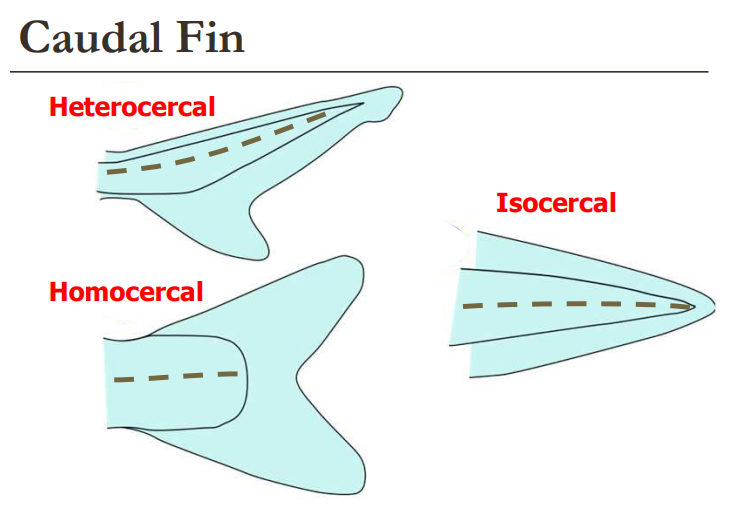
- 68caudal fin shape tradeoffmore speed with greater forking (lunate the fastest)
more acceleration and maneuverability with rounded tails - 69anal fin purposestability
- 70adipose finfleshy dorsal appendage (on top of fish behind dorsal fin)
most fish don't have this - 71caudal pedunclethe base of a fish’s tail
- 72mouth placementsuperior, terminal, inferior
- 73superior mouthon top of head
good for fish foraging at surface - 74terminal mouthat front of head
good for fish chasing down prey in front of them - 75inferior mouthat bottom of head
good for bottom feeders - 76gill rakersbony or cartilaginous arches within the mouth
-structure can indicate diet - 77naresnostrils
- 78barbelswhiskery strucutres (fleshy) covered in smell receptors
- 79ampullaeelectroreceptors; can detect electric fields
- 80axial skeleton
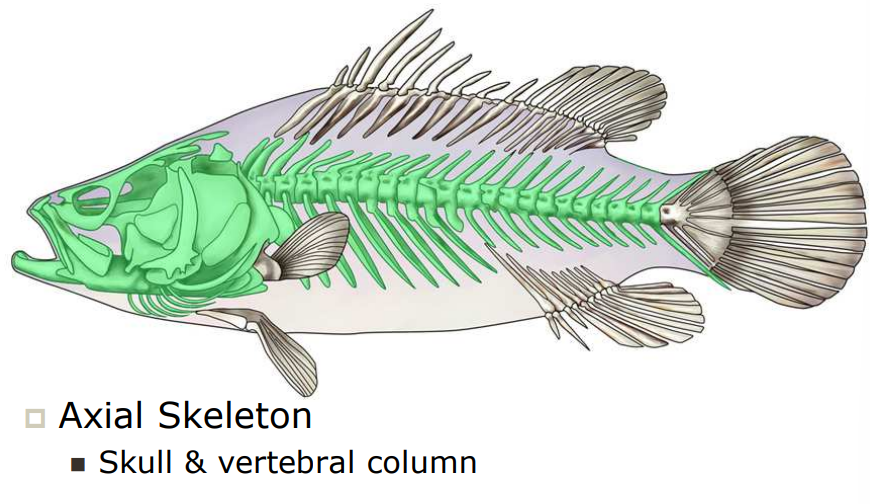
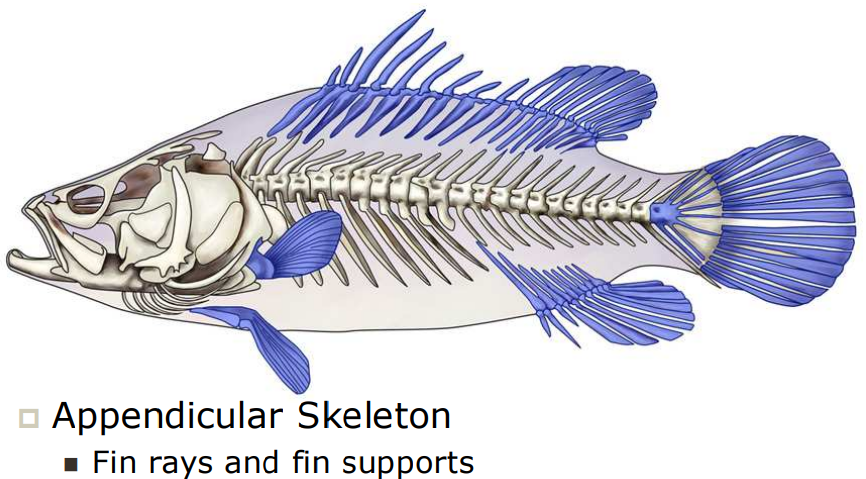
- 81appendicular skeleton
- 82vertebral elements
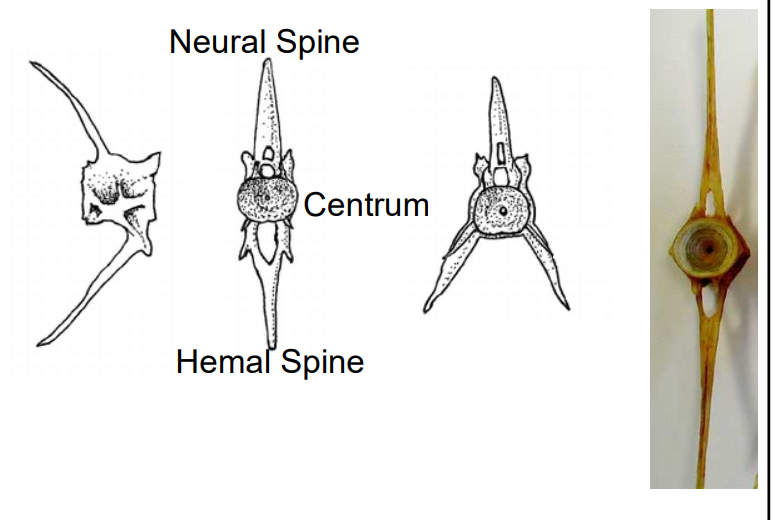
- 83myomeresW shaped bundles of muscles that extend the length of the body
- 84myoseptaconnective tissue that vertically separates each myomere bundle
- 85white muscleburst swimming
anaerobic - 86red musclesustained swimming/cruising
aerobic
lots of capillaries - 87anadromousadults live in saltwater, but spawn in freshwater
- 88catadromousadults live in freshwater, but spawn in saltwater
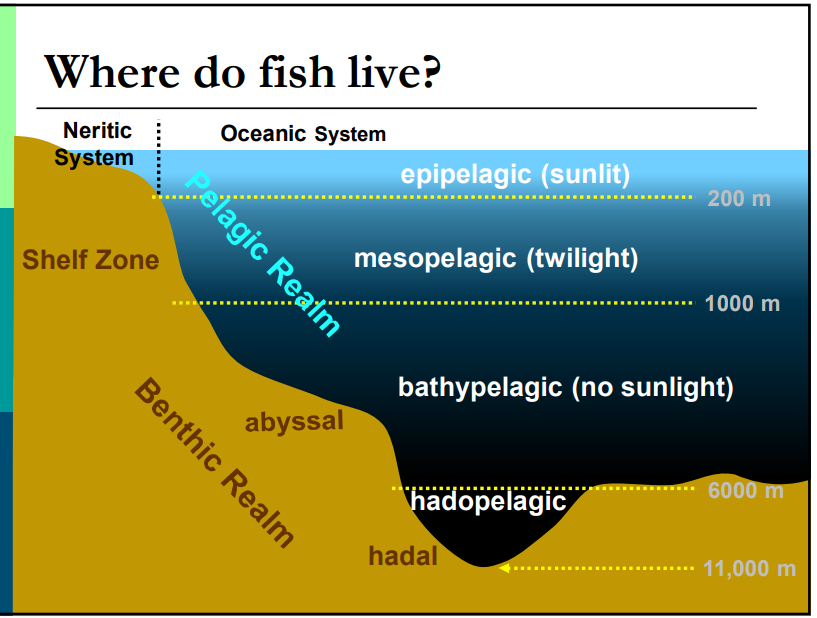
- 89abyssal zonethe deep sea floor
- 90bathypelagic zonethe layer of the pelagic realm where no sunlight is present
- 91epipelagic zoneteh top layer of the pelagic realm, where sunlight is present
- 92fishany swimming vertebrate with fins
- 93hadopelagic zonethe deepest depths of the pelagic realm, in ocean trenches
- 94hadal zonethe sea floor at the bottoms of ocean trenches
- 95mesopelagic zonethe 'twilight' zone of the pelagic realm
- 96neritic systemshallow-water environment near the coast
- 97oceanic systemdeep water environment away from the coast
- 98pelagic realmthe water part of oceanic systems
- 99ocean zones (photo)
Información
- Descripción
- intro and form and function powerpoints
- Creado por
- Katerina Petrova
- Visitas
- 10
- Valoración