
Fichas
Reactions of Alkenes and Electrophillic Addition
Fichas del conjunto (10)
- 1Name four addition reactions of alkenes- Hydrogenation
- Hydration
- Halogenation
- Alkene + Hydrogen Halide - 2What is added to an alkene in a hydrogenation reaction? What is formed? Are there any required conditions?Alkene + Hydrogen --> Alkane
A nickel catalyst is required, and a temperature of 423 Kelvin - 3What is added to an alkene in a hydration reaction? What is the product formed? Are there any required conditions?Alkene + Water (steam) --> Alcohol
The water added has to be in a gaseous state - steam. This reaction also requires the presence of a phosphoric acid catalyst = H2PO4 - 4What reacts with an alkene in a halogenation reaction? What is the product formed? Are there any required conditions for this reaction?Alkene + Halogen --> Haloalkane
The halogen is something like: Br2 or Cl2
and the reaction is done at room temperature - 5What reacts with an alkene in a hydrogen halide reaction? What is the product formed? Are there any required conditions for this reaction?Alkene + Hydrogen Halide = Haloalkane
The hydrogen halide could be; HBr or HCl.
If the alkene is gaseous, the reaction goes as normal but if alkene is liquid, the hydrogen halide is bubbled through it. - 6In an addition reaction what happens? e.g, what bond(s) is broken?In an addition reaction, a small molecule is added to the double bond, causing it to break and new bonds to form
- 7Define the term 'electrophile'An electrophile is an electron pair acceptor
- 8How come electrophillic addition occurs?Electrophillic addition occurs because the pi-bond have a high electron density, and so attract electrophiles
- 9State very simply, the basis of Markovnikoff's RuleMarkovnikoff's Rule states that there could be a primary or secondary carbocation formed, and as you go from primary to secondary (e.c.t) the carbocation gets more stable
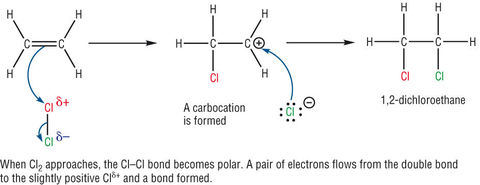
- 10Draw out and label with all appropriate curly arrows, the electrophillic addition mechanism for ethene and chlorine
Información
- Descripción
- AS - Level (13 - Alkenes) Chemistry Fichas sobre Reactions of Alkenes and Electrophillic Addition, creado por Bee Brittain el 13/03/2016.
- Creado por
- Bee Brittain
- Visitas
- 83
- Etiquetas
- Valoración