
Fichas
CBAP Exam Prep
Fichas del conjunto (58)
- 1BEERS RU (Knowledge Areas)*BA planning and monitoring
*Elicitation
*Enterprise Analysis
*Requirements Analysis
*Solution assessment and validation
*Requirement mgmt and communication
*[Underlying Competencies] - 2What are the BA Outcomes?* Reduce waste
* Create solutions
* Complete projects on time
* Improve efficiency
* Document the right requirements - 3What is the Domain?The area undergoing analysis
- 4What is the solution(s)?A set of changes to the current state of an organization to move from how things work today to the envisioned "to-be" state
(The scope of the solution is usually narrower than the scope of a domain
(Move from where they are to where they think they should be) - 5What is a requirement?1. condition or capability needed by a stakeholder to solve a problem or achieve an objective
2. A condition or capability that must be met or possessed by a solution or solution component to satisfy a contract, standard, specification, or other formally imposed documents
3. A documented representation of a condition or capability as in (1) or (2)
(CAN'T be verbal MUST be documented) - 6Are requirements needs, wishes, desires, or all of the above?Needs.
Requests are wishes and desires - 7What are the Requirement Types?Business
Stakeholder
Solution
Transition - 8What are the solution sub-types?Functional and non-functional (requirements)
- 9POET (BA Behavioral Characteristics)*Personal Organization
*Ethics
*Trustworthiness - 10TOW (BA Communication Skills)*Teaching
*Oral
*Written - 11FLINT (BA Interaction Skills)*Facilitation
*Negotiation
*Leadership
*Influencing
*Teamwork - 12A SCAMP (Planning and Monitoring)*Plan BA Approach
*Conduct Stakeholder Analysis
*Plan BA Activities
*Plan BA Communication
*Plan Requirements Management Process
*Manage BA Performance - 13What is IDDP in Planning and Monitoring?Identify, Define, Develop, Plan
- 14What are the Requirements and Elicitation Tasks? (PC in DC)Prepare, conduct, document, confirm
- 15How many tasks in Planning and Monitoring?6
- 16How many tasks in Requirements Elicitation?4
- 17What are the Elicitation Techniques? (BIRDS OF PI)*Brainstorming
*Interface analysis
*Requirements workshop
*Document analysis
*Survey/Questionnaire
*Observation
*Focus Groups
*Prototyping
*Interviews - 18What are the requirements management and communication tasks? STREP-C: Fight Strep w/ Vitamin C*Manage Solution Scope
*Manage Requirements Traceability
*Maintain Requirements for Re-Use
*Prepare Requirements Package
*Communication Requirements - 19What are the 5 Conflict Resolution Methods?1. Forcing: force own decision at others expense
2. Avoiding: Do nothing; walk away
3. Compromising: No one party wins
4. Accommodating: Downplay areas of disagreement
5. Collaborating: Working together - 20What are the three different requirements traceability directions?1. Top-down - forward traceability
2. Bottom-up - Start at low level of detail to highest/goal level
3. Sideways - Same level to link together; association - 21What are the Traceability relationship types? (NESCV)1. Necessity - when one requirement doesn't make sense without the other
2. Effort - When requirement is easier to implement other requirement at same time (ease of implementation)
3. Subset - When requirement is child of parent requirement; subset; parent-child relationship
4. Cover - When requirement fully includes another requirement; Parent, in parent-child relationship
5. Value - when second requirement brings value (increase or decrease) to original requirement; linked to first - 22What is a BRD?Business Requirements Document:
Business needs of the organization - 23What is a product roadmap?Long-term technology plan;
Multi-year plan;
For product to be create and how it will roll out over next period of time - 24What is a SRS?Software/System Requirements Specification:
To be used by development team. More Technical and detailed;Written usually as functional requirements. - 25What is the supplemental requirements specification?Non-functional requirements; All the ilities
- 26What is the vision document?Use in Enterprise Analysis. Provides high-level purpose for solution;
Higher level than BRD for enterprise. Exclude all the details. Just painted picture of future, not the moment - 27What are the 5 tasks in Enterprise Analysis? N GAS C (No GAS for Cooking)*Define Business Need
*Assess Capability Gaps
*Determine Solution Approach
*Define Solution Scope
*Define Business Case - 28What are the KPI Characteristics?Clear, relevant, economical adequate, quantifiable
- 29What is SWOT?Strengths
Weaknesses
Opportunities
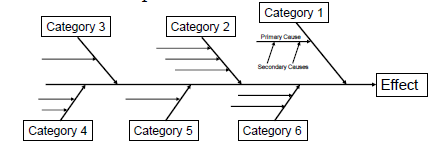
Threats - 30What diagram was created by Ishikawa?Fishbone diagram
- 31What is a fishbone diagram?Cause and Effect diagramming technique used in root cause analysis to identify underlying causes of an observed problem and the relationship between causes.
- 32What three elements determine how best to present requirements?1. Audience
2. Format
3. Information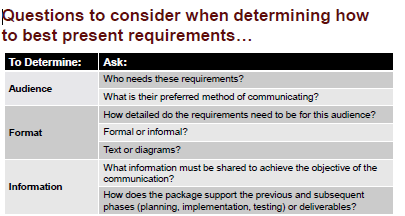
- 33What are the 5 Requirement Analysis Tasks? P O M A V V Pomegranate Martini Made with Vanilla Vodka1. Prioritize Requirements
2. Organize Requirements - most written as fragments
3. Specify and model requirements
4. Define assumptions and constraints (dependencies)
5. Verification - build system right
6. Validation - building the right system - 34What are the three ways in which requirements are written/modeled?1. Textually (words),
2. visually (pictures),
3. Matrix (table or grid) - 35What is MoSCoW* Must Do: Req must be satisfied.
* Should Do: High priority, but not critical.
* Could do: Desirable but not necessary...bells and whistles
* Won't do: Out of scope; future release - 36What are business constraints?Limitations imposed by business
- 37What are Technical Constraints?Limitations imposed by technology
- 38Whats the difference between verify and validate?*Verify: written correctly? Written well?
* Validate: Ensure requirement brings value (Does it fulfill its goal and relate back to original stakeholder goal?)
* Identify assumptions, *define measurable evaluation criteria, *determine business value,
* determine dependencies for benefits realization, * evaluate need vs. want - 39What is RACIResponsible - does the work
Accountable - the decision maker
Consulted - consulted prior to work
Informed - notified of outcome - 40What is a DFD and who invented?Data flow diagram invented by Todd Demarco
- 41What is an ERD and who invented?Entity-Relationship Diagram invened by Chen
- 42What us UML?Unified Modeling Language
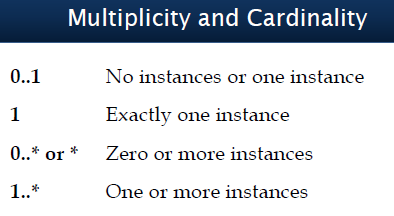
Industry standard replacing old ERD - 43In Multiplicity and Cardinality what does: 0..1 mean? 1 mean? 0..* or *? 1..*
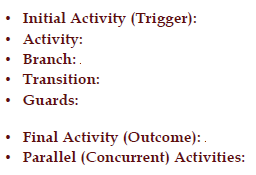
- 44What are the process modeling icons in an activity diagram?
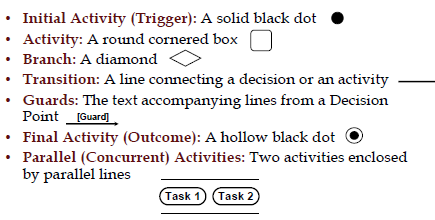
- 45What is the Gaps between AS IS and TO BE processes?The requirements starting point
- 46What are the solution assessment and Validation tasks? PART VP*Assess Proposed solution
*Allocate Requirements
*Assess Organizational Readiness
*Define Transition Requirements
*Validate Solution
*Evaluate Solution Performance - 47Is Testing part of the BA work or toolkit?No. BA's DO NOT TEST SOFTWARE.
The BA Job stops before testers job begins - 48What is ORA?Organizational Readiness Assessment
Assesses if we are really ready to integrate the changes into the organization - 49How is "tasks" defined in the BABOK?Performed to accomplish the purpose of a knowledge area
- 50How is "techniques" defined in the BABOK?Techniques alter the way a business analysis task is performed or describe a specific form the output of a task may take
Techniques apply across multiple knowledge areas - 51What are the characteristics of a task?* Accomplishes a result in an output that creates value
*Is complete; Can be used by successor tasks
*A necessary part of the purpose of the associated knowledge Area - 52Does the BABOK prescribe or determine the order in which tasks are performed?No, only that the input MUST exist
- 53What is an input?Represents the information and preconditions necessary for a task to begin
Generated by a BA task - 54What is an output?*A necessary result of the work described in the task.
*Created, transformed or change state resulting from successful completion of task
*May be a deliverable or part of a larger deliverable - 55The primary purpose of the BABOK® Guide isTo define the profession of business analysis
- 56Transition requirements are developed in which knowledge area?Solution Assessment and Validation
- 57What are the inputs to 4.2 Manage Requirements Traceability? (2)Requirements
Requirements Management Plan - 58A problem statement contains 4 key pieces of informationDescribe the problem
Identify the stakeholders affected
Describe the impact on each stakeholder
Key benefits
Información
- Descripción
- General flashcards to prepare for the Certified Business Analyst Professional certification exam.
- Creado por
- Isadelle Mercede
- Visitas
- 150
- Etiquetas
- Valoración