
Fichas
F4 Cards
Fichas del conjunto (105)
- 1Definition of LawRules and regulation passed by higher authorities to regulate the conduct of the society or community
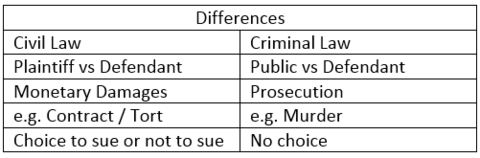
- 2Differences between Civil Law and Criminal Law?
- 3Name 2 Supreme CourtsCourt of Appeal
High Court - 4Name 3 State CourtDistrict Court
Magistrates Court
Small Claims Tribunal - 5Jurisdiction of Court of AppealHear appeals from the High Court
- 6Jurisdiction of High Court1st instance for Civil more than $250,000 and Criminal jurisdiction
- 7Jurisdiction of District Court1st instance for Civil $60,000 - $250,000 and Criminal jurisdiction less than 10 years
- 8Jurisdiction of Magistrates Court1st instance for Civil less than $60,000 and Criminal jurisdiction less than 3 years
- 9Jurisdiction of Small Claims Tribunal1st instance for civil less than $10,000 or $20,000 if both parties agree
- 10Name 5 Alternative Dispute Resolution (ADR)1.Arbitration
2.Mediation
3.Conciliation
4.Tribunals
5.Negotiation - 11Define Stare Decisis遵循先例 – to stand by what has been decided
- 12Define Ratio Decidendi法律原则 – the material decision
- 13Define Obiter Dicta附带意见 – by the way statement, opinion or view
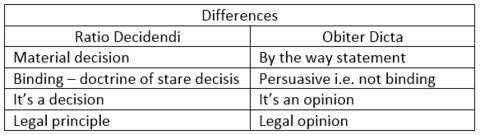
- 14Differences between Ratio Decidendi and Obiter Dicta ?
- 15What are the advantages of precedent?1.Certainty
2.Consistencies
3.Uniformity
4.Persistence
5.Help to anticipate the result thus encourage out of court solutions - 16What are the disadvantages of precedent?1.Difficult to identify ratio decidendi and obiter dicta
2.Too rigid, no much choice for lower court
3.Law develops in a slow pace
4.Overlapping - too may case law with similar references - 17Give 4 written source of Law1.Constitution
2.Legislation (Statute)
3.Delegated legislation
4.Judicial Precedent - 18Give 3 unwritten source of law1. Equity
2.Common Law
3.Case law - 19What is Statute ?A piece of legislation passed by the Singapore Parliament
- 20What is Delegated Legislation ?A.K.A Subsidiary Legislation / Subordinate Legislation
Any law passed other than parliament
Cannot conflict with Constitution or Statute - 21What is Judicial Precedent ?A decision of the court used as a source for future decision making.
- 22What is Equity ?A supplement to prevent common law to give a too harsh result, which is also use to address fairness
- 23What is Common law ?Is law developed by judges, courts, and similar tribunals, have precedential effect on future cases.
- 24What is Case Law ?Interpretation of Statute, it is a Judge made law
- 25What are the Canons of interpretation ?1.Literal rule
2.Golden rule
3.Mischief rule - 26What is Literal rule ?The court will look into plain ordinary meaning / dictionary meaning
- 27What is Golden Rule ?Allows a judge to depart from a word's normal meaning in order to avoid an absurd result.
- 28What is Mischief Rule ?Judges will look at the defect of the common law
- 29What is Purposive Approach ?Judges will look at the purpose of Parliament in legislation of the law. I.e. to read he whole statue and to look at the intention of Parliament
- 30What are the elements of contract ?1.Offer
2.Accptance
3.Consideration
4.Consenting mind
5.Capacity
6.Certainty
7.Intentino to create legal relations - 31Types of invitation to treat1.Dispaly of goods
2.Auction
3.Bilateral dvertisment
4.Mere enquiry
5. Price list
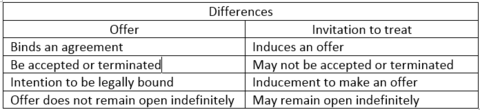
6. Tender - 32What are the differences between Offer and Invitation to treat?
- 33What are the ways to terminate an offer?1. Revocation 撤销
2.Rejection
3. Non-fulfilment of condition
4.Couter-offer
5.Death of the parties - 34What is Consideration ?Money or money’s worth – an act, promise, hardship, detriment or forbearance
- 35What are the types of consideration ?1. Executory consideration
2. Executed consideration
3. Past consideration - 36What is Excutory consideration ?Where the party will perform an act which will eventually become executed.
- 37What is excuted consideration ?Where one party does something at another party’s request for some payment or money
- 38What is Past consderation ?Where the act has already been done and the promise came later
- 39What is Promissory estoppel ?A party is prevented from going back to his promise even through there may be no consideration provided.
- 40What are the Limitations of promissory estopple ?1.Shield and not a sword
2.The promise must be clear
3There must be reliance on the promise
4.It must not be equitable to back to the promise (unfair to break) - 41What si Doctrine of privity ?Only contracting parties can sue each other- the party that provides consideration can sue each other
- 42What is void agreement / contract ?Agreements not recognized by courts or law. E.g. illegal contract
- 43What is Voidable agreement / contract ?Agreement which lack voluntariness, consenting mind and free consent. E.g. contract obtained by coercion, fraud, duress, misrepresentation and mistake.
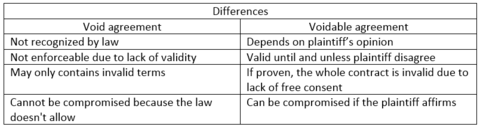
- 44Differences between Void agreement and Voidable agreement ?
- 45What is Misrepresentation ?It is a false staterment of fact, which induced a party and was relied by the party to enter in to a contract
- 46What are the types of Misrepresentation ?1.Fraudulent Misrepresentation
2.Negligent Misrepresentation
3.Innocent Misrepresentation - 47What is Fraudulent misrepresentation ?It is cheat or deceit, where the party knowingly lied or he doesn't believe in the truth of the statement, and has the intention to cheat.
- 48What is Negligent misrepresentation ?It is reckless or careless act, where the party did not take reasonable care on the truth of the statement
- 49What is innocent misrepresentation ?Where the party has reasonable grounds to believe it is true, and there is no element of false and careless.
- 50What are the remedies for misrepresentation ?Rescission and damages for all 3 types. Negligent and innocent can claim damages in lieu.
- 51Who can imply a term ?1. Fact
2. Law
3. Custom - 52What cannot be excluded by an exclusion clause ?1. Death
2. Personal injuries
3. Liability for negligence - 53what is Contra Proferentum Rule ?When an exclusion clause is not clearly worded, the party relying on it must explain, otherwise that party may bear the damages
- 54What are the ways to discharge a contract ?1. By performance
2. By agreement
3. By breach of contract
4. By frustration
5. By death - 55What is Discharge by frustration?An occurrence of an event which is neither party's fault, which make the contract impossible to perform
- 56How to determine a discharge by frustration ?Both party has no knowledge, no intention, no control and no fault at the event
- 57What are the limitations of discharge by frustration ?1. Cannot be self-induced
2. Must have no intention, no knowledge and no fault
3. There must be no alternative way - 58What are the remedies of discharge by frustration ?Deposit paid can be recovered
Future money ceased to be payable
Pay for the benefit enjoyed - 59What are the remedies available for Equity Law ?1. Specific performance
2. Injunction 禁令
3. Damages
4. Rescind 撤销
5. Restitution 复原
6. Reimbursement 补款 - 60What is the remedy available for Equity Law ?Monetary Compensation
- 61What is Tort ?Civil wrong
- 62How to prove Negligence ?1. Duty of care
2. Breach of duty of care
3. Causation
4. Damages
5. Remoteness - 63How to prove Duty of care ?Single Composite Test -
1. Foreseeability
2.Proximity
3.Policy consideration on just and reasonable - 64What is Professional negligence ?A breach of the duty of care between professionals and their clients.
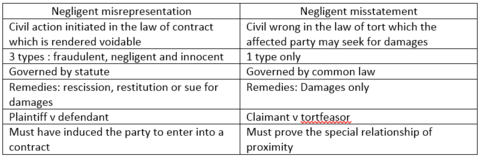
- 65What are the differences between Negligent misrepresentation and Negligent misstatement ?
- 66What is Passing off?Any person who carries on a business by using another business’ named
Defence of tort - 67What is Express authority ?A.K.A. Actual Authority - where the partnership will be bound by the partners’ authority so are the other partner
- 68What is Implied authority ?A.K.A Apparent authority / Ostensible authority - where the partners are presumed to be a partner even though he may lack the authority
- 69What is the liability of a partner in a partnership ?Jointly and severally for any liability of the partnership
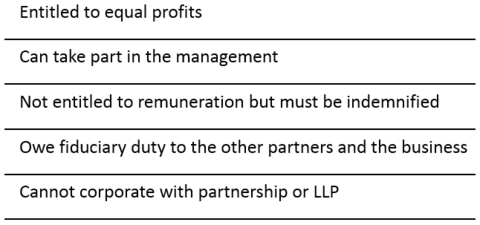
- 70What are the similarities between Partnership and Limited Liability Partnership ?
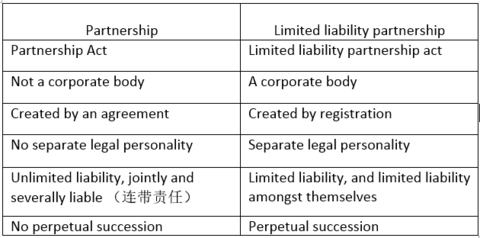
- 71What are the differences between Partnership and Limited Liability Partnership ?
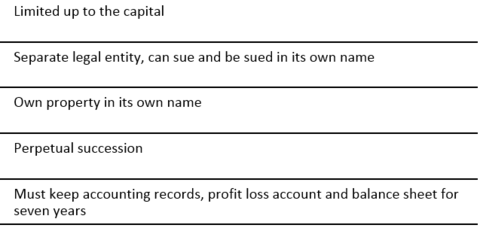
- 72What are the similarities between Company and Limited Liability Partnership ?
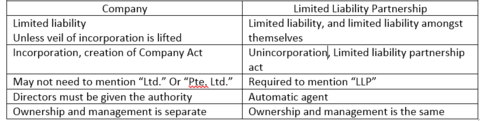
- 73What are the differences between Company and Limited Liability Partnership ?
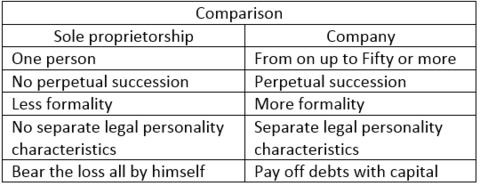
- 74What are the differences between Company and Sole proprietorship?
- 75How many members does a Private company have ?1 - 50
- 76How many members does a Exempted Private company have ?1-20
- 77How many members does a Non-exempted Private company have ?21-50
- 78How many members does a Public company have ?Unlimited number of members
- 79What is the use of a Separate legal personality ?1. Can sue and be sued in its own name
2. Can own property in its own name
3. Perpetual succession
4. Members has limited liability - 80What is an Ultra vires act ?Acting beyond the authorities or powers
- 81How many vote is needed to pass an Ordinary resolution and how long is the notice period?More than 50% vote
14 days’ notice - 82How many vote is needed to pass an Special resolution and how long is the notice period?More than 75% vote
21 days’ notice - 83What is 28-days notice period for ?For removal of director or auditor or liquidator
- 84What is Fixed charge ?Where the company’s immovable properties are charged to the creditors
- 85What is Floating charge ?Company’s present and future properties, which the company can still deal with, are charged to the creditor.
- 86What is Executive director ?A full time director and also an employee of the company
- 87What is Non-executive director ?A part time director and who are not the employee of the company
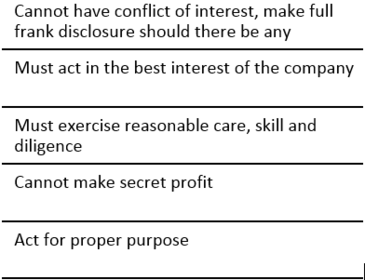
- 88What are the Director's duties ?
- 89What are the types of director's duties ?1. Fiduciary duty
2. Common law duty
3. Statutory duty - 90Explain The proper plaintiff rule.If a wrong is done to the company, only the company can sue
- 91Explain The majority rule.Decision taken by the majority shareholders are binding on the minority shareholders.
- 92Explain Derivative action .A member may derive his authority to sue on behalf of the company
- 93Explain Representative action .A member may also sue on behalf other members
- 94Explain Personal action .A member may also sue personally in his own capacity
- 95What is Minority protection ?It is the protection provided when the minority shareholder treated oppressively and unfairly.
- 96Procedure for voluntary winding up by member1.Director make a declaration of solvency
2.A special resolution passed
3.A liquidator is appointed - 97Procedure for voluntary winding up by creditor1.A meeting of creditors to be held upon a special resolution
2.Liquidator appointed - 98Procedure for compulsory winding up1.Initiated by a petition to the court
2.Liquidator will be appointed by the court - 99Who can give petition to the court ?Creditor, contributor, company liquidator and etc.
- 100What are the grounds for winding up ?Unable to pay debts
Just and equitable
Company used for unlawful purpose - 101What is Judicial management ?Managing the company’s business by appointing a judicial manger
- 102What is Scheme of arrangement ?An arrangement to compromise with creditors on the rights and obligation
- 103What is Corporate governance ?How companies are controlled and administered
- 104What company are required to have an audit committee, and what is the composition of an audit committee ?Required for listed company, must have at least 3 members, who are non-executive directors
- 105What is quorum ?Minimum number of person required to attend a meeting, which is normally 2. This is stated in AA