
Fichas
OCR Physics P1 P2 P3
Fichas del conjunto (129)
- 1What is the order of the planets in our solar system?Mercury
Venus
Earth
Mars
Jupiter
Saturn
Uranus
Neptune - 2What is between Mars and Jupiter?Asteroid belt
- 3What orbits the sun?Dwarf Planets
Planets
Comets
Dust
Asteroids - 4What orbits planets?Moons
- 5What's the difference between planets and stars?Stars are much larger, far away, very hot and emit their own light
Planets reflect light from the sun, are much smaller and are much closer. - 6How did the sun form?Dust and gas began to collapse in on itself and gravity took over. They came together at the centre to form a protostar and nuclear fusion began. It gave out huge amounts of heat and light.
- 7How did the planets form?Material in clouds around the sun containing helium, hydrogen and heavier elements clumped together.
- 8What is the oldest rock on Earth and how old is it?Meteorites that crashed into the Earth. They are 4500 million years old.
- 9What are asteroids?Clumps of rock that didn't form planets left over form the formation of our solar system
- 10What are comets?Made of rock dust and ice left over from the solar system formation. They orbit the sun on elongates elipses with the sun at one end, often on a different plane to planets. They form a tail when they get close to the sun as the ice melts.
- 11How many stars are in the Milky Way?1 x 10^11
- 12What makes up most of the Universe?Empty space
- 13What is a light year?How far light can travel in a year. Measure of distance.
- 14How does parallax work?Pictures are taken of the sky 6 months apart when the Earth is at opposite sides of its orbit. The closer the star, the greater the apparent movement against distant stars.
- 15How can brightness measure distance?Brightness. However a star can be really bright and far away or dim and close. Scientists know how much radiation is emitted by different types of star therefore by looking at how bright they seem from Earth, they can work out the distance.
- 16Why are space telescoped used?To overcome the issues of the atmosphere absorbing radiation and light; and light pollution making dim objects hard to see.
- 17Why do we see stars and galaxies in the past?Because they are really far away therefore their light takes a long time to reach us. It takes 8 minutes for the sun's light to reach us. The amount of light years away a star is, the amount of years it takes us to see it.
- 18What is red shift and how does it show the universe is expanding??When galaxies move away, their wavelength changes, becoming redder. The greater the red shift, the faster it's moving away. The more distant the galaxy, the greater the red shift and the faster it is moving away. This shows the universe is expanding.
- 19What is the 'Big Bang' theory?The Universe started from a single point and an explosion caused it to begin expanding. It is still expanding now. Based on the rate of expansion, this probably began about 14,000 million years ago, but is difficult to estimate as we may have slowed down.
- 20How could the Universe end?If there's enough mass compared to the speed of expansion, it will eventually stop and begin contracting , ending in a 'Big Crunch'.
If there isn't enough mass compared to speed, it will continue to expand forever into eternity. - 21Why is this difficult to guess?It is hard to work out the speed of expansion as the Universe is so huge. Also, we don't know the mass due to dark matter being difficult to detect.
- 22Why is Earth an 'active planet'?It's changing all the time
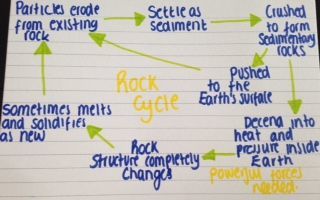
- 23What is the rock cycle?
- 24What was believed before Continental Drift?Land bridges connected continents which sunk under the sea as the Earth cooled. Not every believed this.
- 25What did he hypothesise?There was one super continent - Pangaea- 300 million years ago. This broke into chunks and are still slowly drifting apart.
- 26What was Wegener's evidence?Matching rock layer formation and fossils on South America and Africa.
Matching coastlines of South America and Africa - 27Why was his theory rejected at first?He was a meteorologist
He had no mechanism
Hostile the huge change
Not detectable - 28How did seafloor spreading prove Wegener's theory?Magma rises up through the the sea floor, solidifies and forms undersea mountains that are symmetrical about the ridge. Showed the sea floor was spreading therefore continents were moving apart. The alternating polarity shows this too.
- 29How do volcanoes form?At boundaries, plates meet and magma is produced, which can rise up.
- 30How do earthquakes occur?The plates move very suddenly, rubbing together and causing an earthquake.
- 31How are mountains formed?Plates crash into each other - one goes up and one goes down. This contributes to the rock cycle
- 32What are seismic waves?Waves produced by earthquakes
- 33What are P- waves?Quicker than S waves
Longitudinal (compressions and rarefractions) vibrations in direction
Solids and liquids - 34What are S-wavesSlower than P-waves
Transverse - perpendicular to the direction of travel
Only through solids - 35What happens when S- waves reach the liquid core?They are reflected as they can't go through
- 36What happens to P-waves as they enter the liquid core?Their speed changes and are refracted due to the change in density. This is why we know there is a solid inner core as they are again refracted.
- 37What is the wavelength? What is the amplitude?Distance from crest to crest/ trough to trough/ rest to rest
Distance from rest to crest or trough - 38What do waves transfer?Energy, NOT MATTER
- 39What is radiation?A transfer of energy - not matter
- 40What is the electromagnetic spectrum?Radiowaves
Microwaves
Infrared
Visible Light
Ultraviolet
X-ray
Gamma Rays - 41What is a photon?A packet of energy
- 42What happens to radiation as you go through the spectrum?Radio waves have the lowest frequency and biggest wavelength
Gamma rays have the highest frequency and smallest wavelength - 43What is something called that emits radiation?A source
- 44What happens to thermal radiation as you increase the temperature?The frequency increases
- 45What speed does radiation travel?The speed of light
3 X 10^8 m/s - 46What can happen to radiation once it has left the source?Transmitted - go through e.g. glass
Reflected - bounce back e.g. mirror
Absorbed - taken in e.g. sunbather
Multiple of these can occur at one e.g. windows reflect adn transmit - 47What is intensity?How much energy arrives at each square meter of surface per second
watts per square meter - 48What happens to intensity as distance increases?It decreases as photons spread out so less hit the detector. Also, some may be absorbed or reflected on the way.
- 49What is ionisation?When a photon hits an atom or molecule, it sometimes has enough energy to remove an electron, changing the atom or molecule.
- 50What are the 3 types of ionising radiation and why are they ionising?Ultraviolet
X-ray
Gamma Ray
A lot of energy is needed to do this and these have the highest energy - 51What can this do to your cells?Can damage DNA which causes mutations. This is cancer.
They can kill cells altogether. This is radiation poisoning.
The longer the exposure, the more damage it causes. - 52How do X-rays work?They are transmitted through less dense materials but absorbed by more dense materials. The varying amounts of radiation absorbed produces an image.
- 53How are people protected from any potential X-ray dangers?Radiographers stand behind concrete or wear lead aprons.
Lead shields are put around areas that aren't being x-rayed.
This protects people from any unnecessary exposure that could cause damage. - 54How can people be protected from UV rays?Wear clothing to cover up
Use suncream
Stay inside at hottest times - 55What radiation can cause heating?Infra-red and microwaves
- 56How do microwave ovens work?They're strongly absorbed by water molecules and make them vibrate, causing them to heat. Most food contains water.
The higher the power, the quicker it heats the food. - 57What would they do to body cells and how is this risk prevented?Heat up the water in them.
Metal casing and screens on the doors reflect the radiation to stop it getting out. - 58How are microwaves used in mobile phones?Emitted by them and carry the signal when making a call. Also, are emitted by phone masts.
- 59What are perceived risks of using mobile phones?Microwaves can heat body tissue which is believed to be caused cancer. However, the intensity is low and nothing to worry about. There is no evidence for any risk.
- 60What radiation can pass through the atmosphere easily?Radio waves and visible light
- 61What are the greenhouse gasses and what do they do?Water, Methane, Water Vapour
Absorb radiation and re-radiate it in all directions, often back toward Earth - 62What is the greenhosue effect?The Earth absorbs radiation from the sun, warming us up. The Earth emits some back to space, cooling us down. It's a lower frequency than that of the sun as Earth's cooler. The greenhouse gasses do their job. The atmosphere acts as an insulating layer.
- 63What is ozone?O3, a layer that absorbs UV radiation. Without it, a lot more UV would reach us which is ionising so can harm us.
- 64How is it formed?When an ozone molecule absorbs UV radiation, it splits into O2 and O. The O reacts with another O2 to make O3 again. Therefore the reaction is reversible.
- 65What inputs carbon dioxide into the atmosphere?Combustion of fossil fuels
Respiration of plants and animals
Respiration from decomposers - 66What removes carbon dioxide from the atmosphere in the carbon cycle?Photosynthesis
- 67The carbon cycle has been balanced for thousands of years. How are humans upsetting this?Using more energy, e.g. for electricity or fuel in cars. This burns fossil fuels which produces a lot of carbon dioxide
Population is rising therefore more space is needed for living and food. Deforestation to do this increases carbon dioxide through combustion/ reduces amount taken out. - 68What is a climate model?Equations that mimic what is going on in the real climate taking into account information from various parts of the climate sytem
- 69What does the climate model show?Explains why the climate is changing now. We know it varies naturally, but recent changes cannot be explained naturally. Therefore it's due to human activity.
- 70What are the consequences of global warming?Rising sea levels - flooding
Ice melts
Changing weather patterns
Heat = more storms and floods
Impacts on food production - 71How is a) infrared b) radio waves c) microwaves Radiation used in communication?a) TV controls/ night vision/ optical fibres
b) TV & radio transmissions/ radar
c) Mobile phones and satellite communication - 72Why are radiowaves adn microwaves good at transmitting information over long distances?They don't get absorbed easily by the atmosphere due to their large wavelength.
- 73What is the difference in communicating wavelengths compared to normal radiowaves and microwaves?Radio waves for TV and radio are much shorter than normal
Microwaves for mobiles are much longer than normal - but still tiny compared to radio waves. - 74How do satellites work?Transmitter transmitted into space
Absorbed by satellite receiver dish
Transmits signal back to Earth
Received by satellite dish on ground
Reflects microwaves to reach a focal point - receiver. - 75How do optical fibres work?Infrared or visible light bounces off the sides of a thin inner core of glass or plastic. The wave enters one end and keeps reflecting until it comes out the other. Light and infrared work well as they don't weaken too much and the glass doesn't absorb much
- 76How is information transmitted?Superimposed onto carrier EM waves ir sent long distance down telephone wires
- 77What is the difference between analogue and digital?Digital only has 2 values.
Analogue has any value in a particular range - 78What happens to signals on their way and how is this overcome?They weaken and collect noise. They are amplified to keep them able to be transmitted and digital signals are more often used to reduce noise. Amplifying analogue signals just amplifies noise too
- 79Why are digital signals better than analogue?Noise can be removed easier
More information (bytes) can be sent at once
Digital signals higher quality
Easier to process due to computers being digital - 80What is power?The rate of energy transfer
- 81What does it mean to have 'high power'?It transfers a lot of energy in a short space of time
- 82What is efficiency?How much % of the energy supplied is actually used for its intended purpose
- 83What does a Sankey Diagram show?How much energy is usefully used and how much is being wasted and in what from the output
- 84Where is energy lost in a power station?Through heat and sound
- 85Why do we need to reduce the amount of energy we use?Mainly comes from fossil fuels, which is a finite source and also pollutes a lot. Reducing energy means we reduce fuels needed to be burned so there's less pollution
- 86How can we save energy at home?Stop heat escaping-
Cavity walls and loft insulation, double glazing and draught-proofing.
Thick curtains/ fiberglass wool hot water tank jacket
Reduce energy used - efficient appliances/ energy saving bulbs/ wash at lower temperatures/ turn down heating - 87What is cost effective? What is payback time?How good something is for how much it costs
How long it takes for he money saved to match the initial costs - 88How can energy be saved in the workplace?Using less paper
Incentives for energy efficient travel to work e.g. cycling/ public transport - 89How can the government encourage energy saving?Offer grants for better home insulation
Trade in old boilers for more efficient ones
More public transport
Investing in alternative energy sources
Improving recycling services
Making laws to ensure new housing and businesses are energy efficient - 90What does renewable mean? Why do we need to use renewable sources?A source will never run out or can be easily replenished
Non- renewable resources will run out and currently provide most of our energy. They damage the environment less - 91What's a problem with renewable energy?They don't provide as much energy and are often unreliable depending on the weather. Some cannot increase supply to meet high demand
- 92How do primary resources work in power stations?Energy is released from the fuel (burning or splitting of atoms) and generates steam.
The steam turns a turbine.
A generator turns the kinetic energy from the turbine into electricity - 93How can fossil fuels harm the environment?Release a lot of carbon dioxide, resulting in global warming
Coal and oil release sulfur dioxide, causing acid rain
Coal mining makes a mess of landscape
Oil spillages damage wildlife - 94Why do we use fossil fuels?They produce lost of energy, are relatively cheap and don't rely on weather so can meet high demand. There are already lots of power stations so more don't have to be built, saving money.
- 95How does a nuclear power station work?Fission releases energy
This heats water to make steam
Turns a turbine
Generator converts this into electricity - 96What are the advantages of this?Lots more energy than combustion
Doesn't produce carbon dioxide
The fuel (uranium/plutonium) is relatively cheap - 97What are the disadvantages?Radioactive waste - stays for long time
Extra safety precautions needed e.g. test workers/ waste disposal/ contamination of land
People near may oppose
High set up and decommissioning costs
Longest time to start up
Ionising radiation - kill/damage cells - 98What is the difference between contamination and irradiation?Irradiation is being exposed to radiation without coming into contact with the source. You stop being exposed as soon as you leave. Contamination is picking up radiation so you're still exposed for a long time.
- 99How does wind power work?Turbines put in exposed places e.g. moors/coast
Wind turns turbine which directly turns a generator inside each turbine
Energy is generated directly from the wind - 100What are the advantages?No CO2 is produced during use
Is renewable
No running costs and minimal running costs
No permanent damage to landscape if removed - 101What are the disadvantages?Noisy
Spoil the view
High set up costs
Don't produce much energy
Can't increase supply with demand
Unreliable e.g. if not windy - 102How do solar cells work?They generate electric currents directly from the sunlight. Often used in remote places and on a small scale
- 103What are the advantages?They have no fuel costs and running costs
Renewable
Don't produce CO2
Cost - effective even in cloudy countries
Good for small scale - 104What are the disadvantages?High set up costs
Not cost-effective or practical to join to National Grid
A lot of energy in manufacture - 105How does wave power work?Small wave-powered turbines located around the coast. As waves come in, their up/ down motion spins a turbine which drives a generator. Good on small islands but not a huge scale.
- 106What are the advantages?Renewable
No pollution
No fuel costs and minimal running costs - 107What are the disadvantages?Hazard for boats
Spoil the view
High set up costs
Unreliable - wind drop = wave drop - 108How do tidal barrages work?Dams are built across river estuaries with turbines in them. As the tide comes in, it fills the estuary to a height of several meters and spins the turbines. The water is allowed through the turbines at a controlled rate. The source is the gravity fo sun and moon controlling tides
- 109What are the advantages?Renewable
Reliable - always at least 2 tides a day
No fuel costs and minimal running costs
Potential to generate significant amount of energy - 110What are the disadvantages?Prevents access by boats
Ruins view
Alters wildlife habitat
High initial costs
Variable height tide means sometimes less energy is produced - 111How do biofuels work?Burned to produce energy in thermal power stations. Can also be used in cars.
Solids, (straw/ woodchips) liquids (ethanol) and gasses (methane biogas) - 112What are the advantages?They are carbon neutral
Renewable
Quick to access - 113What are the disadvantages?Forest has been cleared to make room for these. Therefore animal lose habitat and CO2 added to atmosphere from the decay and burning.
Room for this could be used for other things, like growing crops - 114What is geothermal energy?Water is piped down into hot rocks. It boils and becomes steam which turns a turbine and a generator turns this into electrical energy.
- 115What are the advantages?Free
Renewable energy
No real environmental problems - 116What are the disadvantages?Costly to drill several km down to reach the hot rock so not many places where this is economically viable
- 117What is hydroelectricity?Flooding a valley by building a big dam. This collects rainwater which is allowed out through turbines, driving them directly to drive generators to produce electricity. Located in remote values to reduce human impact
- 118What are the advantages?Immediate response to increased demand
No fuel and minimal running costs
No pollution (as such)
Reliable - except in drought - 119What are the disadvantages?Flooding valley causes animals to lose habitat
Rotting vegetation releases methane and CO2
High initial costs - 120Why do we need to use a mix of energy sources?Renewable resources struggle to produce the same output as fossil fuels
We're dependent on other countries for fossil fuels
Fossil fuels are finite/ major pollutants
Renewable resources are variable - 121What do we need to consider when deciding what energy source to use?Economics (cost)
Environmental impact - 122What do we consider with economics?Running costs - renewables have lowest because no fuel needed.
Set up costs - Renewables often need more for the same output so costs more
Nuclear reactors, hydroelectric dams and geothermal power stations need lost of engineering - 123What do we consider with environmental impact?Different types of pollution in the book e.g. light/ waste and air/ noise/ view/ habitat destruction/ resources/ carbon dioxide/ leisure activity disruption
- 124How does a generator work?The turbine rotates a magnet in a coil of wire. The turning magnet causes the magnetic field through the coil to change, inducing a voltage and making a current flow in the coil. The kinetic energy from turbines it turned into electrical energy.
- 125What is electromagnetic induction?Moving a magnet in a coil of wire causes them magnetic field through the coil to change. This induces a voltage and if this is part of a complete circuit, a current will flow.
- 126How can you increase the voltage and current in the wire? What does this mean in terms of energy?Turn the magnet - therefore the turbine - faster.
This means more primary resources are used to produce more energy to turn it quicker so more finite resources are used. - 127What is the National Grid?Network of pylons and cables over Britain that takes electrical from power stations to where it's needed in homes and industry. Power can be generated anywhere on the grid and supplied to anywhere else on the grid
- 128Why is high voltage used instead of high current?Lots of energy is lost through heat with high current. The voltage is much more efficient and cheaper. It reduces energy loss.
- 129What happens to voltage before it reaches our homes?It is reduced to 230 v - the mains supply.
Información
- Descripción
- GCSE Physics Fichas sobre OCR Physics P1 P2 P3, creado por Alice Hathaway el 24/05/2016.
- Creado por
- Alice Hathaway
- Visitas
- 43
- Valoración