
Fichas
The Cell : Anatomy and Division
Fichas del conjunto (36)
- 1Define Cell .Cell : the structural and functional unit of all living things .
- 2In all cells; name 3 major regions, or parts that can easily be identified with a light microscope-Nucleus
-Cytoplasm
-Plasma Membrane - 3The nucleus containsThe genetic material, DNA, which are also called "genes"
- 4The nucleus is also known asThe control Center
- 5Define Chromatin .Chromatin : a threadlike material that contains genetic material .
- 6Define Nucleoli .Nucleoli : composed of primarily proteins and Ribonucleic Acid (RNA); sites for ribosomal particles .
- 7The nucleus is bound by a double-layered membrane called ?The Nuclear Envelope
- 8The nuclear envelope is similar in composition to other cellular membranes but, it is distinguished by ?its large Nuclear Pores
- 9What does the plasma membrane do ?the plasma membrane separates cell contents from the surrounding environment .
- 10what does a plasma membrane consists of ?-phospholipids (fats)
-Globular protein - 11Besides providing a protective barrier, the plasma membrane plays an active role in determining what ?Determing which substances may enter or leave the cell and in what quantity aka Selective Permeability .
- 12Transport in the plasma membrane occurs in two ways :1. Active Transport : the cell must provide energy, ATP to power the transport process .
2. Passive Transport : the transport process is driven by concentration or pressure . - 13Define Microvilli .Microvilli : fingerlike projections or folds
- 14Microvilli's Function.Microvilli :
1. increases the surface area of the cell available for absorption or passage of materials
2. and for binding of signaling molecules. - 15What does the cytoplasm consists of ?cell contents; lies between the nucleus and the plasma membrane .
- 16The fluid cytoplasmic material is called ?Cytosol
- 17Organelles found in the cytosol-Ribosomes
-Endoplasmic Reticulum (Rough & Smooth)
-Golgi Apparatus
-lysosomes
-peroxisomes
-mitochondria
-centrioles
-Cytoskeletal elements (intermidiate filaments, microfilaments, microtubules ) - 18Location and function of a RibosomeFunction : Tiny spherical bodies composed of RNA and protein .
Location : floating free or attached to a membranous structure (Rough ER) in the cytoplasm . - 19Location and Function of the Endoplasmic Reticulum .Location : membranous system of tubules that extends throughout the cytoplasm
Smooth ER Function : has no function in protein synthesis (rather its a site for steroid, & lipid sythesis, lipid metabolism, drug detoxification)
Rough ER Function : studded with ribosomes, its tubules provides an area for storage and transport of proteins made on ribosomes to other cell areas; external face synthesizes phospholipids and cholesterol . - 20Location and Function of Golgi ApparatusLocation : stackd of flattened sacs and small vesicles. found close to the nucleus
Function : plays a role in packaging proteins or other substances for export - 21Function of LysosomesVarious-sized membranous sacs containing digestive enzymes (acid hydrolases)
Function : to digest worn out cell organelles and foreign substances that enter the cell. - 22Function of PeroxisomesFunction : Small lysosome-like membranous sacs containing oxidase enzymes that detoxify alcohol, hydrogen peroxide, and other harmful chemicals .
- 23Function of MitochondriaFunction : contains enzymes that oxidize foodsrtuffs to produce cellular energy (ATP) often referred to as "Powerhouse of the cell"
- 24Location and function of CentriolesLocation : Paired, cylindrical bodies that lie at right angles to each other, close to the nucleus.
Function : directs the formation if the mitotic spindle during cell division; forms the bases of cilia and flagella . - 25Location and Function of Cytoskeletal ElementsFunction: provides cellular support
-Microfilaments are important in cell motility
-intermediate filaments resists mechanical forces acting on cells
-Microtubules form internal structures of centrioles and help determine cell shape - 26deine interphaseInterphase : the longer period during which the cell grows and carries out its usual activities.
- 27Define cell divisionCell division : when the cell reproduces itself by dividing
- 28Cell division consists of a series of events called ?Mitosis and Cytokinesis
-Mitosis : a nuclear division
-Cytokinesis: the division of the cytoplasm - 29Define mitosisMitosis : is two daughter nuclei that are genetically identical to the mother nucleus
- 30Define Meiosis.Meoisis: is a specialized type of nuclear division that occurs only in the reproductive organs (testes, ovaries) contains 4 daughter nuclei that differ genetically in composition from the mother nucleus.
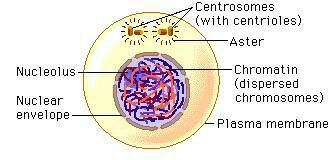
- 31Interphasethe period of a cell's life when it carries out its normal metabolic activities and grows
- 32Early Prophase-duplicated chromosome appear as identical threads now called sister chromatids
-microtubules propel centrosomes towards opposite ends (poles)
-microtubules exhibit rays called asters (stars)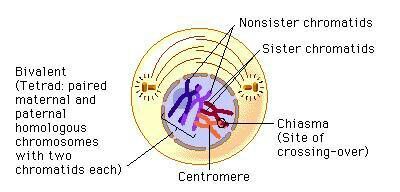
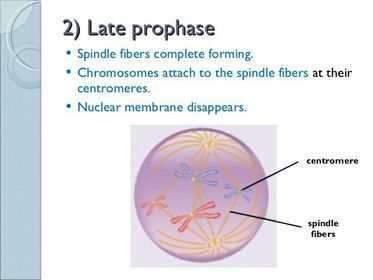
- 33Late Prophase
- 34Metaphase-second phase of mitosis
-centrosomes at opposite poles of cell
-chromosomes clusterat the middle of the cell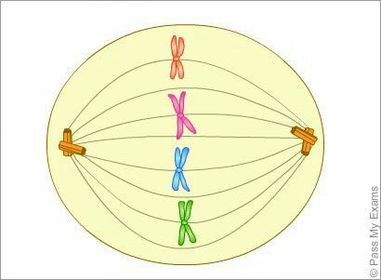
- 35Anaphase-third short phase
-moving chromosomes look v-shaped "arms" dangle behind them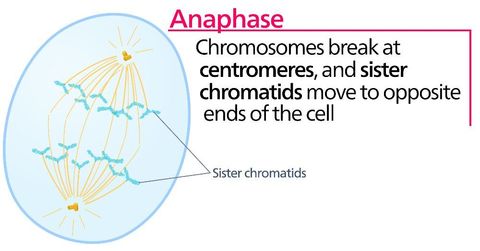
- 36Telophase-nuclearenvelope forms around each chromatin
-nucleoli reappears
-spindle breaks down and disappears
-Mitosis is done
-the cell is binucleate, with a nucleus identical to the original mother nucleus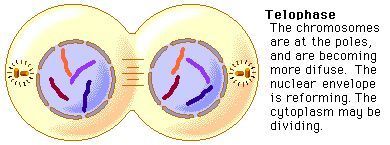
Información
- Descripción
- -Stages of mitosis, inter phase, and cytokinesis -identify and list major functions of organelles -major function of : nucleus, cytoplasm, and plasma membrane -identify mitotic phases -explain the importance of mitotic cell division and its product
- Creado por
- Kisha Limose
- Visitas
- 84
- Valoración