
Fichas
IMMS
Fichas del conjunto (47)
- 1How are our National Interests drawn out?Strategies in Context National Interests flow from a set of national values and the national purpose, which in our case are contained in the Constitution of India and the directions given by the political leadership.
National Interests
National Security Objectives
National Security Policy
Grand Strategy - 2What are the non-military factors that affect Grand Strategy?Political,
Economic
Psychological
Sociological - 3Name the instruments of Grand strategy.Joint Military Strategy
Economic
Diplomatic strategies - 4What does Joint Military Strategy reflect about the Nation?It reflects the nation's attitude towards war and the use of military force to attain political ends.
- 5Maritime StrategyThe Maritime Strategy of a country can be defined as the overall approach of a nation to the oceans around it, with the aim of synergising all aspects related to maritime activities, to maximise national gains.
The Maritime Military Strategy is primarily meant to be executed by the Indian Navy, with the Armed Forces and other government agencies of the union playing supporting roles. - 6What are key determinants shaping the IMMS- An era of violent peace
- Growing Sea Dependence
- India’s Maritime Geography
- Supporting Foreign Policy
- Influencing Operations Ashore
- The Importance of joint operations
- Maritime Domain Awareness
- Role of Air power
- Capability Prioritisation
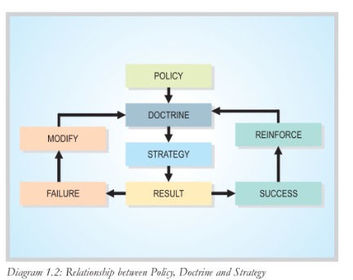
- National Maritime Infrastructure - 7State the difference between Doctrine and Strategy.Doctrine - derived from Government policies
Strategy - derived from doctrine
If Strategy is successful, reenforce the doctrine else modify it. - 8Draw the relational diagram between doctrine and strategyEnter text here...
- 9List the objectives of Maritime Military Strategy.1. A design for relating ends to means
2. Provides rationale for using maritime military power in handling various contingencies
3. Preparation for conflict - 10List the important choke points in the IOR.The Strait of Hormuz.
The Suez Canal and Red Sea.
The Strait of Bab-el-Mandeb and Horn of Africa.
The Malacca Strait.
The Lombok Strait.
The Sunda Strait.
The Six Degree Channel.
The Nine Degree Channel.
The Cape of Good Hope. - 11Which is world's most strategic choke point?The Strait of Hormuz. Connecting the Arabian Sea to the Gulf of Oman and the Persian Gulf
- 12Which choke point is the gateway between Europe and Asia.The Suez Canal
- 13Which choke point connects the Gulf of Aden and the Red Sea.Bab-el-Mandeb
- 14Name an alternate route to the Malacca and Lombok StraitsSunda Strait
- 15Which is the most direct route through India's Lakshadweep Islands for ships sailing from the Persian Gulf bound for East Asia?The Nine Degree Channel
- 16State the 04 major factors that Geopolitics comprises off.Size of Population
Geographical location
Character of Government
Physical conformation - 17Geopolitical Factors Contributing to ConflictState Failure and the Genesis of Conflict (eg 1971 Indo-Pak Conflict)
Territorial and Maritime Disputes
World Population Trends
Terrorism
Various diversities in IOR - 18ISLs of IOR ship : _______of world oil _________ of bulk cargo & _______ of world container shipment2/3
1/3
1/2 - 19Name the straits that connect the South China Sea to the Indian Ocean.Straits of Malacca, Lombok and Sunda
- 20Why is the Malacca strait the most important in the east.Over 60,000 vessels transit annually
- 21List important features of Gulf of Hormuz maki it the most important choke point in the world.1. Connects Persian gulf to the Indian Ocean
2. Persian gulf region possesses
- 60% of worlds oil resources
- 26 % of worlds natural gas
3. 15.5 million barrels of oil passing through it every day - 22Difference between Energy security and Security of energy.Energy security is the assurance of availability of energy at affordable rates.
Security of energy is the physical security of our energy installations and resources held. - 23Difference between Energy security and Security of energy.Energy security is the assurance of availability of energy at affordable rates.
Security of energy is the physical security of our energy installations and resources held. - 24List the domestic and international issues with regards to strategies for security of energy. Domestic Issues
• Investment in assets
• Protection of shipping
• Information sharing between various agencies
• Networking
• Security of Overseas assets
International Issues
• Cooperation for Enhanced Maritime Domain Awareness (MDA).
• Multinational Response Capability Development
• Leverage Peacekeeping Effort - 25Maritime Domain Awareness.A key national security requirement is the effective understanding of all activities, events, and trends within the relevant domain – air, land, maritime, space, and cyberspace – that could threaten safety and security of countries.
Domain Awareness is essential for effective decision-making at all levels of operations – strategic, operational and tactical – though at each level the nature, application, and modes of collection differ - 26Strategic Level of MDAAt the strategic level, Domain Awareness demands that the government and the Armed Forces stay abreast of geopolitical developments and activities of its likely adversary – be they economic, diplomatic or the activities of military forces
- 27Strategic Level of MDAAt the strategic level, Domain Awareness demands that the government and the Armed Forces stay abreast of geopolitical developments and activities of its likely adversary – be they economic, diplomatic or the activities of military forces
- 28Operational Level of MDAAt the operational level, Domain Awareness entails the extraction and review of the adversary's likely operational plan and any military build-up. This forms the basis on which our own concepts of conflict management are drawn up.
- 29Tactical Level of MDAAt the tactical level, Domain Awareness encompasses all activities related to Maritime Domain Awareness within the area of the battle-space centred on a force – be they air, surface or subsurface.
- 30Enumerate the major roles of the Indian Navy.Military
Diplomatic
Constabulary
Benign - 31What is the Indian Navy's most important role in peace?Deter War
- 32Strategic DeterrenceStrategic deterrence aims primarily at maintaining the status quo, by creating the perception that initiation of any level of conflict by the adversary would be infructuous.
It is therefore a National strategy that synergies & leverages all elements of National Power ( diplomatic, economic, informational & military) & international influence - 33Nuclear deterrenceLong term goal - ensure stability
An extremely powerful tool as:
- it can heavily change the cost- benefit equation of warfare
- can shatter the enemy's will and ability to fight
India's policy of NFU. Only as a retaliatory measure of last resort - 34What are the enablers of NFU Policy?Maintenance of robust Command and control
Effective surveillance
Good intelligence
Sound planning
Proper training - 35Name the subdivisions of Nuclear stability.Crisis stability and Arms control stability
- 36Conventional DeterrenceConventional deterrence is achieved through conventional maritime forces with superiority in terms of overall strength, capability and morale.
Empty threats won't do.
Need superior capability.
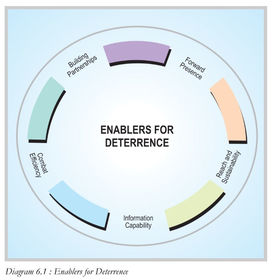
If stronger adversaries, consider collaboration with allies to project higher capability. - 37List the enablers of deterrenceEnter text here...
- 38What are the major tenets of Force build up strategy?a) The Indian Navy will remain committed to the concept of self-reliance and indigenisation.
(b) Additionally, it must occasionally yield to the imperatives of combat readiness. Hence, specific operational requirements may require us to exercise the import option in a limited manner. This would also apply to the import of warships, if indigenous yards lack capacity.
(c) We must aim to bridge the gap with developed nations and avoid a perpetual tail chase.
(d) Maintenance practices and manpower philosophies would need to be reviewed and realigned with global norms. - 39List the thrust areas for Force build upMDA
Reach and sustainability
ASW Operations
Anti-Air Operations
Expeditionary Operations
Joint Operations
Special Operations
MCM Warfare - 40List the thrust areas for Force build upMDA
Reach and sustainability
ASW Operations
Anti-Air Operations
Expeditionary Operations
Joint Operations
Special Operations
MCM Warfare - 41Aids to achieve enhanced MDAInvestment in satellite based surveillance technologies
Surveillance tech to identify friend or foe
Adapt COTS items
Invest in network technologies for better connectivity and interoperability with other forces
Intelligence enhancing technologies - 42Name the advancement in military technologies likely to be inducted by Indian NavyPower Sources
Propulsion Technology
Space Technology
Precision Navigation/Targeting Technologies
Modern Materials and Stealth Technologies
Unmanned Vehicles
Computing Technology
Weapons Technology
Simulators
(Read up technologies chapter from IMMS) - 43________ is the enabling element of conventional deterrence.Forward presence
- 44Presence is a product of ________& ________Reach & sustainability
- 45Presence is a product of ________& ________Reach & sustainability
- 46Information capability consists if 3 factors. Name them.Intelligence, surveillance and networking
- 47Name the communication satellite developed by ISRO for the Indian Navy.GSAT-7 or INSAT-4F
(Rukmini)
Información
- Descripción
- Fichas sobre IMMS, creado por Nikhil Philipose el 01/08/2016.
- Creado por
- Nikhil Philipose
- Visitas
- 77
- Valoración