
Fichas
11 Testing
Fichas del conjunto (29)
- 1What are the differences between Error, Failure and Fault?Error: System is in such a state that further processing by the system can lead to failure
Failure: Any deviation of the observed behavior from the specified behavior
Fault: Mechanical or algorithmic cause of an error ("bug") - 2What are the 3 major fault handling techniques and to which of these does Testing belong?1. Fault avoidance
2. Fault detection -> Testing
3. Fault Tolerance - 3What does a test model consist of?- Test driver
- Test case
- Input data
- Oracle (Compares expected output with test output)
- Test harness (allows to run tests under varying conditions, monitor behavior and outputs of the SUT) - 4What are the advantages of automated testing (in comparison to manual testing)- Less boring for developer
- Better test thoroughness
- Reduces cost of test execution
- Indispensible for regression testing - 5What does model-based testing enable?Early introduction of testing into the system development process
- 6Object-oriented test modeling: How do we deal with the fact that the SUT collaborates with other objects in the system model?We add objects to the test model = Test doubles
- 7Name the 4 types of test doubles- Dummy Object
- Fake object
- Stub
- Mock object (for that the real object/subsystem must be specified with an interface/facade and a class for implementation) - 8Which object does the Mock Object replace?The behavior of the real object called collaborator
- 9How can a Mock object be created at startup time?With the factory pattern
- 10The use of Mock object is based on which metaphor?The Record-Play Metaphor
- 11Which two types of analysis exist?- Static (inexpensive, but only catches 5-10% of quality problems)
- Dynamic (Black-Box/White-Box-Testing) - 12Name the 4 types of White-box testingStatement Testing
Loop Testing
Path Testing
Branch Testing - 13Why are both types of testing (White Box and Black Box) needed?- White Box and Black Box testing are at the ends of a testing continuum
- Any choice of test case lies in between these ends and depends on: Number of possible logical paths, Nature of Input Data, Amount of Computation, Complexity of algorithms and data structures - 14What is unit testing?Testing method where individual units in a program are tested
- 15What is typically a unit in a) procedual programming? b) object-oriented programming?a) Unit is usually a function or procedure
b) Unit is usually the class (attribute, method or interface) - 16Use ...knowledge about functional requirements (Black-Box testing)Analysis
- 17Use ... Knowledge about system structure, algorithms, data structures (white box testing)Design
- 18Use .. Knowledge about algorithms and data structuresImplementation
- 19When are the annotations @BeforeClass and @AfterClass useful?Useful for expensive setups that do not need to be run for every test, such as setting up a database connection
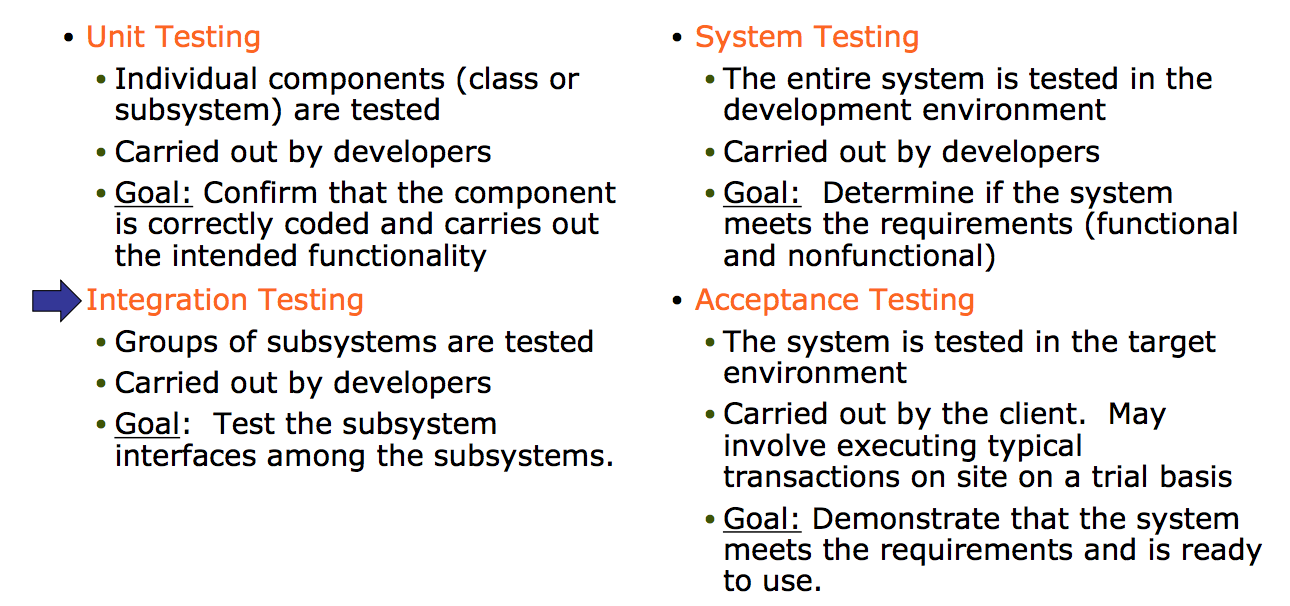
- 20Learn: Types of Testing Activities
- 21What is the goal of integration testing?Test all interfaces between subsystems and the interaction of subsystems
- 22What is a driver?A component that calls the Tested Unit. It controls the test cases
- 23What are the pros and cons of Bottom-up testing?Pros:
- No stubs needed
- Useful for integration testing of object-oriented systems, real-time systems, systems with strict performance requirements
Cons:
- Tests an important subsystem (UI) last
- Drivers are needed - 24What are the Pros and Cons for Top-down testing?Pros:
-Test cases can be defined in terms of the functional requirements of the system
- No drivers needed
Cons:
- Stubs are needed (which are difficult to write)
- Large number of stubs may be required
- Some interfaces are not tested separately
Solution -> Modified top-down testing - 25What are the pros and cons for the sandwich testing strategy?Pro:
- Top and bottom layer tests can be done in parallel
Con:
- Does not test the individual subsystems and their interfaces thoroughly before integration - 26What is the goal of functional testing?Test functionality of a system (essentially same as black box testing)
- 27What is the goal of structure testing?Cover all paths in the system design (essentially same as white box testing)
- 28What is the goal of Performance testing?Try to violate non-functional requirements
- 29What is the goal of Acceptance Testing?Demonstrate system is ready for operational use
Información
- Descripción
- Software Engineering Fichas sobre 11 Testing, creado por Maximilian Zeyda el 22/07/2017.
- Creado por
- Maximilian Zeyda
- Visitas
- 0
- Valoración