
Mapa mental
Materials development for language learning and teaching
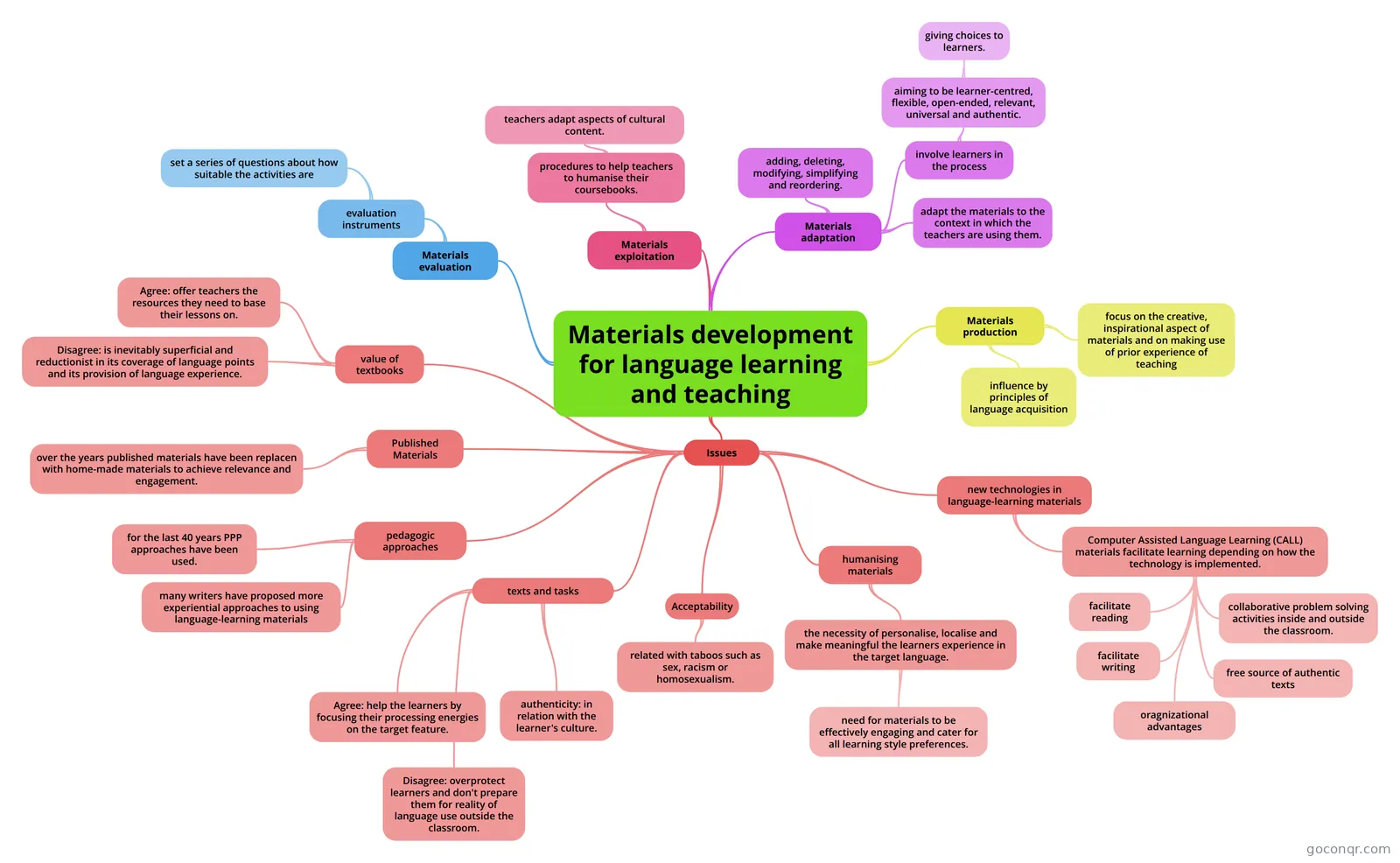
Mind map: materials development for language learning
Contenido del mapa
Materials development for language learning and teaching
Materials evaluation
- evaluation instruments
- set a series of questions about how suitable the activities are
- evaluation instruments
Materials adaptation
- adapt the materials to the context in which the teachers are using them.
- in order to achieve a congruence between materials, methodology, learners, objectives, the target language and the teacher's personality and style.
- adding, deleting, modifying, simplifying and reordering.
- involve learners in the process
- written taking into account the learner adaptation.
- aiming to be learner-centred, flexible, open-ended, relevant, universal and authentic.
- giving choices to learners.
- adapt the materials to the context in which the teachers are using them.
Materials production
- influence by principles of language acquisition
- focus on the creative, inspirational aspect of materials and on making use of prior experience of teaching
Materials exploitation
- procedures to help teachers to humanise their coursebooks.
- teachers adapt aspects of cultural content.
- local institutional and classroom requirements.
- teachers adapt aspects of cultural content.
- procedures to help teachers to humanise their coursebooks.
Issues
- value of textbooks
- Agree: offer teachers the resources they need to base their lessons on.
- Disagree: is inevitably superficial and reductionist in its coverage of language points and its provision of language experience.
- Published Materials
- over the years published materials have been replacen with home-made materials to achieve relevance and engagement.
- pedagogic approaches
- for the last 40 years PPP approaches have been used.
- frequent use of low-level practice activities as listen and repeat, dialogue repetition, matching and filling in the blanks.
- many writers have proposed more experiential approaches to using language-learning materials
- language awareness approach: learners first experience a text holistically and then analyse it with a view to making discoveries for themselves about language use
- for the last 40 years PPP approaches have been used.
- texts and tasks
- Agree: help the learners by focusing their processing energies on the target feature.
- Disagree: overprotect learners and don't prepare them for reality of language use outside the classroom.
- authenticity: in relation with the learner's culture.
- Acceptability
- related with taboos such as sex, racism or homosexualism.
- humanising materials
- the necessity of personalise, localise and make meaningful the learners experience in the target language.
- need for materials to be effectively engaging and cater for all learning style preferences.
- the necessity of personalise, localise and make meaningful the learners experience in the target language.
- new technologies in language-learning materials
- Computer Assisted Language Learning (CALL) materials facilitate learning depending on how the technology is implemented.
- facilitate reading
- by supporting comprehension with graphics, video and sound.
- facilitate writing
- trough modelling the genre, demonstrating the process, facilitating brainstorming and research.
- oragnizational advantages
- such as easy acces, convenient storage and retrieval and easy sharing.
- free source of authentic texts
- collaborative problem solving activities inside and outside the classroom.
- facilitate reading
- Computer Assisted Language Learning (CALL) materials facilitate learning depending on how the technology is implemented.
- value of textbooks
Información
- Descripción
- Mapa Mental sobre Materials development for language learning and teaching, creado por lkog-kam.y el 16/09/2014.
- Creado por
- lkog-kam.y
- Visitas
- 28
- Valoración