
Mapa mental
Integration techniques
Contenido del mapa
Integration techniques
The process of finding a function, given its derivative, is called anti-differentiation (or integration). If F'(x) = f(x), we say F(x) is an anti-derivative of f(x).
Partial Fractions
- This technique is used when we have a integral expressed as a fraction. When we try solving it by using "The Logaritmic Rule" we wouldn't be able to cancel alike terms, as the numerator is not the derivative of the denominator.
- This technique is based on "Partial fraction descomposition", which is process of taking a rational expression and decomposing it into simpler rational expressions that we can add or subtract to get the original rational expression
- The first step is to factor the denominator as much as possible and get the form of the partial fraction decomposition.
- The next step is to actually add the right side back up and simplify so that the numerators are equal for every x.
- The third step is to find values for "x" so we can solve for A, B, C and D (NOTE: the number of constants may vary)
- Finally we substitute for A, B, C, D so we can solve the integral by the "Logarithmic Rule" or any other rule necessary.
- The third step is to find values for "x" so we can solve for A, B, C and D (NOTE: the number of constants may vary)
- The next step is to actually add the right side back up and simplify so that the numerators are equal for every x.
- The first step is to factor the denominator as much as possible and get the form of the partial fraction decomposition.
- This technique is based on "Partial fraction descomposition", which is process of taking a rational expression and decomposing it into simpler rational expressions that we can add or subtract to get the original rational expression
- This technique is used when we have a integral expressed as a fraction. When we try solving it by using "The Logaritmic Rule" we wouldn't be able to cancel alike terms, as the numerator is not the derivative of the denominator.
Change of Variable / Double Substitution
- This technique is used when we have two terms are multiplying each other and need to be integrated, but if we try using "The Generalized Powe Rule", we wouldn't be able to cancel alike terms and integrate correctly.
- This technique is based on the change of variables. In essence is taking an integral in terms of "x" and changing it into terms of "u".
- The first step is to identy "x" and "u" in the function. In general "u" is the term that is elevated to a power greater or less than 1 (not equal). While "x" is the remaining term.
- The second step is to substitute "x" and "u" in the function in terms of "u" and then we simplify.
- Finally, after simplifying we can use "The Generalized Power Rule" to solve the Integral.
- The second step is to substitute "x" and "u" in the function in terms of "u" and then we simplify.
- The first step is to identy "x" and "u" in the function. In general "u" is the term that is elevated to a power greater or less than 1 (not equal). While "x" is the remaining term.
- This technique is based on the change of variables. In essence is taking an integral in terms of "x" and changing it into terms of "u".
- This technique is used when we have two terms are multiplying each other and need to be integrated, but if we try using "The Generalized Powe Rule", we wouldn't be able to cancel alike terms and integrate correctly.
Integration by parts
- Integration by parts or partial integration is a process that finds the integral of a product of functions in terms of the integral of their derivative and antiderivative. It is frequently used to transform the antiderivative of a product of functions into an antiderivative for which a solution can be more easily found.
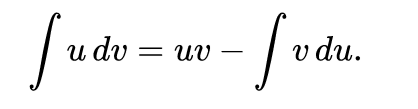
- Then, integration by parts state that:
- We follow the LATE rule: 1. Logarithmic 2. Algebraic 3. Trigonometric 4. Exponentials
- The fist step is to identify "u" and "dv" in the function.
- Next, we integrate "dv" to get "v" and we we derive "u" to obtain "du".
- The third step is to substitute for "u", "v", and "du" according to the formula. Then, we simplify if it's needed.
- Finally, we solve the integrate as the formula states and simplify. After, simplifying we obtain the final answer.
- Sometimes running the integration by parts process only once will NOT be enough to solve the integral at hand and we will have to run the process several times
- This applies if we have an Algebraic expression and Trigonometric expression together or when we have an Algebraic expression and Exponential expression together.
- We then use the tabulation method using: 1. Signs Start with + and alternate , 2. Function and its derivatives 3. Differential and its anti derivatives. We calculate until we obtain 0 as a derivative.
- This applies if we have an Algebraic expression and Trigonometric expression together or when we have an Algebraic expression and Exponential expression together.
- Sometimes running the integration by parts process only once will NOT be enough to solve the integral at hand and we will have to run the process several times
- Finally, we solve the integrate as the formula states and simplify. After, simplifying we obtain the final answer.
- The third step is to substitute for "u", "v", and "du" according to the formula. Then, we simplify if it's needed.
- Next, we integrate "dv" to get "v" and we we derive "u" to obtain "du".
- Then, integration by parts state that:
- Integration by parts or partial integration is a process that finds the integral of a product of functions in terms of the integral of their derivative and antiderivative. It is frequently used to transform the antiderivative of a product of functions into an antiderivative for which a solution can be more easily found.
Imágenes y archivos del mapa
Información
- Descripción
- Mapa Mental sobre Integration techniques, creado por Danna Argáez el 19/04/2018.
- Creado por
- Danna Argáez
- Visitas
- 0
- Valoración