
Mapa mental
Why Teach Art?
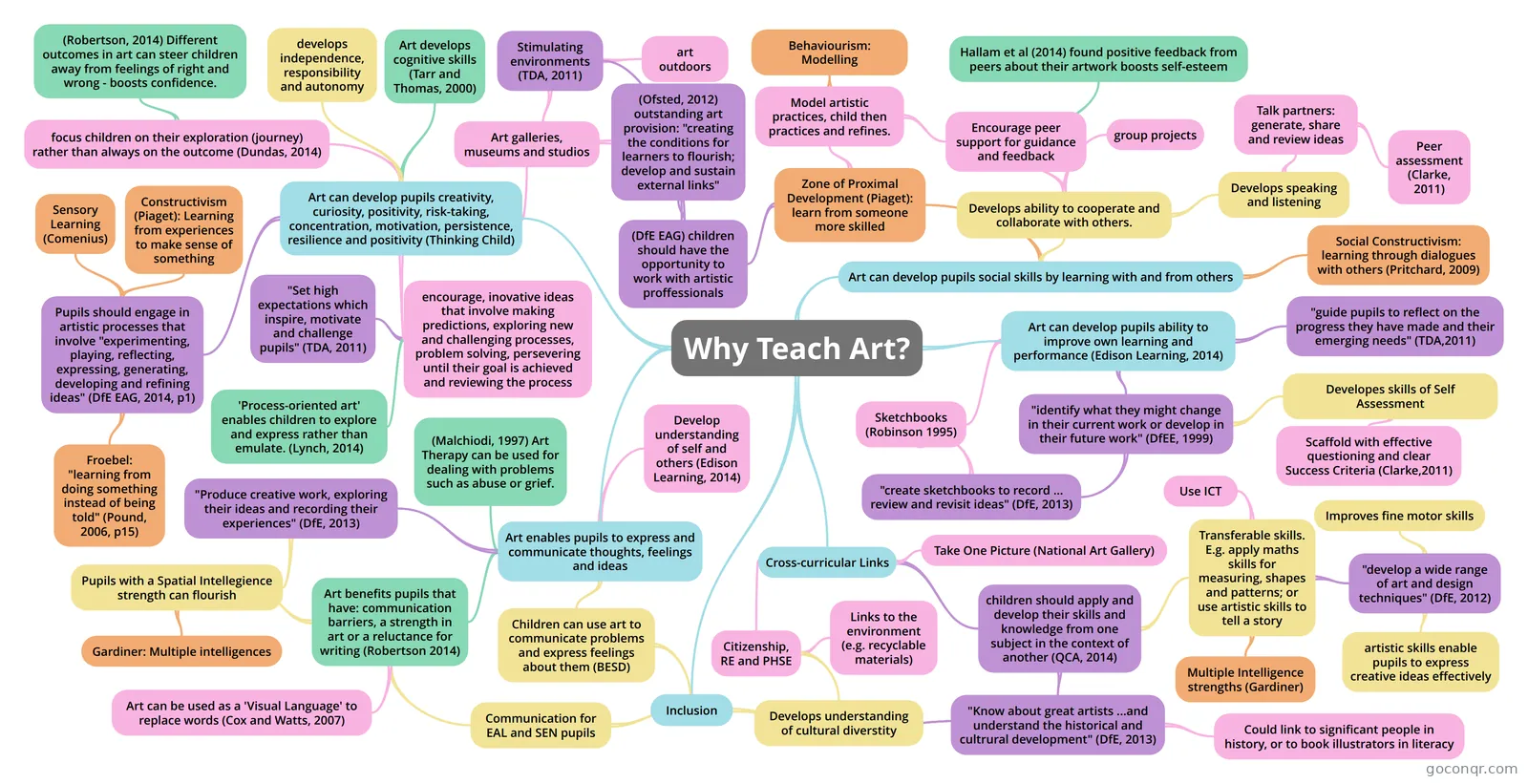
Mind map: why teach art
Contenido del mapa
Why Teach Art?
Art can develop pupils social skills by learning with and from others
- Develops ability to cooperate and collaborate with others.
- group projects
- Hallam et al (2014) found positive feedback from peers about their artwork boosts self-esteem
- Develops speaking and listening
- Talk partners: generate, share and review ideas
- Peer assessment (Clarke, 2011)
- Talk partners: generate, share and review ideas
- Social Constructivism: learning through dialogues with others (Pritchard, 2009)
- Zone of Proximal Development (Piaget): learn from someone more skilled
- (DfE EAG) children should have the opportunity to work with artistic proffessionals
- (Ofsted, 2012) outstanding art provision: "creating the conditions for learners to flourish; develop and sustain external links"
- Stimulating environments (TDA, 2011)
- art outdoors
- (Ofsted, 2012) outstanding art provision: "creating the conditions for learners to flourish; develop and sustain external links"
- Model artistic practices, child then practices and refines.
- Behaviourism: Modelling
- Encourage peer support for guidance and feedback
- (DfE EAG) children should have the opportunity to work with artistic proffessionals
- Develops ability to cooperate and collaborate with others.
Art can develop pupils creativity, curiosity, positivity, risk-taking, concentration, motivation, persistence, resilience and positivity (Thinking Child)
- develops independence, responsibility and autonomy
- encourage, inovative ideas that involve making predictions, exploring new and challenging processes, problem solving, persevering until their goal is achieved and reviewing the process
- 'Process-oriented art' enables children to explore and express rather than emulate. (Lynch, 2014)
- "Set high expectations which inspire, motivate and challenge pupils" (TDA, 2011)
- focus children on their exploration (journey) rather than always on the outcome (Dundas, 2014)
- (Robertson, 2014) Different outcomes in art can steer children away from feelings of right and wrong - boosts confidence.
- Pupils should engage in artistic processes that involve "experimenting, playing, reflecting, expressing, generating, developing and refining ideas" (DfE EAG, 2014, p1)
- Sensory Learning (Comenius)
- Froebel: "learning from doing something instead of being told" (Pound, 2006, p15)
- Constructivism (Piaget): Learning from experiences to make sense of something
- Art galleries, museums and studios
- Art develops cognitive skills (Tarr and Thomas, 2000)
Art can develop pupils ability to improve own learning and performance (Edison Learning, 2014)
- "guide pupils to reflect on the progress they have made and their emerging needs" (TDA,2011)
- "identify what they might change in their current work or develop in their future work" (DfEE, 1999)
- "create sketchbooks to record ... review and revisit ideas" (DfE, 2013)
- Developes skills of Self Assessment
- Scaffold with effective questioning and clear Success Criteria (Clarke,2011)
- "create sketchbooks to record ... review and revisit ideas" (DfE, 2013)
- Sketchbooks (Robinson 1995)
Art enables pupils to express and communicate thoughts, feelings and ideas
- "Produce creative work, exploring their ideas and recording their experiences" (DfE, 2013)
- Pupils with a Spatial Intellegience strength can flourish
- Gardiner: Multiple intelligences
- Pupils with a Spatial Intellegience strength can flourish
- Develop understanding of self and others (Edison Learning, 2014)
- Children can use art to communicate problems and express feelings about them (BESD)
- (Malchiodi, 1997) Art Therapy can be used for dealing with problems such as abuse or grief.
- Art benefits pupils that have: communication barriers, a strength in art or a reluctance for writing (Robertson 2014)
- Art can be used as a 'Visual Language' to replace words (Cox and Watts, 2007)
- Communication for EAL and SEN pupils
- "Produce creative work, exploring their ideas and recording their experiences" (DfE, 2013)
Cross-curricular Links
- Citizenship, RE and PHSE
- Develops understanding of cultural diverstity
- Links to the environment (e.g. recyclable materials)
- Take One Picture (National Art Gallery)
- children should apply and develop their skills and knowledge from one subject in the context of another (QCA, 2014)
- Transferable skills. E.g. apply maths skills for measuring, shapes and patterns; or use artistic skills to tell a story
- Multiple Intelligence strengths (Gardiner)
- "develop a wide range of art and design techniques" (DfE, 2012)
- artistic skills enable pupils to express creative ideas effectively
- Improves fine motor skills
- Use ICT
- "Know about great artists ...and understand the historical and cultrural development" (DfE, 2013)
- Could link to significant people in history, or to book illustrators in literacy
- Transferable skills. E.g. apply maths skills for measuring, shapes and patterns; or use artistic skills to tell a story
- Citizenship, RE and PHSE
Inclusion
- y
- y
Información
- Descripción
- Mapa Mental sobre Why Teach Art?, creado por Amy Williams9517 el 11/10/2014.
- Creado por
- Amy Williams9517
- Visitas
- 34
- Valoración