
Mapa mental
First language acquisition
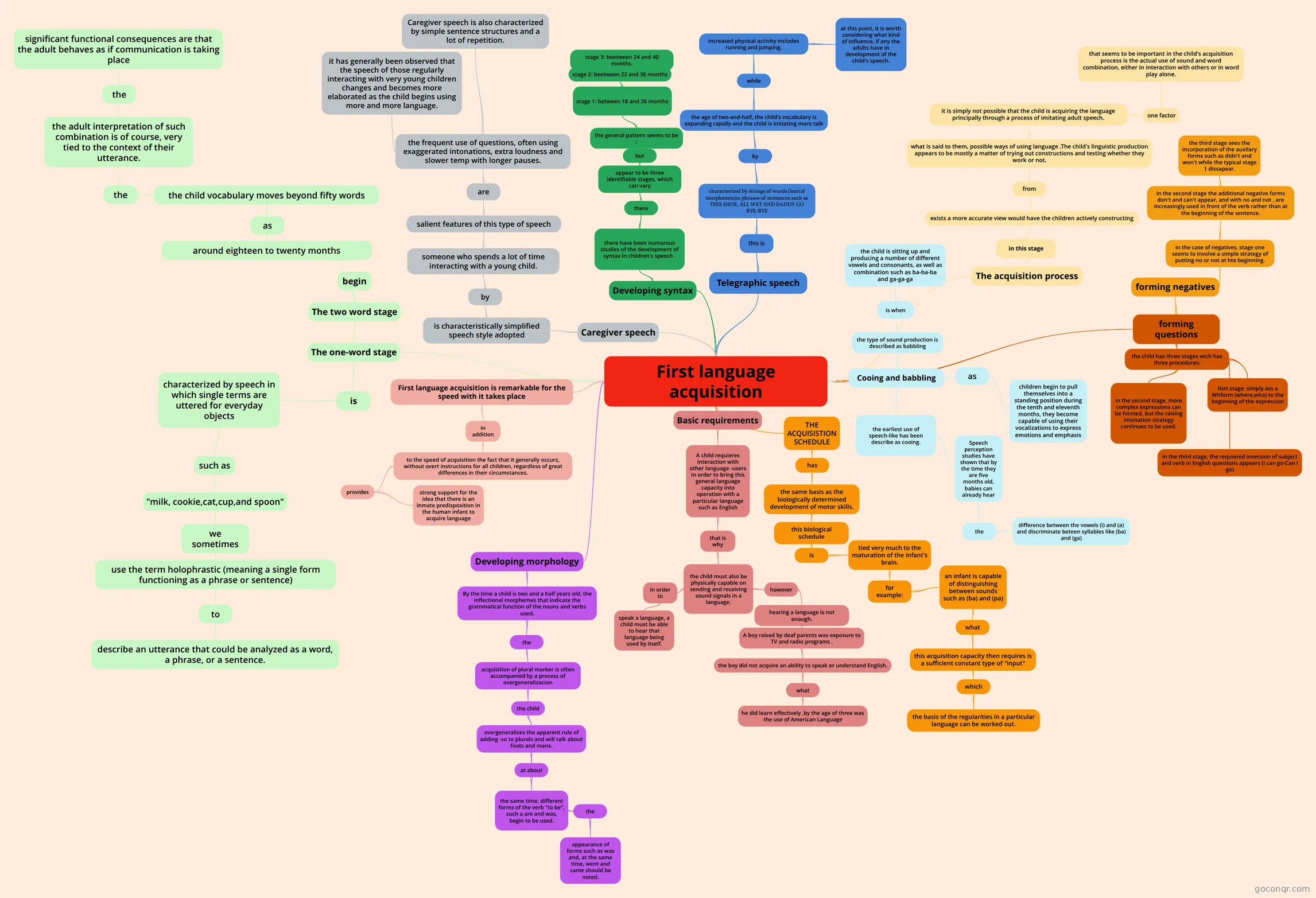
Mind map: First language acquisition
Contenido del mapa
First language acquisition
First language acquisition is remarkable for the speed with it takes place
- in addition
- to the speed of acquisition the fact that it generally occurs, without overt instructions for all children, regardless of great differences in their circumstances.
- provides
- strong support for the idea that there is an inmate predisposition in the human infant to acquire language
- provides
- to the speed of acquisition the fact that it generally occurs, without overt instructions for all children, regardless of great differences in their circumstances.
- in addition
Basic requirements
- A child requieres interaction with other language -users in order to bring this general language capacity into operation with a particular language such as English
- that is why
- the child must also be physically capable on sending and receiving sound signals in a language.
- in order to
- speak a language, a child must be able to hear that language being used by itself.
- however
- hearing a language is not enough.
- A boy raised by deaf parents was exposure to TV and radio programs .
- the boy did not acquire an ability to speak or understand English.
- what
- he did learn effectively ,by the age of three was the use of American Language
- what
- the boy did not acquire an ability to speak or understand English.
- A boy raised by deaf parents was exposure to TV and radio programs .
- hearing a language is not enough.
- in order to
- the child must also be physically capable on sending and receiving sound signals in a language.
- that is why
- A child requieres interaction with other language -users in order to bring this general language capacity into operation with a particular language such as English
THE ACQUISISTION SCHEDULE
- has
- the same basis as the biologically determined development of motor skills.
- this biological schedule
- is
- tied very much to the maturation of the infant's brain.
- for example:
- an infant is capable of distinguishing between sounds such as (ba) and (pa)
- what
- this acquisition capacity then requires is a sufficient constant type of "input"
- which
- the basis of the regularities in a particular language can be worked out.
- which
- this acquisition capacity then requires is a sufficient constant type of "input"
- what
- an infant is capable of distinguishing between sounds such as (ba) and (pa)
- for example:
- tied very much to the maturation of the infant's brain.
- is
- this biological schedule
- the same basis as the biologically determined development of motor skills.
- has
Caregiver speech
- is characteristically simplified speech style adopted
- by
- someone who spends a lot of time interacting with a young child.
- salient features of this type of speech
- are
- the frequent use of questions, often using exaggerated intonations, extra loudness and slower temp with longer pauses.
- Caregiver speech is also characterized by simple sentence structures and a lot of repetition.
- it has generally been observed that the speech of those regularly interacting with very young children changes and becomes more elaborated as the child begins using more and more language.
- the frequent use of questions, often using exaggerated intonations, extra loudness and slower temp with longer pauses.
- are
- salient features of this type of speech
- someone who spends a lot of time interacting with a young child.
- by
- is characteristically simplified speech style adopted
Cooing and babbling
- the earliest use of speech-like has been describe as cooing.
- Speech perception studies have shown that by the time they are five months old, babies can already hear
- the
- difference between the vowels (i) and (a) and discriminate beteen syllables like (ba) and (ga)
- the
- Speech perception studies have shown that by the time they are five months old, babies can already hear
- the type of sound production is described as babbling
- is when
- the child is sitting up and producing a number of different vowels and consonants, as well as combination such as ba-ba-ba and ga-ga-ga
- is when
- as
- children begin to pull themselves into a standing position during the tenth and eleventh months, they become capable of using their vocalizations to express emotions and emphasis
- the earliest use of speech-like has been describe as cooing.
The one-word stage
- is
- characterized by speech in which single terms are uttered for everyday objects
- such as
- "milk, cookie,cat,cup,and spoon"
- we sometimes
- use the term holophrastic (meaning a single form functioning as a phrase or sentence)
- to
- describe an utterance that could be analyzed as a word, a phrase, or a sentence.
- to
- use the term holophrastic (meaning a single form functioning as a phrase or sentence)
- we sometimes
- "milk, cookie,cat,cup,and spoon"
- such as
- characterized by speech in which single terms are uttered for everyday objects
- The two word stage
- can
- around eighteen to twenty months
- the child vocabulary moves beyond fifty words
- as
- the
- the adult interpretation of such combination is of course, very tied to the context of their utterance.
- the
- significant functional consequences are that the adult behaves as if communication is taking place
- the
- the adult interpretation of such combination is of course, very tied to the context of their utterance.
- the child vocabulary moves beyond fifty words
- around eighteen to twenty months
- begin
- can
- is
Telegraphic speech
- this is
- characterized by strings of words (lexical morphemes)in phrases of sentences such as THIS SHOE, ALL WET AND DADDY GO BYE-BYE
- by
- the age of two-and-half, the child's vocabulary is expanding rapidly and the child is initiating more talk
- while
- increased physical activity includes running and jumping.
- at this point, it is worth considering what kind of influence, if any the adults have in development of the child's speech.
- increased physical activity includes running and jumping.
- while
- the age of two-and-half, the child's vocabulary is expanding rapidly and the child is initiating more talk
- by
- characterized by strings of words (lexical morphemes)in phrases of sentences such as THIS SHOE, ALL WET AND DADDY GO BYE-BYE
- this is
The acquisition process
- in this stage
- exists a more accurate view would have the children actively constructing
- from
- what is said to them, possible ways of using language .The child's linguistic production appears to be mostly a matter of trying out constructions and testing whether they work or not.
- it is simply not possible that the child is acquiring the language principally through a process of imitating adult speech.
- one factor
- that seems to be important in the child's acquisition process is the actual use of sound and word combination, either in interaction with others or in word play alone.
- one factor
- it is simply not possible that the child is acquiring the language principally through a process of imitating adult speech.
- what is said to them, possible ways of using language .The child's linguistic production appears to be mostly a matter of trying out constructions and testing whether they work or not.
- from
- exists a more accurate view would have the children actively constructing
- in this stage
Developing morphology
- By the time a child is two and a half years old, the inflectional morphemes that indicate the grammatical function of the nouns and verbs used.
- the
- acquisition of plural marker is often accompanied by a process of overgeneralizacion
- the child
- overgeneralizes the apparent rule of adding -so to plurals and will talk about foots and mans.
- at about
- the same time, different forms of the verb "to be", such a are and was, begin to be used.
- the
- appearance of forms such as was and, at the same time, went and came should be noted.
- the
- the same time, different forms of the verb "to be", such a are and was, begin to be used.
- at about
- overgeneralizes the apparent rule of adding -so to plurals and will talk about foots and mans.
- the child
- acquisition of plural marker is often accompanied by a process of overgeneralizacion
- the
- By the time a child is two and a half years old, the inflectional morphemes that indicate the grammatical function of the nouns and verbs used.
Developing syntax
- there have been numorous studies of the development of syntax in children's speech .
- there
- appear to be three identifiable stages, which can vary
- but
- the general pattern seems to be :
- stage 1: between 18 and 26 months
- stage 2: beetween 22 and 30 months
- stage 3: beetween 24 and 40 months.
- stage 2: beetween 22 and 30 months
- stage 1: between 18 and 26 months
- the general pattern seems to be :
- but
- appear to be three identifiable stages, which can vary
- there
- there have been numorous studies of the development of syntax in children's speech .
forming questions
- the child has three stages wich has three procedures:
- fisrt stage: simply ass a Whform (where,who) to the beginning of the expression
- in the second stage, more complex expressions can be formed, but the raising intonation strategy continues to be used.
- in the third stage, the requiered inversion of subject and verb in English questions appears (I can go-Can I go)
- forming negatives
- in the case of negatives, stage one seems to involve a simple strategy of putting no or not at hte beginning.
- in the second stage the additional negative forms don't and can't appear, and with no and not , are increasingly used in front of the verb rather than at the beginning of the sentence.
- the third stage sees the incorporation of the auxilary forms such as didn't and won't while the typical stage 1 dissapear.
- in the second stage the additional negative forms don't and can't appear, and with no and not , are increasingly used in front of the verb rather than at the beginning of the sentence.
- in the case of negatives, stage one seems to involve a simple strategy of putting no or not at hte beginning.
- the child has three stages wich has three procedures:
Información
- Descripción
- Mapa Mental sobre First language acquisition, creado por ANA G Jimenez el 20/01/2015.
- Creado por
- ANA G Jimenez
- Visitas
- 38
- Valoración