
Mapa mental
AQA Physics 3 - Using Physics to Make Things Work
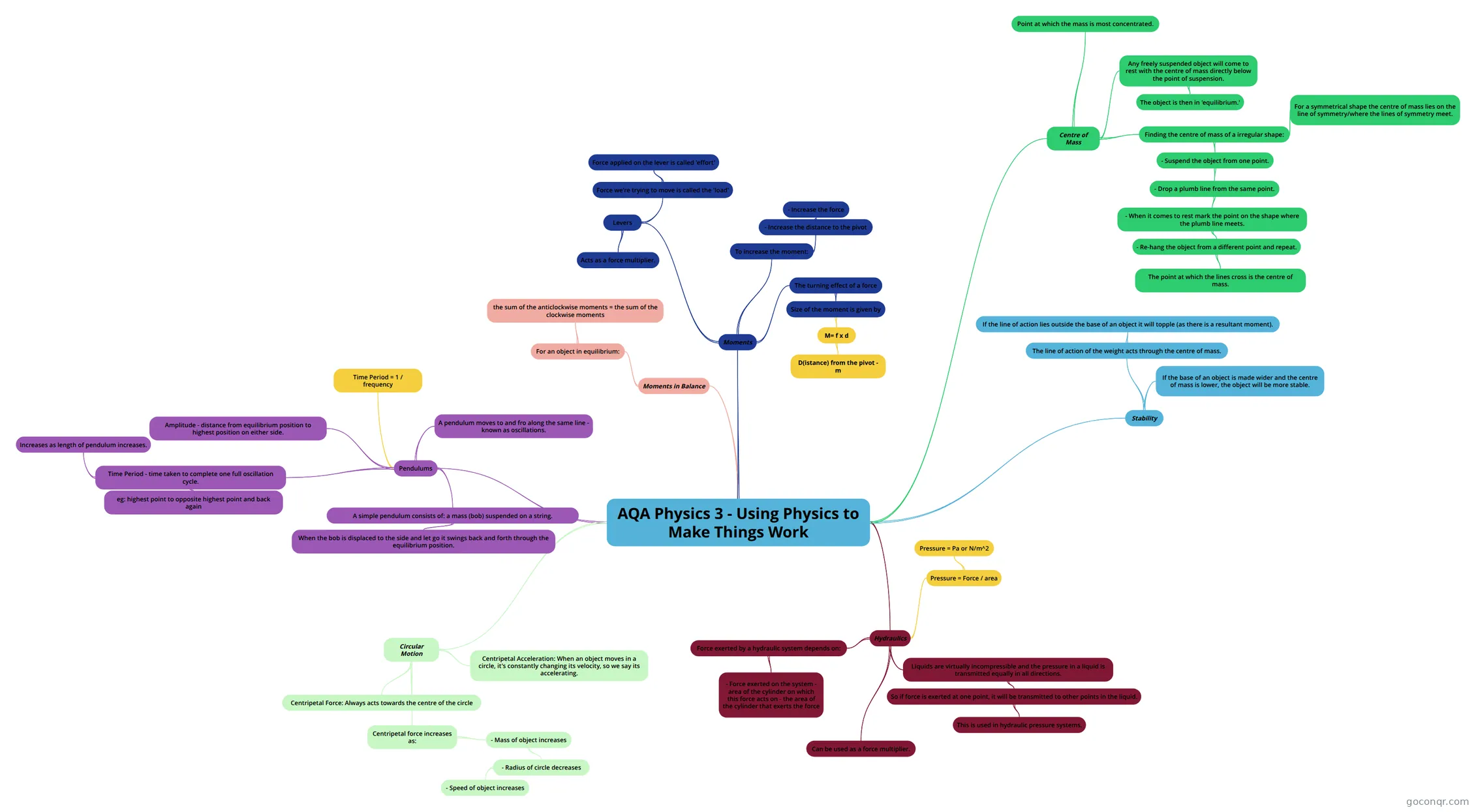
Mind map: AQA Physics 3 moments hydraulics circular motion
Contenido del mapa
AQA Physics 3 - Using Physics to Make Things Work
Moments
- The turning effect of a force
- Size of the moment is given by
- M= f x d
- D(istance) from the pivot - m
- M= f x d
- Size of the moment is given by
- To increase the moment:
- - Increase the distance to the pivot
- - Increase the force
- - Increase the distance to the pivot
- Levers
- Force we're trying to move is called the 'load'
- Force applied on the lever is called 'effort'
- Acts as a force multiplier.
- Force we're trying to move is called the 'load'
- The turning effect of a force
Centre of Mass
- Point at which the mass is most concentrated.
- Any freely suspended object will come to rest with the centre of mass directly below the point of suspension.
- The object is then in 'equilibrium.'
- Finding the centre of mass of a irregular shape:
- - Suspend the object from one point.
- - Drop a plumb line from the same point.
- - When it comes to rest mark the point on the shape where the plumb line meets.
- - Re-hang the object from a different point and repeat.
- The point at which the lines cross is the centre of mass.
- - Re-hang the object from a different point and repeat.
- - When it comes to rest mark the point on the shape where the plumb line meets.
- - Drop a plumb line from the same point.
- For a symmetrical shape the centre of mass lies on the line of symmetry/where the lines of symmetry meet.
- - Suspend the object from one point.
Moments in Balance
- For an object in equilibrium:
- the sum of the anticlockwise moments = the sum of the clockwise moments
- For an object in equilibrium:
Stability
- The line of action of the weight acts through the centre of mass.
- If the line of action lies outside the base of an object it will topple (as there is a resultant moment).
- If the base of an object is made wider and the centre of mass is lower, the object will be more stable.
- The line of action of the weight acts through the centre of mass.
Hydraulics
- Pressure = Force / area
- Pressure = Pa or N/m^2
- Liquids are virtually incompressible and the pressure in a liquid is transmitted equally in all directions.
- So if force is exerted at one point, it will be transmitted to other points in the liquid.
- This is used in hydraulic pressure systems.
- So if force is exerted at one point, it will be transmitted to other points in the liquid.
- Force exerted by a hydraulic system depends on:
- - Force exerted on the system - area of the cylinder on which this force acts on - the area of the cylinder that exerts the force
- Can be used as a force multiplier.
- Pressure = Force / area
Circular Motion
- Centripetal Force: Always acts towards the centre of the circle
- Centripetal Acceleration: When an object moves in a circle, it's constantly changing its velocity, so we say its accelerating.
- Centripetal force increases as:
- - Mass of object increases
- - Radius of circle decreases
- - Speed of object increases
- - Radius of circle decreases
- - Mass of object increases
Pendulums
- A pendulum moves to and fro along the same line - known as oscillations.
- A simple pendulum consists of: a mass (bob) suspended on a string.
- When the bob is displaced to the side and let go it swings back and forth through the equilibrium position.
- Amplitude - distance from equilibrium position to highest position on either side.
- Time Period - time taken to complete one full oscillation cycle.
- eg: highest point to opposite highest point and back again
- Increases as length of pendulum increases.
- Time Period = 1 / frequency
Información
- Descripción
- Mapa Mental sobre AQA Physics 3 - Using Physics to Make Things Work, creado por 10jgorman el 16/02/2015.
- Creado por
- 10jgorman
- Visitas
- 97
- Etiquetas
- Valoración