
Mapa mental
Academic Report
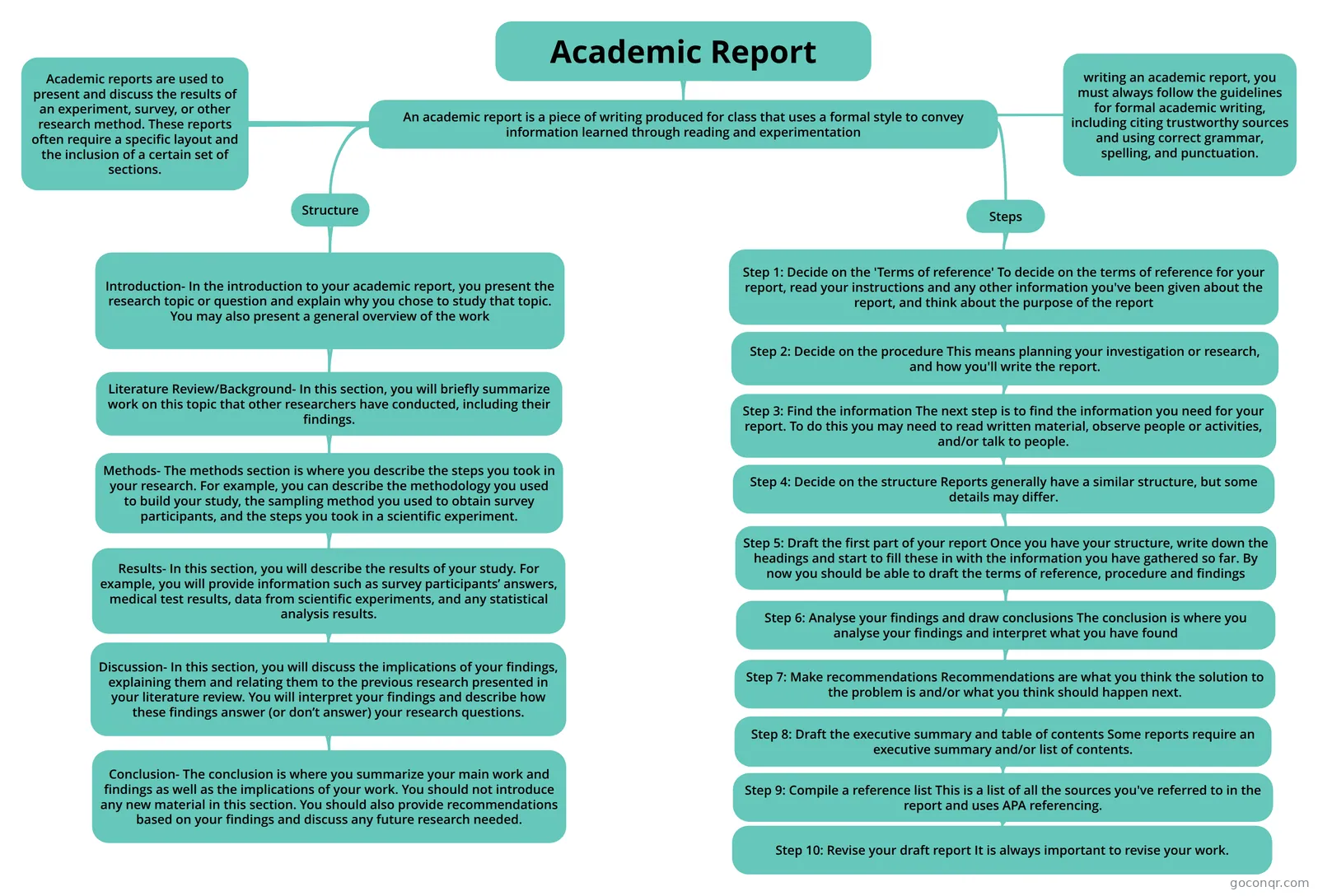
Mind map: Academic report structure and steps
Contenido del mapa
Academic Report
An academic report is a piece of writing produced for class that uses a formal style to convey information learned through reading and experimentation
- Academic reports are used to present and discuss the results of an experiment, survey, or other research method. These reports often require a specific layout and the inclusion of a certain set of sections.
- writing an academic report, you must always follow the guidelines for formal academic writing, including citing trustworthy sources and using correct grammar, spelling, and punctuation.
- Structure
- Introduction- In the introduction to your academic report, you present the research topic or question and explain why you chose to study that topic. You may also present a general overview of the work
- Literature Review/Background- In this section, you will briefly summarize work on this topic that other researchers have conducted, including their findings.
- Methods- The methods section is where you describe the steps you took in your research. For example, you can describe the methodology you used to build your study, the sampling method you used to obtain survey participants, and the steps you took in a scientific experiment.
- Results- In this section, you will describe the results of your study. For example, you will provide information such as survey participants’ answers, medical test results, data from scientific experiments, and any statistical analysis results.
- Discussion- In this section, you will discuss the implications of your findings, explaining them and relating them to the previous research presented in your literature review. You will interpret your findings and describe how these findings answer (or don’t answer) your research questions.
- Conclusion- The conclusion is where you summarize your main work and findings as well as the implications of your work. You should not introduce any new material in this section. You should also provide recommendations based on your findings and discuss any future research needed.
- Discussion- In this section, you will discuss the implications of your findings, explaining them and relating them to the previous research presented in your literature review. You will interpret your findings and describe how these findings answer (or don’t answer) your research questions.
- Results- In this section, you will describe the results of your study. For example, you will provide information such as survey participants’ answers, medical test results, data from scientific experiments, and any statistical analysis results.
- Methods- The methods section is where you describe the steps you took in your research. For example, you can describe the methodology you used to build your study, the sampling method you used to obtain survey participants, and the steps you took in a scientific experiment.
- Literature Review/Background- In this section, you will briefly summarize work on this topic that other researchers have conducted, including their findings.
- Introduction- In the introduction to your academic report, you present the research topic or question and explain why you chose to study that topic. You may also present a general overview of the work
- Steps
- Step 1: Decide on the 'Terms of reference' To decide on the terms of reference for your report, read your instructions and any other information you've been given about the report, and think about the purpose of the report
- Step 2: Decide on the procedure This means planning your investigation or research, and how you'll write the report.
- Step 3: Find the information The next step is to find the information you need for your report. To do this you may need to read written material, observe people or activities, and/or talk to people.
- Step 4: Decide on the structure Reports generally have a similar structure, but some details may differ.
- Step 5: Draft the first part of your report Once you have your structure, write down the headings and start to fill these in with the information you have gathered so far. By now you should be able to draft the terms of reference, procedure and findings
- Step 6: Analyse your findings and draw conclusions The conclusion is where you analyse your findings and interpret what you have found
- Step 7: Make recommendations Recommendations are what you think the solution to the problem is and/or what you think should happen next.
- Step 8: Draft the executive summary and table of contents Some reports require an executive summary and/or list of contents.
- Step 9: Compile a reference list This is a list of all the sources you've referred to in the report and uses APA referencing.
- Step 10: Revise your draft report It is always important to revise your work.
- Step 9: Compile a reference list This is a list of all the sources you've referred to in the report and uses APA referencing.
- Step 8: Draft the executive summary and table of contents Some reports require an executive summary and/or list of contents.
- Step 7: Make recommendations Recommendations are what you think the solution to the problem is and/or what you think should happen next.
- Step 6: Analyse your findings and draw conclusions The conclusion is where you analyse your findings and interpret what you have found
- Step 5: Draft the first part of your report Once you have your structure, write down the headings and start to fill these in with the information you have gathered so far. By now you should be able to draft the terms of reference, procedure and findings
- Step 4: Decide on the structure Reports generally have a similar structure, but some details may differ.
- Step 3: Find the information The next step is to find the information you need for your report. To do this you may need to read written material, observe people or activities, and/or talk to people.
- Step 2: Decide on the procedure This means planning your investigation or research, and how you'll write the report.
- Step 1: Decide on the 'Terms of reference' To decide on the terms of reference for your report, read your instructions and any other information you've been given about the report, and think about the purpose of the report
- Academic reports are used to present and discuss the results of an experiment, survey, or other research method. These reports often require a specific layout and the inclusion of a certain set of sections.
Información
- Descripción
- Mapa Mental sobre Academic Report, creado por Adrian Velasco el 25/04/2020.
- Creado por
- Adrian Velasco
- Visitas
- 39
- Valoración