
Mapa mental
Bacteria; structure and function
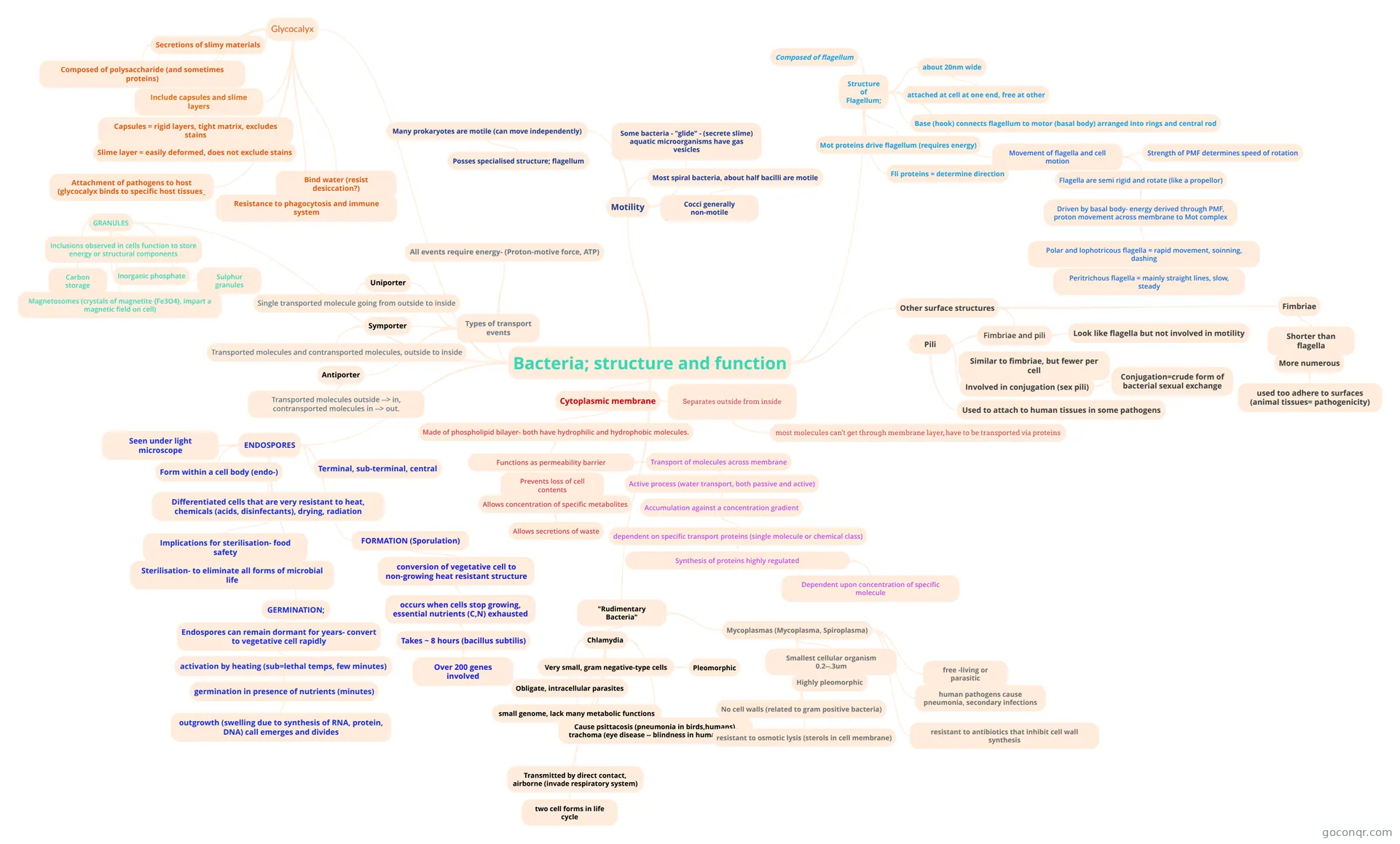
Mind map: Bacteria: structure and function
Contenido del mapa
Bacteria; structure and function
Cytoplasmic membrane
- Made of phospholipid bilayer- both have hydrophilic and hydrophobic molecules.
- Functions as permeability barrier
- Prevents loss of cell contents
- Allows concentration of specific metabolites
- Allows secretions of waste
- Allows concentration of specific metabolites
- Transport of molecules across membrane
- Active process (water transport, both passive and active)
- Accumulation against a concentration gradient
- dependent on specific transport proteins (single molecule or chemical class)
- Synthesis of proteins highly regulated
- Dependent upon concentration of specific molecule
- Synthesis of proteins highly regulated
- dependent on specific transport proteins (single molecule or chemical class)
- Accumulation against a concentration gradient
- Active process (water transport, both passive and active)
- Prevents loss of cell contents
- Functions as permeability barrier
- Separates outside from inside
- most molecules can't get through membrane layer, have to be transported via proteins
- Made of phospholipid bilayer- both have hydrophilic and hydrophobic molecules.
Types of transport events
- Uniporter
- Single transported molecule going from outside to inside
- Symporter
- Transported molecules and contransported molecules, outside to inside
- Antiporter
- Transported molecules outside --> in, contransported molecules in --> out.
- All events require energy- (Proton-motive force, ATP)
- Uniporter
Motility
- Many prokaryotes are motile (can move independently)
- Posses specialised structure; flagellum
- Most spiral bacteria, about half bacilli are motile
- Cocci generally non-motile
- Some bacteria - "glide" - (secrete slime) aquatic microorganisms have gas vesicles
- Many prokaryotes are motile (can move independently)
Structure of Flagellum;
- about 20nm wide
- attached at cell at one end, free at other
- Composed of flagellum
- Base (hook) connects flagellum to motor (basal body) arranged into rings and central rod
- Mot proteins drive flagellum (requires energy)
- Fli proteins = determine direction
- Movement of flagella and cell motion
- Flagella are semi rigid and rotate (like a propellor)
- Driven by basal body- energy derived through PMF, proton movement across membrane to Mot complex
- Polar and lophotricous flagella = rapid movement, soinning, dashing
- Peritrichous flagella = mainly straight lines, slow, steady
- Polar and lophotricous flagella = rapid movement, soinning, dashing
- Driven by basal body- energy derived through PMF, proton movement across membrane to Mot complex
- Strength of PMF determines speed of rotation
- Flagella are semi rigid and rotate (like a propellor)
- about 20nm wide
Other surface structures
- Fimbriae and pili
- Look like flagella but not involved in motility
- Pili
- Similar to fimbriae, but fewer per cell
- Involved in conjugation (sex pili)
- Conjugation=crude form of bacterial sexual exchange
- Used to attach to human tissues in some pathogens
- Fimbriae
- Shorter than flagella
- More numerous
- used too adhere to surfaces (animal tissues= pathogenicity)
- More numerous
- Shorter than flagella
- Fimbriae and pili
Glycocalyx
- Secretions of slimy materials
- Composed of polysaccharide (and sometimes proteins)
- Include capsules and slime layers
- Capsules = rigid layers, tight matrix, excludes stains
- Slime layer = easily deformed, does not exclude stains
- Attachment of pathogens to host (glycocalyx binds to specific host tissues_
- Resistance to phagocytosis and immune system
- Bind water (resist desiccation?)
- Secretions of slimy materials
GRANULES
- Inclusions observed in cells function to store energy or structural components
- Carbon storage
- Inorganic phosphate
- Sulphur granules
- Magnetosomes (crystals of magnetite {Fe3O4}, impart a magnetic field on cell)
ENDOSPORES
- Form within a cell body (endo-)
- Differentiated cells that are very resistant to heat, chemicals (acids, disinfectants), drying, radiation
- Implications for sterilisation- food safety
- Sterilisation- to eliminate all forms of microbial life
- Implications for sterilisation- food safety
- Seen under light microscope
- Terminal, sub-terminal, central
- FORMATION (Sporulation)
- conversion of vegetative cell to non-growing heat resistant structure
- occurs when cells stop growing, essential nutrients (C,N) exhausted
- Takes ~ 8 hours (bacillus subtilis)
- Over 200 genes involved
- Takes ~ 8 hours (bacillus subtilis)
- occurs when cells stop growing, essential nutrients (C,N) exhausted
- conversion of vegetative cell to non-growing heat resistant structure
- GERMINATION;
- Endospores can remain dormant for years- convert to vegetative cell rapidly
- activation by heating (sub=lethal temps, few minutes)
- germination in presence of nutrients (minutes)
- outgrowth (swelling due to synthesis of RNA, protein, DNA) call emerges and divides
- germination in presence of nutrients (minutes)
- activation by heating (sub=lethal temps, few minutes)
- Endospores can remain dormant for years- convert to vegetative cell rapidly
"Rudimentary Bacteria"
- Chlamydia
- Very small, gram negative-type cells
- Pleomorphic
- Obligate, intracellular parasites
- small genome, lack many metabolic functions
- Cause psittacosis (pneumonia in birds,humans), trachoma (eye disease -- blindness in humans), STIs
- Transmitted by direct contact, airborne (invade respiratory system)
- two cell forms in life cycle
- Very small, gram negative-type cells
- Mycoplasmas (Mycoplasma, Spiroplasma)
- Smallest cellular organism 0.2--.3um
- Highly pleomorphic
- No cell walls (related to gram positive bacteria)
- resistant to osmotic lysis (sterols in cell membrane)
- free -living or parasitic
- human pathogens cause pneumonia, secondary infections
- resistant to antibiotics that inhibit cell wall synthesis
- Smallest cellular organism 0.2--.3um
- Chlamydia
Información
- Descripción
- university the microbial world Mapa Mental sobre Bacteria; structure and function, creado por Giulia Sgro-Ralp el 28/03/2015.
- Creado por
- Giulia Sgro-Ralp
- Visitas
- 1
- Valoración