
Mapa mental
MODALS OF DEDUCTIONS
Contenido del mapa
MODALS OF DEDUCTIONS
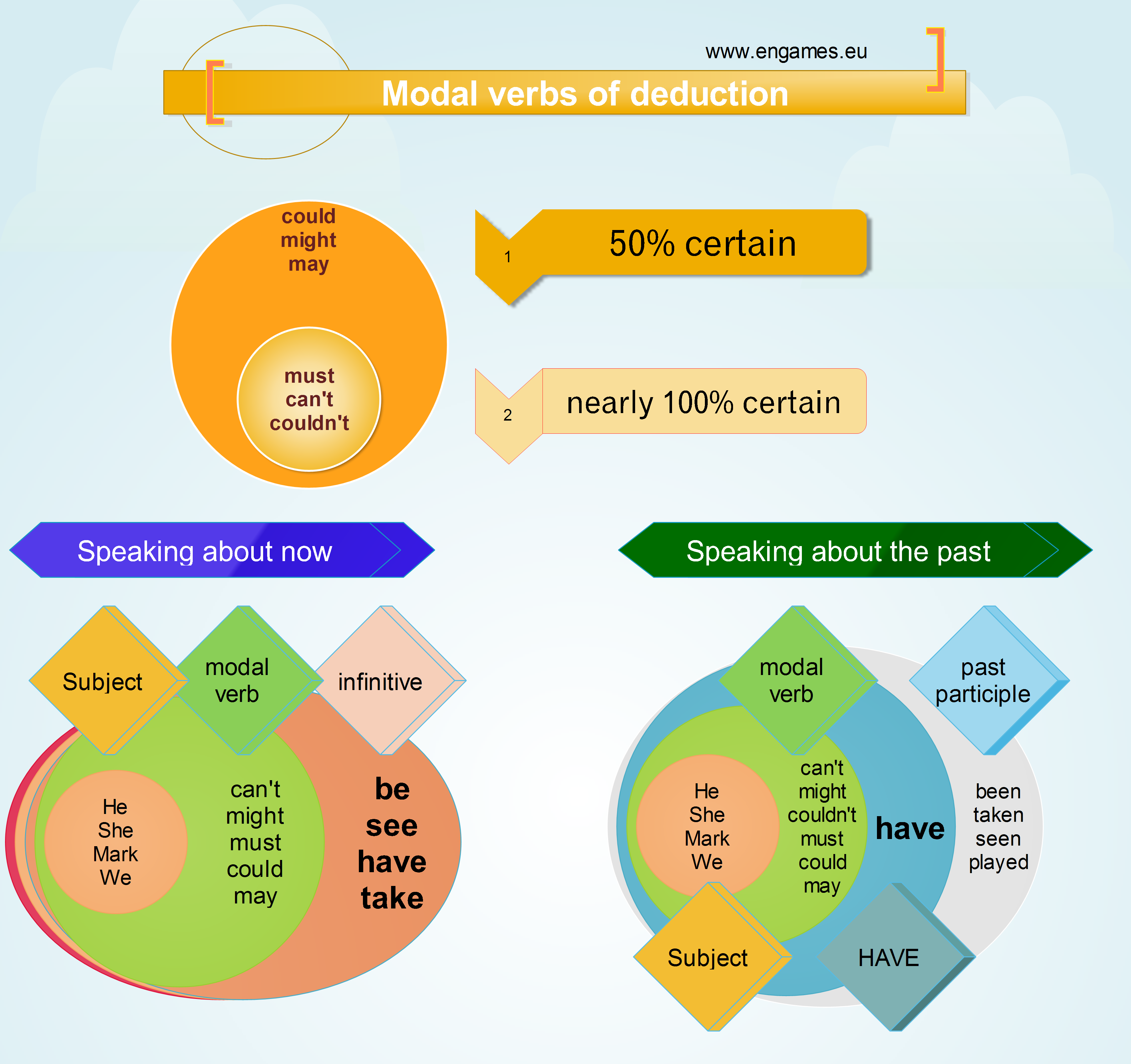
Some modal verbs can be used to express probability in the present and past.
Must, can't: expressing present probability
- We use must to express that we feel sure that something is true.
- The team is playing really well today; they must win.
- We use can't to say we are sure that something is impossible.
- She can't be so ill – I saw her playing volleyball yesterday.
- We use must to express that we feel sure that something is true.
We use might, may or could
- To say that we think something is possible but we’re not sure.
- They may be arriving tomorrow. He might be away on holiday at the moment. He could be away on holiday. He might get the job.
- The negative of may is may not. The negative of might is might not
- He might not get the job. I may not pass the exam. I might not go to the match tomorrow.
In Present
in Past
- In the same way that we use modal verbs to say how certain we are about things in the present we can also use them to speculate about the past.
- we are using deduction the form is MODAL + have +past participle
- Must have + past participle
- You must have been very pleased when you received the results of your exams.
- Might have/may have/could have + past participle
- He may have said he was coming but I can’t really remember. I wasn’t listening. I might have been here when I was a child but I can’t really remember.
- Can’t have + past participle
- You can’t have seen him this morning. He was with me all the time. She can’t have liked the show. She hates musicals.
- Must have + past participle
- we are using deduction the form is MODAL + have +past participle
- In the same way that we use modal verbs to say how certain we are about things in the present we can also use them to speculate about the past.
Imágenes y archivos del mapa
Información
- Descripción
- We use modal verbs to say how sure we are about something.
- Creado por
- tedretz
- Visitas
- 148
- Etiquetas
- Valoración