
Mapa mental
The Lucknow Pact
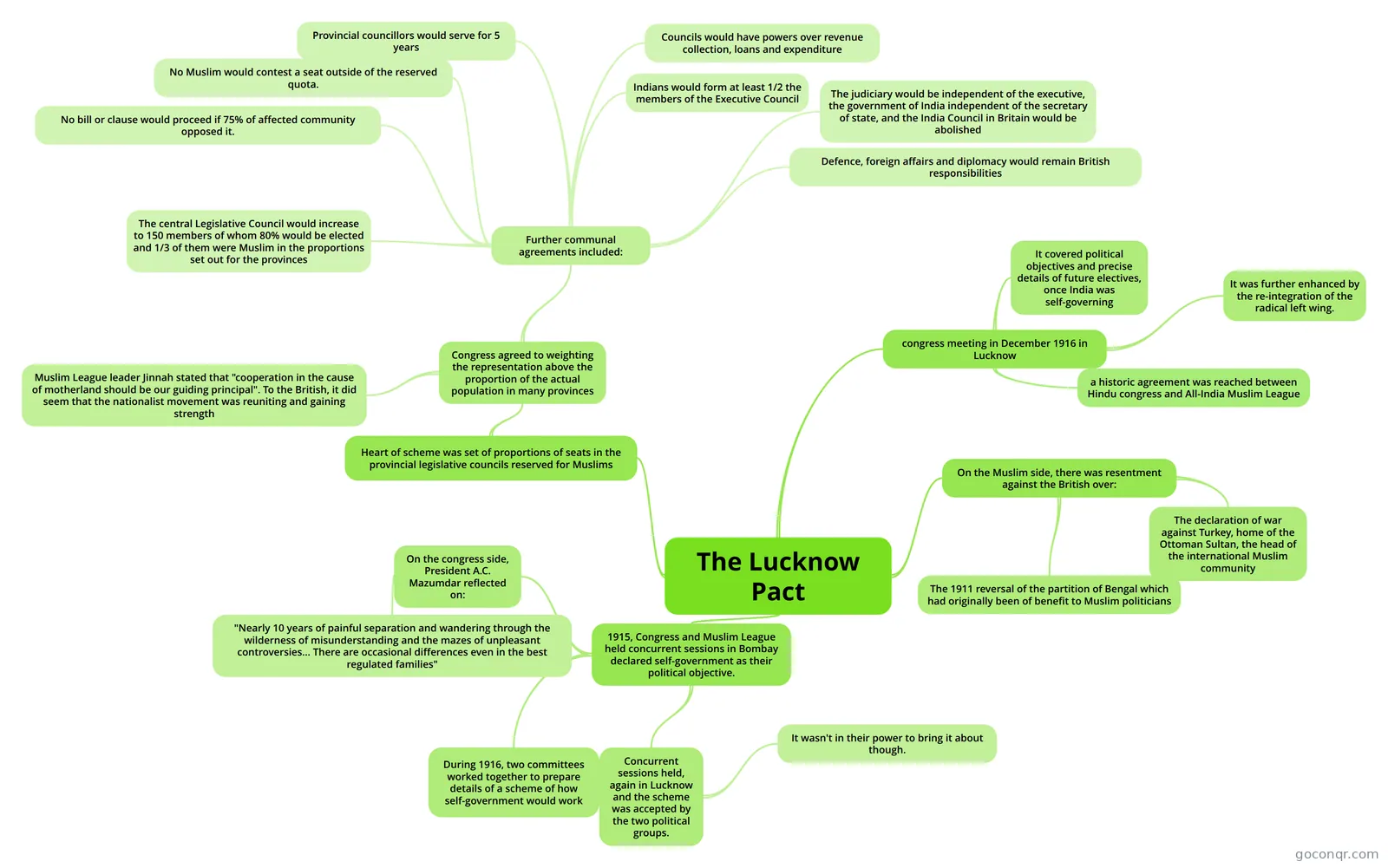
Mind map: The Lucknow Pact
Contenido del mapa
The Lucknow Pact
congress meeting in December 1916 in Lucknow
- a historic agreement was reached between Hindu congress and All-India Muslim League
- It covered political objectives and precise details of future electives, once India was self-governing
- It was further enhanced by the re-integration of the radical left wing.
On the Muslim side, there was resentment against the British over:
- The 1911 reversal of the partition of Bengal which had originally been of benefit to Muslim politicians
- The declaration of war against Turkey, home of the Ottoman Sultan, the head of the international Muslim community
1915, Congress and Muslim League held concurrent sessions in Bombay declared self-government as their political objective.
- On the congress side, President A.C. Mazumdar reflected on:
- "Nearly 10 years of painful separation and wandering through the wilderness of misunderstanding and the mazes of unpleasant controversies... There are occasional differences even in the best regulated families"
- During 1916, two committees worked together to prepare details of a scheme of how self-government would work
- Concurrent sessions held, again in Lucknow and the scheme was accepted by the two political groups.
- It wasn't in their power to bring it about though.
- On the congress side, President A.C. Mazumdar reflected on:
Heart of scheme was set of proportions of seats in the provincial legislative councils reserved for Muslims
- Congress agreed to weighting the representation above the proportion of the actual population in many provinces
- Further communal agreements included:
- No Muslim would contest a seat outside of the reserved quota.
- No bill or clause would proceed if 75% of affected community opposed it.
- The central Legislative Council would increase to 150 members of whom 80% would be elected and 1/3 of them were Muslim in the proportions set out for the provinces
- Provincial councillors would serve for 5 years
- Councils would have powers over revenue collection, loans and expenditure
- Indians would form at least 1/2 the members of the Executive Council
- The judiciary would be independent of the executive, the government of India independent of the secretary of state, and the India Council in Britain would be abolished
- Defence, foreign affairs and diplomacy would remain British responsibilities
- Muslim League leader Jinnah stated that "cooperation in the cause of motherland should be our guiding principal". To the British, it did seem that the nationalist movement was reuniting and gaining strength
- Further communal agreements included:
- Congress agreed to weighting the representation above the proportion of the actual population in many provinces
Información
- Descripción
- Mapa Mental sobre The Lucknow Pact, creado por ben hambidge el 15/10/2013.
- Creado por
- ben hambidge
- Visitas
- 284
- Valoración