
Mapa mental
Climate
Contenido del mapa
Climate
1. The atmosphere
- Layer of gases surrounding the Earth up to an altitude of more than 1 000 Km
- Climate and weather
- Weather is the state of the atmosphere at a particular time.. (this can change from one day to another
- CLimate iis the typical state of the atmosphere over a long period of time
- Different layers:
- Troposphere contains the 80% of all gases, Meteorogical phenomena takes place in this layer
- Stratosphere contains the ozone layer, so temperatures rise in the strastosphere
- Mesosphere has temperatures very low, they reach -140º C.
- Thermosphere, also called the ionosphere has temperatures very high
- Exosphere is the outer layer. Artificial satellites orbit the Earth in this layer
2. Temperature
- the amount of heat in the atmosphere, it is measured in degrees Centigrade.
- Factors which influence temperatura
- Latitude: temperatures are higher near the Equator
- ALtitude: Temperatures are usually higher in low Areas
- Distance from the sea: The sea makes coastal climates milder
- Climate zones
- Hot zone: between Tropic of Cancer and Tropic of Capricorn. There is very little difference between the seasons
- Temperate zones: between the Tropic and Polar Circles. temperatures are mild and vary with the seasons
- Cold zones: between the Polar Circles. Temperatures are always very low
3. Precipitation
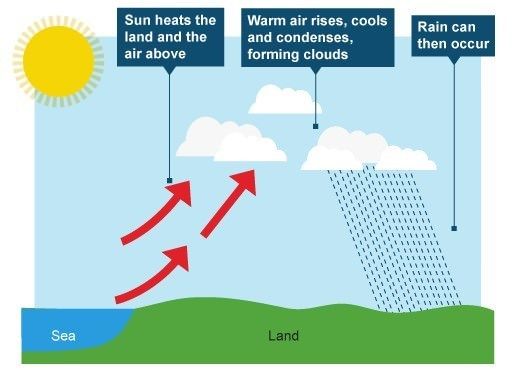
- What causes Precipitation? Humidity is the amount of water vapour in the air. It is caused by the evaporation of water. Then water wapour condenses, it becomes liquid and forms small drops form clouds
- Factors affecting orecipitation
- Latitude: In regions near the Equator than rains more because temperatures are higher near the Equator so water eevaporates rapidly
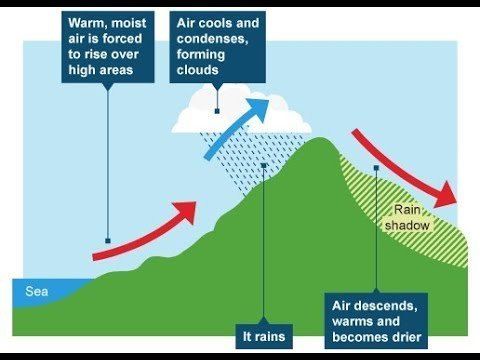
- Altitude: in the mountains rains more
- Humidity: on the cost rains more because oceans and seas are a source of humidity
- Types of rainfall
- Conventional rain is found in hot and temperate zones
- Orographic rain is found in mountainous regions
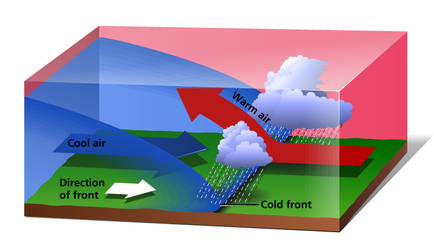
- Frontal rain occurs at the front between a mass of warm air and a mass of cold air
4. Atmospheric pressure and wind
- Atmospheric pressure is the weight of the air on the Earth´s surface.
- It varies according to altitude and temperature
- Altitude: Atmospheric pressure is lower in high, mountainous areas
- Temperatures: Hot air weighs less than cold air
- Pressure affects atmospheric conditions
- Anticyclones are arias of high pressure
- Depressions are areas of low pressure
- It varies according to altitude and temperature
- Wind is a mass of moving air, its measured in km/h by an anemometer
- There are different types of wind
- Prevailing winds always blow in the same direction
- There are also local winds
- Seasonal Winds change direction according to the season
- Some winds change direction dialy
- Prevailing winds always blow in the same direction
- There are different types of wind
- Weather maps shows Atmospheric pressure at sea lever
- A series of lines called isobars connect areas that have the sam,e atmospheric pressure
- The letter H shows high pressure area. The weather is usually stable and dry
- The letter L shows pressure area. There are often storms and rain
- Fronts are shown as continuous lines (Blue = cold fronts, Red = warm fronts) the wather is often unstable
- Atmospheric pressure is the weight of the air on the Earth´s surface.
5. The earth´s climates
- The earth has hot, temperate and cold climate zones however, different climates are found un each sone
- Hot climates
- Equatorial: Temperatures are high all year, precipitation regular and abundant
- Tropical: Temperatures are high all year, precipitation is abundant in the rainy season
- Hot desert: Temperatures are high and precipitation is very scarce
- Temperate climates
- Mediterranean: summers are hot and winters are mild, precipitation is irregular and mainly occurs in winter
- Oceanic: Temperatures are mild all year and precipitation is abundant
- Continental: summers are hot and winters are very cold, precipitation mainly occurs in the summer
- Cold climates
- Polar: Temperatures are ectremely low near the poles and the precipitation is very scarce, usually in form of snow
- Mountain: Tempertatures are low and precipitation is seasonal
Imágenes y archivos del mapa
Información
- Descripción
- 1º de ESO Geografia Mapa Mental sobre Climate, creado por Marvir 1515 el 06/02/2021.
- Creado por
- Marvir 1515
- Visitas
- 20
- Valoración