
Mapa mental
Group Technology
Contenido del mapa
Group Technology
- " GT is an approach to manufacturing that seeks to maximize production efficiencies by grouping similar and recurring problems or tasks" (Hyer & Wemmerlöv, 1985)
Essence of GT
- Performing similar activities together
- " thereby avoiding wasteful time in changing from one unrelated activity to the next." (Hyer & Wemmerlöv, 1985)
- Standardizing closely related activities
- " thereby focusing only on distinct differences and avoiding unnecessary duplication of effort." (Hyer & Wemmerlöv, 1985)
- Efficiently storing and retrieving information
- " thereby reducing the search time for the information and eliminating the need to solve the problem again." (Hyer & Wemmerlöv, 1985)
- Performing similar activities together
Classification & Coding
- determine similarities between items
- Similarities in shape
- Similarities in process
- Similarities in geometry
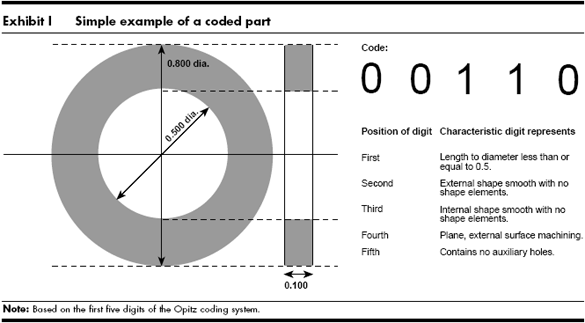
- Coded Part
- " the greatest potential of GT comes via a formal coding system in which each part gets a numeric or alphanumeric code describing the attributes of interest." (Hyer & Wemmerlöv, 1985)
- determine similarities between items
Applications
- production planning & control
- Cellular production
- " A cell is a collection of machine tools and materials-handling equipment grouped to process one or several part families." (Hyer & Wemmerlöv, 1985)
- Parts are completed within one cell.
- Reduce interference
- Improve quality
- Materials handling more efficient
- Trim inventories
- Reduce times
- Sequencing of parts families
- " This procedure, followed daily by foremen in most machine shops, often means overriding formal dispatch lists, which are made up with no consideration of efficiency." (Hyer & Wemmerlöv, 1985)
- Similar Features
- Reduces time on setup
- Use GT code
- Fewer interfering flows of material
- Setup time is reduced
- Quality improvement
- Cellular production
- Process planning
- Computer-aided process planning (CAPP)
- " Process planning normally is not a formal procedure. Each time a new part is designed, a process planner will look at the drawing and decide which machine tools should process the parts, which operations should be performed, and in what sequence." (Hyer & Wemmerlöv, 1985)
- Standardize process plans
- Reduce the number of process plans
- Obtain production plans easily
- 2 different forms
- Variant-based planning
- " one standardized plan (and possibly one or more alternate plans) is created and stored for each part family. When the planner enters the GT code for a part, the computer will retrieve the best process plan. If none exists, the computer will search for routings and operations sequences for similar parts. The planner can edit the scheme on the CRT screen before printout." (Hyer & Wemmerlöv, 1985)
- Generative planning
- "can but does not necessarily rely on coded and classified parts, the computer forms the process plan through a series of questions the computer poses on the screen. The end product is also a standardized process plan, which is the best plan for a particular part." (Hyer & Wemmerlöv, 1985)
- Variant-based planning
- Reduce Time
- Reduce Costs
- Computer-aided process planning (CAPP)
- Parts design
- " GT coding of parts is useful for the efficient retrieval of previous designs as well as for design standardization." (Hyer & Wemmerlöv, 1985)
- Help speed up the design process
- Reduce variations
- Purchasing area
- It provides statistics
- Reduce proliferation of purchases
- Sales area
- Turned up a substitute part
- Cost estimation
- production planning & control
Definition
- Philosophy grouping
- Missing link between CAD and CAM
- Important building block for CIM
- Philosophy grouping
Implemention
- Slow implementation
- Problems more commond
- Organizational change and associated human resistance
- Classification and coding of parts
- Planning and execution manufacturing cell
- Actions to implement
- Extensive education about GT
- Hands-on training
- Early involvement