
Mapa mental
Physics Unit 2
Contenido del mapa
Physics Unit 2
Using the Sun's energy
- The Sun is the ultimate source of loads of our energy
- The Sun has been giving out loads of energy-mostly heat and light
- Some of that energy is stored here on Earth as fossil fules
- We can also use photocells and solar heating
- You can capture the suns energy using photocells
- Photocells generate electricity directly from sunlight
- They generate diret current (DC)
- Direct current means the current flows the same round the circuit all the time
- Photocells are usually made of silicon
- The silicon atombs absorb some of the energy, knocking loose some electrons
- These electrons then flow round a circuit-which is electricity
- The current and power output of a photocell depends on
- It's surface area
- The bigger the cell the more electricity it produces
- The intensity of light
- brighter light=more electricity
- The distance from the light source
- The closer the cell, the more intense the light hitting it will be
- It's surface area
- Advantages
- There are no moving parts
- Sturdy, low maintenance and lasts a long time
- You don't need power cables or fuel
- Solar power won't run out and it does not pollute the enviroment
- Disadvantages
- No sunlight, no power
- Curved mirrors can concentrate energy from the sun
- The Sun is the ultimate source of loads of our energy
Solar and Wind power
- Passive solar heating
- PSH is when energy from the sun is used to heat something directly
- Glass lets heat and light in from the sun
- Wind Farms
- Lots of little wind turbines
- Uses wind to produce electricity
- Passive solar heating
Producing and Distributing Electricity
- The national grid connects power stations to consumers
- The national grid allows electricity to be supplied anywhere around the country
- There are different power sources
- Fossil Fules
- Produces a lot of energy
- Releases a lot of carbon-dioxide
- Biomass
- It is a renewable source
- You need a lot of it
- Nuclear Power
- Does not produce a lot of CO2
- Can make a lot of energy without producing a lot of CO2
- Risk of leaks and disasters
- Photo cells
- Advantages and disadvantages in Red
- Wind Power
- Cheap to run
- 1500 turbines=one coal powered stations
- Fossil Fules
- The national grid connects power stations to consumers
The Dynamo Effect
- Electromagnetic Induction
- The creation of a voltage in a wire which is experiencing a change in magnetic field
- Move the wire or the magnet
- Two ways to get EMI
- An electrical conductor (a coil of wire is used often) moves through a magnetic field
- The magnetic field through an electrical conductor changes (gets bigger, smaller or reverses
- To get a bigger voltage
- The strength of the magnet
- The umber of turns on the coil
- The speed of movement
- Two ways to get EMI
- Generators move a coil in a magnetic field
- Every half turn, the current in the coil swaps direction
- This means that generators produces an alternating current (AC)
- Turning the coil faster produces
- More pearks
- A higher voltage
- A higher current
- The frequency of AC is measured in Hz
- Electricity in the UK is 50 Hz
- Meaning that the coil is rotating 50 times per second
- Electricity in the UK is 50 Hz
- Turning the coil faster produces
- This means that generators produces an alternating current (AC)
- Every half turn, the current in the coil swaps direction
- Electromagnetic Induction
Supplying electricity efficiently
- Electricity is transformed to high voltage before distribution
- To transmit a lot of power you need
- A high voltage
- A high current
- But a high current means the cables get hot
- It is cheaper to increase the voltage
- To bring down voltage you need a step-down transformer (AC)
- This is why mains energy is AC so that transformers work
- To increase voltage you need a step-up transformer (AC)
- To bring down voltage you need a step-down transformer (AC)
- To transmit a lot of power you need
- Power stations aren't very efficient
- Power stations make a lot of waste energy
- Total Energy=Useful energy output + waste energy output
- Efficiency=Useful energy output/total energy input (x 100)
- Total Energy=Useful energy output + waste energy output
- Power stations make a lot of waste energy
- Electricity is transformed to high voltage before distribution
Electrical Power
- Running costs depend on an appliances power rating
- Power (W) = Voltage (V) x Current (A)
- Kilowatt-hours (kWh) are units of energy
- Energy Supplied (kwh) = Power (kW) x Time (H)
- Cost = number of units x price per unit
- kWh = amount of energy converted by 1 kW appliance left on for 1 hour
- Energy Supplied (kwh) = Power (kW) x Time (H)
- Off-peak electricity is cheaper
- Running costs depend on an appliances power rating
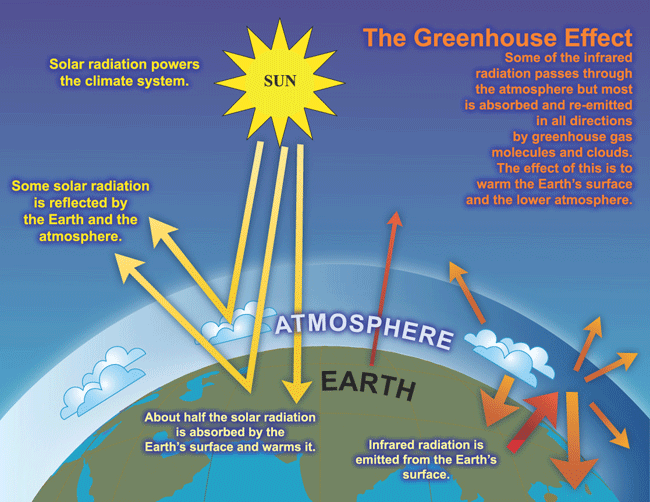
The green house effect
Global warming and climate change
- Upsetting the greenhouse effect has led to climate change
- Evidence shows that the rising of CO2 is causing global warming.
- There is a scientific consensus the humans are causing global warming
- Evidence shows that the rising of CO2 is causing global warming.
- Changes to the weather can have human and natural causes
- Changes in temperature can have large effects on weather
- Some crops won't be able to grow
- Changes in temperature can have large effects on weather
- Upsetting the greenhouse effect has led to climate change
Nuclear radiation
- Nuclear radiation causes ionisation
- Ionisation is when alpha, beta or gamma radiation hits atoms causing them to lose (positive) or gain (negative) electrons
- Alpha particles are big and heavy
- Strongly ionising
- Easily stopped
- Beta particles are electrons
- Moderately ionising
- Mediumly stopped
- Gamma rays are very high frequency electromagnetic waves
- Weakly ionising
- Hard to be stopped
- When radiation enters human skin it damages cells, can cause mutations
- Alpha particles are big and heavy
- Ionisation is when alpha, beta or gamma radiation hits atoms causing them to lose (positive) or gain (negative) electrons
- Nuclear radiation causes ionisation
Uses of nuclear radiation
- Alpha radiation is used in smoke detectors
- Beta radiation is used in tracers and thickness gauges
- Gamma radiation has medical and industrial uses
- Can treat cancers
- Sterilise medical instruments
- Non-destructive testing
Nuclear power
- Nuclear power uses Uranium as fuel
- Uranium atoms split in 2
- Water used as coolant to produce steam
- Steam powers turbine which produces kinetic energy
- This then goes into a generator which creates electrical energy
- Steam powers turbine which produces kinetic energy
- Water used as coolant to produce steam
- Uranium atoms split in 2
- Advantages
- Doesn't release alot of CO2
- Realises a lot of energy
- It is cheap
- Plenty of uranium left
- Disadvantages
- Expensive to build and maintain
- Expensive to decomision
- Longer to start up
- Risk of leaks
- Uranium non-renewable source
- Expensive to build and maintain
- Nuclear power uses Uranium as fuel
Danger from radioactive matirials
- You should always protect yourself
- Handle with tongs
- Store safely
- Keep at arms length
- Don't look at it
- Industrial workers have
- Full protective suits
- Lead-lined suits
- Lead/concrete barriers
- Thick lead screens
- Remote-control robot arms
- Radioactive waste is hard to dispose of
- High level
- Stored underground in glass cases
- Low level
- Put in land-fill sites
- High level
- You should always protect yourself
The Solar System
- Planets reflect sunlight and orbits the sun in ellipses
- Our star (the Sun) has lots of stuff orbiting it
- Mercury
- Venus
- Earth
- Mars
- Asteroids
- Jupiter
- Saturn
- Uranus
- Neptune
- Our star (the Sun) has lots of stuff orbiting it
- The solar system is held together by gravitational attraction
- Gravity pulls everything in the universe towards everything else
- Gravity makes things that are already moving change course
- Gravity pulls everything in the universe towards everything else
- Planets reflect sunlight and orbits the sun in ellipses
Asteroids and Comets
- There's a belt of asteroids orbiting between Jupiter and Mars
- When the solar system was formed the large rocks between Jupiter and Mars didn't form a planet as the large gravitational pull from Jupiter kept interfering
- This left millions of asteroids orbiting the sun between Mars and Jupiter
- Asteroids usually stay in their orbit but sometimes they are pushed or pulled into others
- When the solar system was formed the large rocks between Jupiter and Mars didn't form a planet as the large gravitational pull from Jupiter kept interfering
- Meteorites are rocks that have crashed down to Earth
- As the enter Earth's atmosphere they burn up
- These are known as shooting stars
- Sometimes, rarely, they don't burn up and they crash into the Earth's surface
- They can start fires, throw lots of hot rocks and dust into the air
- They make big holes in the ground called craters
- The dust and smoke can block out the sun for many months
- This causes climate change and can make animals extinct
- As the enter Earth's atmosphere they burn up
- Comets orbit the sun in very elliptical orbits
- Comets are balls of rock, dust and ice which orbit the Sun
- They come form objects orbiting around the sun way beyond the planets
- As comet approaches Sun, it's ice melts leaving a bright tail of gas and debris which can be millions of KM long
- This is what is seen from Earth
- Comets speed up when the get closer to the Sun as of it's gravitational pull
- As comet approaches Sun, it's ice melts leaving a bright tail of gas and debris which can be millions of KM long
- They come form objects orbiting around the sun way beyond the planets
- Comets are balls of rock, dust and ice which orbit the Sun
- There's a belt of asteroids orbiting between Jupiter and Mars
NEOs and the Moon
- Near-Earth objects could colloid with Earth
- NEOs are meteors or comets that are o course to crash into Earth
- Scientist calculate the trajectory of the NEO using powerful telescopes
- Small NEO are harmless but the big ones can make an explosion bigger than a nuclear bomb
- We could tr to deflect the NEO using a bomb to nudge it off course
- Small NEO are harmless but the big ones can make an explosion bigger than a nuclear bomb
- Scientist calculate the trajectory of the NEO using powerful telescopes
- NEOs are meteors or comets that are o course to crash into Earth
- The moon may have come from a colliding planet
- Scientist think the moon came from another planet colliding with the Earth soon after the planet was formed
- In the collision it is believed the Earth core was created when the planets collided
- The less dense material was ejected as really hot dust and rocks which orbited the Earth eventually came together to form the Moon
- Evidence to support this
- The Moon has a lower density than the Earth
- It does not have an iron core
- Moon rock contains few substances which evaporate at low temperatures
- Suggesting that the moon was made from hot matirials
- Evidence to support this
- The less dense material was ejected as really hot dust and rocks which orbited the Earth eventually came together to form the Moon
- In the collision it is believed the Earth core was created when the planets collided
- Scientist think the moon came from another planet colliding with the Earth soon after the planet was formed
- Near-Earth objects could colloid with Earth
Beyond the Solar System
- We're in the Milky Way Galaxy
- Our Sun only one of millions of stars in the Milky Way
- Gravity keeps Galaxies together
- The Universe has more than a billion Galaxies
- Distances in space are measured in Light Years
- Km are hard to measure between Galaxies
- Scientists use light years
- Light Years=The distance light travels through a vacuum in a year
- Scientists use light years
- Km are hard to measure between Galaxies
- Stars can explode and sometimes leave behind black holes
- When a big star runs out of fuel it explodes and what is left it really dense
- Sometimes it is so dense nothing can escape it's gravitational pull.
- This is called a black hole
- Black holes have a
- Large mass
- Small volume
- Very high density
- They are not visible not even light can escape it
- Sometimes it is so dense nothing can escape it's gravitational pull.
- When a big star runs out of fuel it explodes and what is left it really dense
- We're in the Milky Way Galaxy
The origin of the Universe
- The universe seems to expanding because of redshift
- Red shift is when scientists look at what colour galaxies are and this determines how far away it is using the visible light spectrum
- The further away the galaxy is the more red it is
- There are microwave radiation everywhere-it is known as cosmic background radiation
- As the universe and cools, the background cools and drops in frequency
- The universe started with the big bang
- This is when all that was in the universe was all gathered in one small space
- It then exploded and started expanding and the expansion continues
- The big bang allows us to see how old the Universe is
- It is about 14 billion years old
- It is hard to estimate as it is hard to tell the change in the speed of expansion since the start
- The big bang allows us to see how old the Universe is
- It then exploded and started expanding and the expansion continues
- This is when all that was in the universe was all gathered in one small space
- Red shift is when scientists look at what colour galaxies are and this determines how far away it is using the visible light spectrum
- The universe seems to expanding because of redshift
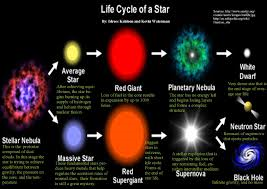
The life cycle of stars
Exploring the solar system
- We can explore space using manned spacecraft
- The solar system is big
- Sending a manned spacecraft to Mars would take years
- It would have to carry
- A lot of fuel
- This makes it heavy and expensive
- Lots of food, water and oxygen
- To keep the astronauts alive and healty
- A sheild
- To protect the astronauts from radiation
- A lot of fuel
- The astronauts will lose bone tissue and muscle wasteage from the low gravity
- A tiny area with the same people could become stressful
- It would have to carry
- Sending a manned spacecraft to Mars would take years
- The solar system is big
- Sending unmanned probes is much easier
- Advantages
- They don't have to carry food, water and oxygen
- Can withstand conditions that humans can't
- Without people, more instruments can be fitted
- They're cheaper
- No one gets hurt if the probe burns up in the atmosphere
- Disadvantages
- They can't think for themselves
- A spacecraft can't do maintenance and repairs-people can
- Advantages
- We can explore space using manned spacecraft
Galileo and Copernicus
- Ancient Greeks thought the Earth was at the centure of the Universe
- Most Ancient Greeks believed the Sun, man and other planets and stars all orbited Earth in perfect circles
- The Ptolemaic model was the model of the Universe of the Ancient Greeks until the 1500s
- Most Ancient Greeks believed the Sun, man and other planets and stars all orbited Earth in perfect circles
- Copernican Model
- This model states that Earth and the planets orbit around the sun, which is at the centre of our Universe
- The idea had been around for 2000 years but it was first published in 1543 in a book by Copernicus
- Galileo noticed that Venus has phases-where the amount off the planet that was lit by the Sun seemed to change over time
- Copernicans' ideas weren't very popular as the others had been their for a long time
- The model was also condemned b the church. They claimed that the model went against the bible, and said that Earth was at the centre of the universe
- Evidence for Copernican model increased thanks to more technological advances
- The current model says that the planets still orbit the sun but these orbit are elliptical rather than circular
- Evidence for Copernican model increased thanks to more technological advances
- The model was also condemned b the church. They claimed that the model went against the bible, and said that Earth was at the centre of the universe
- Copernicans' ideas weren't very popular as the others had been their for a long time
- Galileo noticed that Venus has phases-where the amount off the planet that was lit by the Sun seemed to change over time
- The idea had been around for 2000 years but it was first published in 1543 in a book by Copernicus
- Galileo fond one of the best pieces of evidence for this theory
- Galileo was observing Jupiter using a telescope when he saw some stars in a line near the planet
- He looked again and sore that these stars never moved away from Jupiter and seemed to be carried along with the planet
- This suggested they weren't stars but moons orbiting Jupiter
- This showed not everything orbits around the Earth
- This suggested they weren't stars but moons orbiting Jupiter
- He looked again and sore that these stars never moved away from Jupiter and seemed to be carried along with the planet
- Galileo was observing Jupiter using a telescope when he saw some stars in a line near the planet
- This model states that Earth and the planets orbit around the sun, which is at the centre of our Universe
- Ancient Greeks thought the Earth was at the centure of the Universe
Imágenes y archivos del mapa
Información
- Descripción
- All the areas of Physics Unit 2
- Creado por
- Michael Maidment
- Visitas
- 25
- Etiquetas
- Valoración