
Mapa mental
Q1: How do people learn?
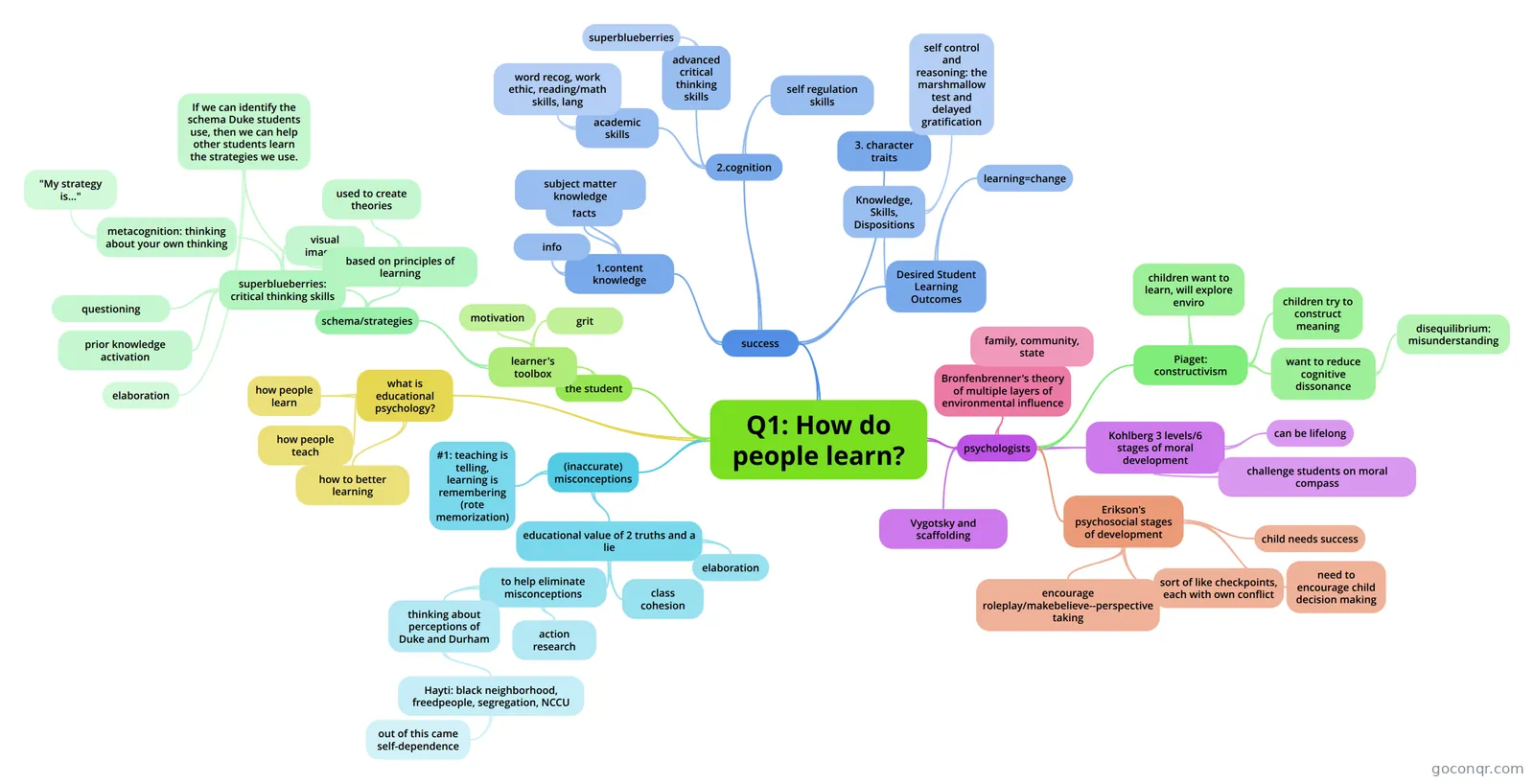
Mind map: how do people learn
Contenido del mapa
Q1: How do people learn?
the student
- learner's toolbox
- schema/strategies
- superblueberries: critical thinking skills
- metacognition: thinking about your own thinking
- "My strategy is..."
- questioning
- prior knowledge activation
- visual imagery
- metacognition: thinking about your own thinking
- based on principles of learning
- If we can identify the schema Duke students use, then we can help other students learn the strategies we use.
- elaboration
- used to create theories
- If we can identify the schema Duke students use, then we can help other students learn the strategies we use.
- superblueberries: critical thinking skills
- motivation
- grit
- schema/strategies
- learner's toolbox
(inaccurate) misconceptions
- #1: teaching is telling, learning is remembering (rote memorization)
- educational value of 2 truths and a lie
- to help eliminate misconceptions
- thinking about perceptions of Duke and Durham
- Hayti: black neighborhood, freedpeople, segregation, NCCU
- out of this came self-dependence
- Hayti: black neighborhood, freedpeople, segregation, NCCU
- action research
- thinking about perceptions of Duke and Durham
- class cohesion
- elaboration
- to help eliminate misconceptions
success
- 1.content knowledge
- info
- facts
- subject matter knowledge
- 2.cognition
- academic skills
- word recog, work ethic, reading/math skills, lang
- advanced critical thinking skills
- superblueberries
- self regulation skills
- academic skills
- 3. character traits
- Desired Student Learning Outcomes
- Knowledge, Skills, Dispositions
- self control and reasoning: the marshmallow test and delayed gratification
- learning=change
- Knowledge, Skills, Dispositions
- 1.content knowledge
psychologists
- Bronfenbrenner's theory of multiple layers of environmental influence
- family, community, state
- Erikson's psychosocial stages of development
- sort of like checkpoints, each with own conflict
- need to encourage child decision making
- encourage roleplay/makebelieve--perspective taking
- child needs success
- Vygotsky and scaffolding
- Piaget: constructivism
- children want to learn, will explore enviro
- children try to construct meaning
- want to reduce cognitive dissonance
- disequilibrium: misunderstanding
- Kohlberg 3 levels/6 stages of moral development
- can be lifelong
- challenge students on moral compass
- Bronfenbrenner's theory of multiple layers of environmental influence
what is educational psychology?
- how people learn
- how people teach
- how to better learning
Información
- Descripción
- Mapa Mental sobre Q1: How do people learn?, creado por leslieniiro el 28/10/2013.
- Creado por
- leslieniiro
- Visitas
- 179
- Valoración