
Mapa mental
Bone
Contenido del mapa
Bone
A highly vascular connective tissue made of specialised cells in a matrix composed of minerals, water and protein fibres.
2 types
- Compact (dense)
- Forms the surface layers of mature bones
- found mainly in shafts of long bones (where strong, tubular structure is required)
- consists of a no. of cylindrical structures called haversian systems (or osteons) which contain:
- a central haversian canal
- lamellae
- lacunae
- canaliculi
- interstitial lamellae
- circumferential lamellae
- Volkmann's canals
- periosteum
- Cancellous (spongy)
- found in parts of bone where lightness, strength and area are required
- has trabeculae instead of osteons
- plates and bars of bones arranged in a haphazard manner
- organised to provide max strength
- follow lines of stress and can realign if direction of stress changes
- contain: lamellae, osteocytes, lacunae and canaliculi
- canaliculi connect to adjacent cavities instead of a central canal
- BONE MARROW found between trabeculae
- at birth it is red and produces cells in the blood e.g. RBCs, WBCs.
- in adults, red found in: upper femora, vertebrae, scapulae, sternum, clavicles, diploe of skull bones and hip bones.
- elsewhere, red becomes inactive yellow marrow
- Compact (dense)
OSSIFICATION - Formation of bone from connective tissue and requires: adequate calcium and phosphate in blood and vitamins A, C and D.
- influenced by hormones: parathormone, growth hormone, thyroxine and testosterone
- intramembranous - takes place in a membrane
- osteogenic fibres and bone cells appear in the connective tissue and calcium salts deposited to form osteoid tissue
- ossification spreads from the centre outwards
- intracartilaginous
- process by which bone formation takes place e.g. in a long bone
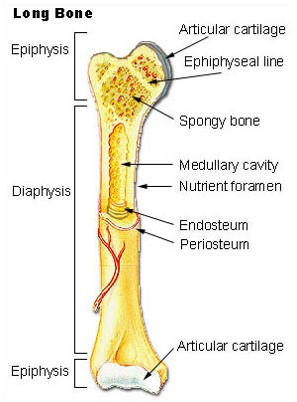
- Primary centre of ossification - middle of diaphysis, osteoblast appear and calcium is laid down, osteoclasts remodel bone into required shape, bone is also being built up on outside of shaft to form periosteum
- Secondary centre of ossification - appears at end of bone to form epiphyses (which are separated from diaphysis by epiphyseal plate
- Growth - occurs during childhood by production of bone at epiphyseal plate nearest shaft - metaphysis.
- Fusion- of epiphysis with diaphysis occurs when bone reaches desired size (approx. 20 years)
- Growth - occurs during childhood by production of bone at epiphyseal plate nearest shaft - metaphysis.
- Secondary centre of ossification - appears at end of bone to form epiphyses (which are separated from diaphysis by epiphyseal plate
- Primary centre of ossification - middle of diaphysis, osteoblast appear and calcium is laid down, osteoclasts remodel bone into required shape, bone is also being built up on outside of shaft to form periosteum
- process by which bone formation takes place e.g. in a long bone
Functions
- Shape
- Protection
- Movement
- Sound transduction
- Production of RBCs- haematopoiesis
- Mineral storage
- Growth factor storage
- Fat storage
Types of cells within bone
- Osteogenic cell - found in inner layer of periosteum - develops into osteoblasts
- Osteoblast - forms bone matrix
- Osteocyte - mature bone cell which maintains bone tissue
- Osteoclast - functions in bone resorption and remodelling
- Bone tissue is maintained by a balance between the activity of osteoblasts that form bone and osteoclasts that break it down - remodelling
BLOOD SUPPLY
- Periosteum has arteries which supply it and also enter the diaphysis through many perforating Volkmann's canals - this supplies the outer part of compact bone
- A hole in compact bone (nutrient foramen) allows passage of nutrient artery into medullary cavity
- Divisions supply inner part of compact bone, spongy bone and red marrow
- nutrient arteries divide into ascending and descending branches in medullary cavity
- some bones have 1 nutrient artery (tibia) and some have several (femur)
- nerves also pass through same nutrient foramen
- broken bones are very painful as periosteum is richly supplied with nerves
- A hole in compact bone (nutrient foramen) allows passage of nutrient artery into medullary cavity
- Periosteum has arteries which supply it and also enter the diaphysis through many perforating Volkmann's canals - this supplies the outer part of compact bone
Imágenes y archivos del mapa
Información
- Descripción
- (Fundamentals of Human Anatomy and Physiology) Mapa Mental sobre Bone, creado por Amber Basra el 02/11/2013.
- Creado por
- Amber Basra
- Visitas
- 454
- Etiquetas
- Valoración