
Mapa mental
Models of Development
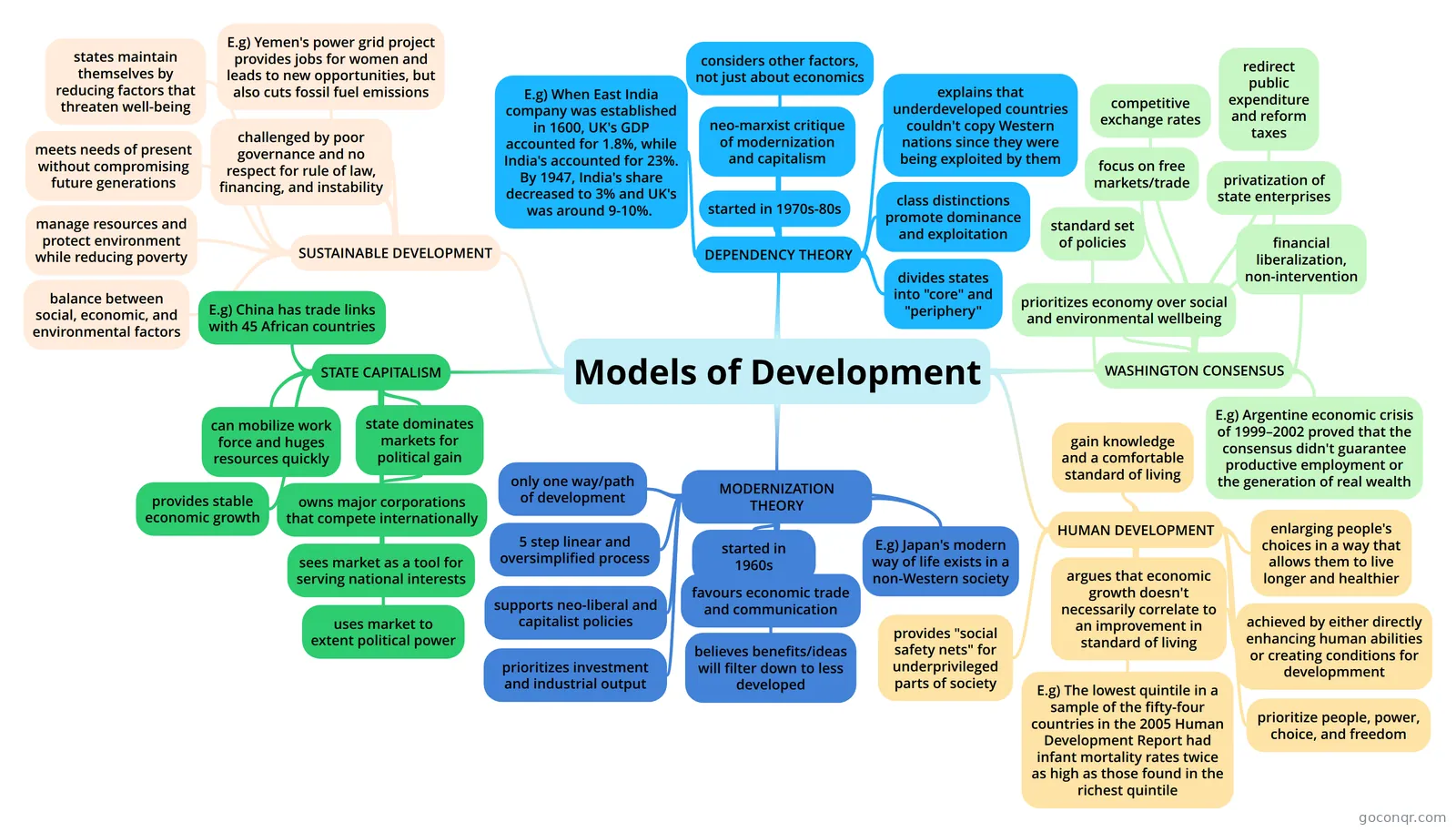
Mind map: Models of development
Contenido del mapa
Models of Development
MODERNIZATION THEORY
- 5 step linear and oversimplified process
- only one way/path of development
- supports neo-liberal and capitalist policies
- prioritizes investment and industrial output
- favours economic trade and communication
- believes benefits/ideas will filter down to less developed
- started in 1960s
- E.g) Japan's modern way of life exists in a non-Western society
DEPENDENCY THEORY
- neo-marxist critique of modernization and capitalism
- considers other factors, not just about economics
- divides states into "core" and "periphery"
- class distinctions promote dominance and exploitation
- explains that underdeveloped countries couldn't copy Western nations since they were being exploited by them
- started in 1970s-80s
- E.g) When East India company was established in 1600, UK's GDP accounted for 1.8%, while India's accounted for 23%. By 1947, India's share decreased to 3% and UK's was around 9-10%.
WASHINGTON CONSENSUS
- prioritizes economy over social and environmental wellbeing
- standard set of policies
- focus on free markets/trade
- privatization of state enterprises
- competitive exchange rates
- redirect public expenditure and reform taxes
- financial liberalization, non-intervention
- E.g) Argentine economic crisis of 1999–2002 proved that the consensus didn't guarantee productive employment or the generation of real wealth
STATE CAPITALISM
- state dominates markets for political gain
- owns major corporations that compete internationally
- sees market as a tool for serving national interests
- uses market to extent political power
- provides stable economic growth
- can mobilize work force and huges resources quickly
- E.g) China has trade links with 45 African countries
- state dominates markets for political gain
HUMAN DEVELOPMENT
- E.g) The lowest quintile in a sample of the fifty-four countries in the 2005 Human Development Report had infant mortality rates twice as high as those found in the richest quintile
- enlarging people's choices in a way that allows them to live longer and healthier
- gain knowledge and a comfortable standard of living
- prioritize people, power, choice, and freedom
- achieved by either directly enhancing human abilities or creating conditions for developmment
- argues that economic growth doesn't necessarily correlate to an improvement in standard of living
- provides "social safety nets" for underprivileged parts of society
SUSTAINABLE DEVELOPMENT
- E.g) Yemen's power grid project provides jobs for women and leads to new opportunities, but also cuts fossil fuel emissions
- manage resources and protect environment while reducing poverty
- meets needs of present without compromising future generations
- states maintain themselves by reducing factors that threaten well-being
- balance between social, economic, and environmental factors
- challenged by poor governance and no respect for rule of law, financing, and instability
Información
- Descripción
- IBDP Global Politics Mapa Mental sobre Models of Development, creado por lisa he el 28/09/2021.
- Creado por
- lisa he
- Visitas
- 1
- Valoración