
Mapa mental
Assignment TOC
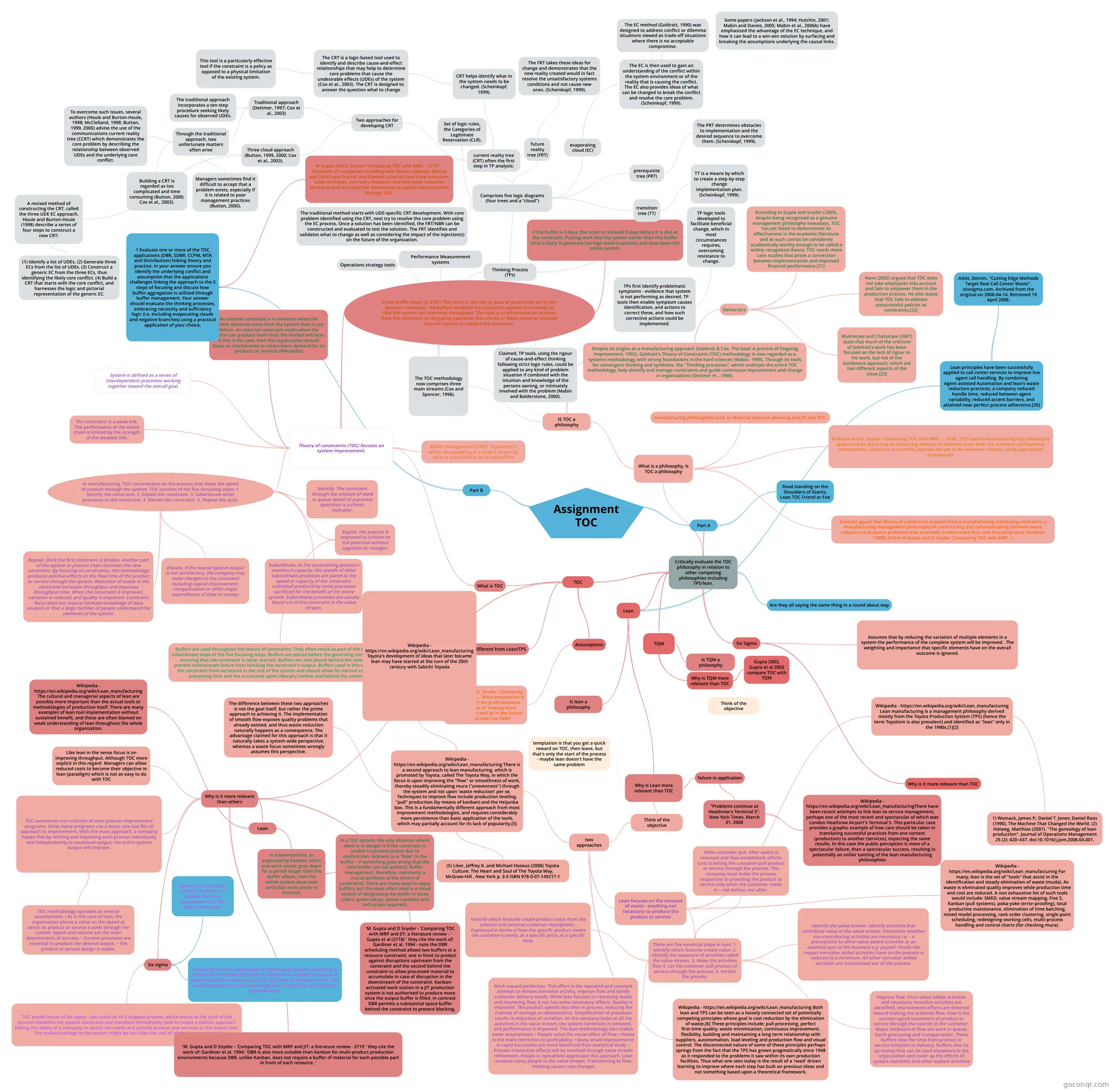
Mind map: Theory of Constraints assignment
Contenido del mapa
Assignment TOC
Part A
- Critically evaluate the TOC philosophy in relation to other competing philosophies including TPS/lean.
- TOC
- What is TOC
- Theory of constraints (TOC) focuses on system improvement.
- The constraint is a weak link. The performance of the entire chain is limited by the strength of the weakest link.
- In manufacturing, TOC concentrates on the process that slows the speed of product through the system. TOC consists of the five focussing steps: 1. Identify the constraint. 2. Exploit the constraint. 3. Subordinate other processes to the constraint. 4. Elevate the constraint. 5. Repeat the cycle.
- Identify. The constraint through the amount of work in queue ahead of a process operation is a classic indicator.
- Exploit. the process is improved to achieve its full potential without upgrades or changes.
- Buffers are used throughout the theory of constraints. They often result as part of the exploit and subordinate steps of the five focusing steps. Buffers are placed before the governing constraint, thus ensuring that the constraint is never starved. Buffers are also placed behind the constraint to prevent downstream failure from blocking the constraint's output. Buffers used in this way protect the constraint from variations in the rest of the system and should allow for normal variation of processing time and the occasional upset (Murphy) before and behind the constraint.
- Subordinate. At the constraining process's maximum capacity, the speeds of other subordinate processes are paced to the speed or capacity of the constraint. individual productivity some processes sacrificed for the benefit of the entire system. Subordinate processes are usually found u/s of the constraint in the value stream.
- Elevate. If the overall system output is not satisfactory, the company may make changes to the constraint including capital improvement, reorganization or other major expenditures of time or money.
- Repeat. Once the first constraint is broken, another part of the system or process chain becomes the new constraint. By focusing on constraints, this methodology produces positive effects on the flow time of the product or service through the system. Reduction of waste in the constraint increases throughput and improves throughput time. When the constraint is improved, variation is reduced, and quality is improved. Constraint focus does not require intimate knowledge of data analysis or that a large number of people understand the elements of the system.
- An internal constraint is in evidence when the market demands more from the system than it can deliver. An external constraint exists when the system can produce more than the market will bear. If this is the case, then the organization should focus on mechanisms to create more demand for its products or services.(Wikipedia)
- Drum-Buffer-Rope: (p 3707) 'The drum is the rate or pace of production set by the systme's constraint. the buffers establish the protection against uncertainty so that the system can maximise throughput. The rope is a communication process from the constraint to the gating operation that checks or limits material released into the system to support the constraint.
- if the buffer is 5 days, the order is released 5 days before it is due at the constraint. Putting work into the system earlier than this buffer time is likely to generate too-high work-in-process and slow down the entire system.
- System is defined as a series of interdependent processes working together toward the overall goal.
- Buffer management (3707) ' A process in which all expediting in a shop is driven by what is scheduled to be in the buffers
- Theory of constraints (TOC) focuses on system improvement.
- Why is it more relevant than others
- Like lean in the sense focus is on improving throughput. Although TOC more explicit in this regard. Managers can allow reduced costs to become their objective in lean (paradigm) which is not as easy to do with TOC
- TOC overcomes one criticism of most process improvement programs: thhat many programs use a mass, one size fits all approach to improvement. With the mass approach, a company hopes that by refining and improving each process individually and independently to maximum output, the entire system output will improve.
- TOC methodology operates on several assumptions: • As in the case of lean, the organization places a value on the speed at which its product or service travels through the system. Speed and volume are the main determinants of success. • Current processes are essential to produce the desired output. • The product or service design is stable.
- Six sigma
- Ignores the economic reality of business: to achieve the most improvement for the least investment.
- TOC avoids issues of six sigma - discussed as its 5 stepped process, which would at the start of the process identifies the system constraint and therefore immediately seek to create a holistic approach linking the ability of a company to satisfy the needs and provide product and services at the lowest cost. The realised savings to the system might be less than the cost of all the improvements
- Improving all of an organization’s individual processes could have a detriment the company’s ability to satisfy the customer’s needs and provide product and services at the right time at the lowest cost. The realized savings to the system might be less than the cost of all the improvements.
- Lean
- In a balanced line, as espoused by Kanban, when one work center goes down for a period longer than the buffer allows, then the entire system must wait until that work center is restored.
- In a TOC system, the only situation where work is in danger is if the constraint is unable to process (either due to malfunction, sickness or a "hole" in the buffer – if something goes wrong that the time buffer can not protect). Buffer management, therefore, represents a crucial attribute of the theory of constraints. There are many ways to apply buffers, but the most often used is a visual system of designating the buffer in three colors: green (okay), yellow (caution) and red (action required).
- Wikipedia - https://en.wikipedia.org/wiki/Lean_manufacturing The cultural and managerial aspects of lean are possibly more important than the actual tools or methodologies of production itself. There are many examples of lean tool implementation without sustained benefit, and these are often blamed on weak understanding of lean throughout the whole organization.
- In a balanced line, as espoused by Kanban, when one work center goes down for a period longer than the buffer allows, then the entire system must wait until that work center is restored.
- 'M. Gupta and D Snyder - 'Comparing TOC with MRP and JIT: a literature review - ' Gupta et al (3718) ' they cite the work of: Gardiner et al. 1994 - note the DBR scheduling method allows two buffers at a resource constraint; one in front to protect against disruptions upstream from the constraint and the second behind the constraint to allow processed material to accumulate in case of disruption in the downstream of the constraint. Kanban- activated work station in a JIT production system is not authorised to produce more once the output buffer is filled, in contrast DBR permits a substantial space buffer behind the constraint to prevent blocking.
- 'M. Gupta and D Snyder - 'Comparing TOC with MRP and JIT: a literature review - 3719 ' they cite the work of: Gardiner et al. 1994: 'DBR is also more suitable than Kanban for multi-product production environments because DBR, unlike Kanban, does not require a buffer of material for each possible part in front of each resource. '
- How is it different from Lean/TPS
- Assumptions
- M Gupta and D. Snyder 'Comparing TOC with MRP...' Main assumption is that for every for-profit business has the goal of 'making more money now as well as in the future' (Goldratt and Cox 1984)
- What is TOC
- Lean
- Why is Lean more relevant than TOC
- temptation is that you get a quick reward on TOC, then leave, but that's only the start of the process - maybe lean doesn't have the same problem
- Think of the objective
- two approaches
- Lean focuses on the removal of waste - anything not necessary to produce the product or service
- There are five essential steps in lean: 1. Identify which features create value. 2. Identify the sequence of activities called the value stream. 3. Make the activities flow 4. Let the customer pull product or service through the process. 5. Perfect the process.
- Allow customer pull. After waste is removed and flow established, efforts turn to letting the customer pull product or service through the process. The company must make the process responsive to providing the product or service only when the customer needs it— not before, not after.
- Improve flow. Once value added activities and necessary nonvalue activities are identified, improvement efforts are directed toward making the activities flow. Flow is the uninterrupted movement of product or service through the system to the customer. Major inhibitors of flow are work in queue, batch processing and transportation. These buffers slow the time from product or service initiation to delivery. Buffers also tie up money that can be used elsewhere in the organization and cover up the effects of system restraints and other wasted activities
- Identify which features create product value from the internal and external customer standpoints . Expressed in terms of how the specific product meets the customer’s needs, at a specific price, at a specific time.
- Identify the value stream. Identify activities that contribute value in the value stream. Determine whether non-contributing activities are necessary i.e. - a prerequisite to other value added activities or an essential part of the business e.g: payroll. Finally the impact nonvalue added activities have on the process is reduced to a minimum. All other nonvalue added activities are transitioned out of the process.
- Work toward perfection. This effort is the repeated and constant attempt to remove nonvalue activity, improve flow and satisfy customer delivery needs. While lean focuses on removing waste and improving flow, it too has some secondary effects. Quality is improved. The product spends less time in process, reducing the chances of damage or obsolescence. Simplification of processes results in reduction of variation. As the company looks at all the activities in the value stream, the system constraint is removed, and performance is improved. The lean methodology also makes some assumptions: • People value the visual effect of flow. • Waste is the main restriction to profitability. • Many small improvements in rapid succession are more beneficial than analytical study. • Process interaction effects will be resolved through value stream refinement. People in operations appreciate this approach. Lean involves many people in the value stream. Transitioning to flow thinking causes vast changes
- Wikipedia - https://en.wikipedia.org/wiki/Lean_manufacturing Lean manufacturing is a management philosophy derived mostly from the Toyota Production System (TPS) (hence the term Toyotism is also prevalent) and identified as "lean" only in the 1990s.[1][2]
- 1) Womack, James P.; Daniel T. Jones; Daniel Roos (1990). The Machine That Changed the World. (2) Holweg, Matthias (2007). "The genealogy of lean production". Journal of Operations Management 25 (2): 420–437. doi:10.1016/j.jom.2006.04.001.
- Wikipedia - https://en.wikipedia.org/wiki/Lean_manufacturing For many, lean is the set of "tools" that assist in the identification and steady elimination of waste (muda). As waste is eliminated quality improves while production time and cost are reduced. A non exhaustive list of such tools would include: SMED, value stream mapping, Five S, Kanban (pull systems), poka-yoke (error-proofing), total productive maintenance, elimination of time batching, mixed model processing, rank order clustering, single point scheduling, redesigning working cells, multi-process handling and control charts (for checking mura).
- There are five essential steps in lean: 1. Identify which features create value. 2. Identify the sequence of activities called the value stream. 3. Make the activities flow 4. Let the customer pull product or service through the process. 5. Perfect the process.
- Wikipedia - https://en.wikipedia.org/wiki/Lean_manufacturing There is a second approach to lean manufacturing, which is promoted by Toyota, called The Toyota Way, in which the focus is upon improving the "flow" or smoothness of work, thereby steadily eliminating mura ("unevenness") through the system and not upon 'waste reduction' per se. Techniques to improve flow include production leveling, "pull" production (by means of kanban) and the Heijunka box. This is a fundamentally different approach from most improvement methodologies, and requires considerably more persistence than basic application of the tools, which may partially account for its lack of popularity.[5]
- (5) Liker, Jeffrey K. and Michael Hoseus (2008) Toyota Culture: The Heart and Soul of The Toyota Way, McGraw-Hill , New York p. 3-5 ISBN 978-0-07-149217-1
- The difference between these two approaches is not the goal itself, but rather the prime approach to achieving it. The implementation of smooth flow exposes quality problems that already existed, and thus waste reduction naturally happens as a consequence. The advantage claimed for this approach is that it naturally takes a system-wide perspective, whereas a waste focus sometimes wrongly assumes this perspective.
- Wikipedia - https://en.wikipedia.org/wiki/Lean_manufacturing Toyota's development of ideas that later became lean may have started at the turn of the 20th century with Sakichi Toyoda
- Wikipedia - https://en.wikipedia.org/wiki/Lean_manufacturing Both lean and TPS can be seen as a loosely connected set of potentially competing principles whose goal is cost reduction by the elimination of waste.[6] These principles include: pull processing, perfect first-time quality, waste minimization, continuous improvement, flexibility, building and maintaining a long term relationship with suppliers, autonomation, load leveling and production flow and visual control. The disconnected nature of some of these principles perhaps springs from the fact that the TPS has grown pragmatically since 1948 as it responded to the problems it saw within its own production facilities. Thus what one sees today is the result of a 'need' driven learning to improve where each step has built on previous ideas and not something based upon a theoretical framework.
- Lean focuses on the removal of waste - anything not necessary to produce the product or service
- two approaches
- failure in application
- "Problems continue at Heathrow's Terminal 5". New York Times. March 31, 2008
- Wikipedia - https://en.wikipedia.org/wiki/Lean_manufacturingThere have been recent attempts to link lean to service management, perhaps one of the most recent and spectacular of which was London Heathrow Airport's Terminal 5. This particular case provides a graphic example of how care should be taken in translating successful practices from one context (production) to another (services), expecting the same results. In this case the public perception is more of a spectacular failure, than a spectacular success, resulting in potentially an unfair tainting of the lean manufacturing philosophies
- "Problems continue at Heathrow's Terminal 5". New York Times. March 31, 2008
- Is lean a philosophy
- Lean principles have been successfully applied to call center services to improve live agent call handling. By combining Agent-assisted Automation and lean's waste reduction practices, a company reduced handle time, reduced between agent variability, reduced accent barriers, and attained near perfect process adherence.[26]
- Adsit, Dennis. "Cutting Edge Methods Target Real Call Center Waste". isixsigma.com. Archived from the original on 2008-04-14. Retrieved 19 April 2008.
- Why is Lean more relevant than TOC
- TQM
- Why is TQM more relevant than TOC
- Think of the objective
- Gupta 2003, Gupta et al 2003 compare TOC with TQM
- Is TQM a philosophy
- Why is TQM more relevant than TOC
- Are they all saying the same thing in a round about way
- Six Sigma
- Assumes that by reducing the variation of multiple elements in a system the performance of the complete system will be improved . The weighting and importance that specific elements have on the overall outcome is ignored.
- Why is it more relevant than TOC
- What is a philosophy, is TOC a philosophy
- IS TOC a philosophy
- Despite its origins as a manufacturing approach (Goldratt & Cox, The Goal: A process of Ongoing Improvement, 1992), Goldratt's Theory of Constraints (TOC) methodology is now regarded as a systems methodology with strong foundations in the hard sciences (Mabin, 1999). Through its tools for convergent thinking and synthesis, the “Thinking processes”, which underpin the entire TOC methodology, help identify and manage constraints and guide continuous improvement and change in organizations (Dettmer H. , 1998).
- Detractors
- According to Gupta and Snyder (2009), despite being recognized as a genuine management philosophy nowadays, TOC has yet failed to demonstrate its effectiveness in the academic literature and as such cannot be considered academically worthy enough to be called a widely recognized theory. TOC needs more case studies that prove a connection between implementation and improved financial performance.[21]
- Nave (2002) argues that TOC does not take employees into account and fails to empower them in the production process. He also states that TOC fails to address unsuccessful policies as constraints.[22]
- Mukherjee and Chatterjee (2007) state that much of the criticism of Goldratt’s work has been focused on the lack of rigour in his work, but not of the bottleneck approach, which are two different aspects of the issue.[23]
- Detractors
- The TOC methodology now comprises three main streams (Cox and Spencer, 1998).
- Operations strategy tools
- Performance Measurement systems
- Thinking Process (TPs)
- Comprises five logic diagrams (four trees and a “cloud”)
- current reality tree (CRT) often the first step in TP analysis:
- CRT helps identify what in the system needs to be changed. (Scheinkopf, 1999).
- The CRT is a logic-based tool used to identify and describe cause-and-effect relationships that may help to determine core problems that cause the undesirable effects (UDEs) of the system (Cox et al., 2003). The CRT is designed to answer the question what to change
- This tool is a particularly effective tool if the constraint is a policy as opposed to a physical limitation of the existing system.
- The CRT is a logic-based tool used to identify and describe cause-and-effect relationships that may help to determine core problems that cause the undesirable effects (UDEs) of the system (Cox et al., 2003). The CRT is designed to answer the question what to change
- Two approaches for developing CRT
- Traditional approach (Dettmer, 1997; Cox et al., 2003)
- The traditional approach incorporates a ten-step procedure seeking likely causes for observed UDEs.
- Through the traditional approach, two unfortunate matters often arise
- Building a CRT is regarded as too complicated and time consuming (Button, 2000; Cox et al., 2003).
- Managers sometimes find it difficult to accept that a problem exists, especially if it is related to poor management practices (Button, 2000).
- To overcome such issues, several authors (Houle and Burton-Houle, 1998; McClelland, 1998; Button, 1999, 2000) advise the use of the communications current reality tree (CCRT) which demonstrates the core problem by describing the relationship between observed UDEs and the underlying core conflict.
- Three-cloud approach (Button, 1999, 2000; Cox et al., 2003).
- A revised method of constructing the CRT, called the three UDE EC approach. Houle and Burton-Houle (1998) describe a series of four steps to construct a new CRT:
- (1) Identify a list of UDEs. (2) Generate three ECs from the list of UDEs. (3) Construct a generic EC from the three ECs, thus identifying the likely core conflict. (4) Build a CRT that starts with the core conflict, and harnesses the logic and pictorial representation of the generic EC.
- A revised method of constructing the CRT, called the three UDE EC approach. Houle and Burton-Houle (1998) describe a series of four steps to construct a new CRT:
- Traditional approach (Dettmer, 1997; Cox et al., 2003)
- CRT helps identify what in the system needs to be changed. (Scheinkopf, 1999).
- future reality tree (FRT)
- The FRT takes these ideas for change and demonstrates that the new reality created would in fact resolve the unsatisfactory systems conditions and not cause new ones. (Scheinkopf, 1999).
- prerequisite tree (PRT)
- The PRT determines obstacles to implementation and the desired sequence to overcome them. (Scheinkopf, 1999).
- transition tree (TT)
- TT is a means by which to create a step-by-step change implementation plan. (Scheinkopf, 1999).
- Set of logic rules, the Categories of Legitimate Reservation (CLR).
- evaporating cloud (EC)
- The EC is then used to gain an understanding of the conflict within the system environment or of the reality that is causing the conflict. The EC also provides ideas of what can be changed to break the conflict and resolve the core problem. (Scheinkopf, 1999).
- The EC method (Goldratt, 1990) was designed to address conflict or dilemma situations viewed as trade-off situations where there is no acceptable compromise.
- Some papers (Jackson et al., 1994; Hutchin, 2001; Mabin and Davies, 2005; Mabin et al., 2006b) have emphasized the advantage of the EC technique, and how it can lead to a win-win solution by surfacing and breaking the assumptions underlying the causal links.
- The EC method (Goldratt, 1990) was designed to address conflict or dilemma situations viewed as trade-off situations where there is no acceptable compromise.
- The EC is then used to gain an understanding of the conflict within the system environment or of the reality that is causing the conflict. The EC also provides ideas of what can be changed to break the conflict and resolve the core problem. (Scheinkopf, 1999).
- The traditional method starts with UDE-specific CRT development. With core problem identified using the CRT, next try to resolve the core problem using the EC process. Once a solution has been identified, the FRT/NBR can be constructed and evaluated to test the solution. The FRT identifies and validates what to change as well as considering the impact of the injection(s) on the future of the organization.
- current reality tree (CRT) often the first step in TP analysis:
- Claimed, TP tools, using the rigour of cause-and-effect thinking following strict logic rules, could be applied to any kind of problem situation if combined with the intuition and knowledge of the persons owning, or intimately involved with the problem (Mabin and Balderstone, 2000).
- TP logic tools developed to facilitate beneficial change, which in most circumstances requires, overcoming resistance to change.
- TPs first identify problematic symptoms - evidence that system is not performing as desired. TP tools then enable symptom causes identification, and actions to correct these, and how such corrective actions could be implemented.
- Comprises five logic diagrams (four trees and a “cloud”)
- Despite its origins as a manufacturing approach (Goldratt & Cox, The Goal: A process of Ongoing Improvement, 1992), Goldratt's Theory of Constraints (TOC) methodology is now regarded as a systems methodology with strong foundations in the hard sciences (Mabin, 1999). Through its tools for convergent thinking and synthesis, the “Thinking processes”, which underpin the entire TOC methodology, help identify and manage constraints and guide continuous improvement and change in organizations (Dettmer H. , 1998).
- manufacturing philosophies such as Material resource planning and JIT and TOC.
- M Gupta and D. Snyder 'Comparing TOC with MRP...' - 3708, TOC based manufacturing mgt philosophy appears to be attracting an increasing amount of attention from both the academic and business communities. Literature in scientific journals has yet to be reviewed critically, using appropriate frameworks.
- Goldratt agued that theory of constraints evolved from a manufacturing scheduling method to a manufacturing management philosophy of constructing and communicating common sense solutions to business problems that invariably involve more than one functional area (Goldratt 1990b) (From M Gupta and D Snyder 'Comparing TOC with MRP...')
- IS TOC a philosophy
- TOC
- Read standing on the Shoulders of Giants, Lean TOC Friend or Foe
- Critically evaluate the TOC philosophy in relation to other competing philosophies including TPS/lean.
Part B
- 1 Evaluate one or more of the TOC applications (DBR, SDBR, CCPM, MTA and Distribution) linking theory and practice. In your answer ensure you identify the underlying conflict and assumption that the applications challenges linking the approach to the 5 steps of focusing and discuss how buffer aggregation is utilized through buffer management. Your answer should evaluate the thinking processes, embracing necessity and sufficiency logic (i.e. including evaporating clouds and negative branches) using a practical application of your choice.
- M Gupta and D. Snyder 'Comparing TOC with MRP...' 3719 - ' Hundreds of companies including kent Moore Cabinets, Binney and Smith and Procter and Gamble acheived lead time reduction, sales increases, inventory reduction and improved customer service as well as respective elimination of capital improvements through TOC.
- 1 Evaluate one or more of the TOC applications (DBR, SDBR, CCPM, MTA and Distribution) linking theory and practice. In your answer ensure you identify the underlying conflict and assumption that the applications challenges linking the approach to the 5 steps of focusing and discuss how buffer aggregation is utilized through buffer management. Your answer should evaluate the thinking processes, embracing necessity and sufficiency logic (i.e. including evaporating clouds and negative branches) using a practical application of your choice.
Información
- Descripción
- source 1 - How To Compare Six Sigma, Lean and the Theory of Constraints A framework for choosing what’s best for your organization by Dave Nave (purple text) Source 2 - Green text - https://en.wikipedia.org/wiki/Theory_of_constraints Source 3 - orange text - Comparing TOC with MRP and JIT: a lit review - M. Gupta and D. Snyder Source 3 - grey shaded nodes - The theory of constraints thinking processes: retrospect and prospect , Victoria Jane Mabin and John Davies
- Creado por
- rajiv_assi
- Visitas
- 21
- Valoración