
Mapa mental
T 22 VARIABLES TO TAKE INTO ACCOUNT IN THE ENGLISH FOREIGN LANGUAGE CLASS:
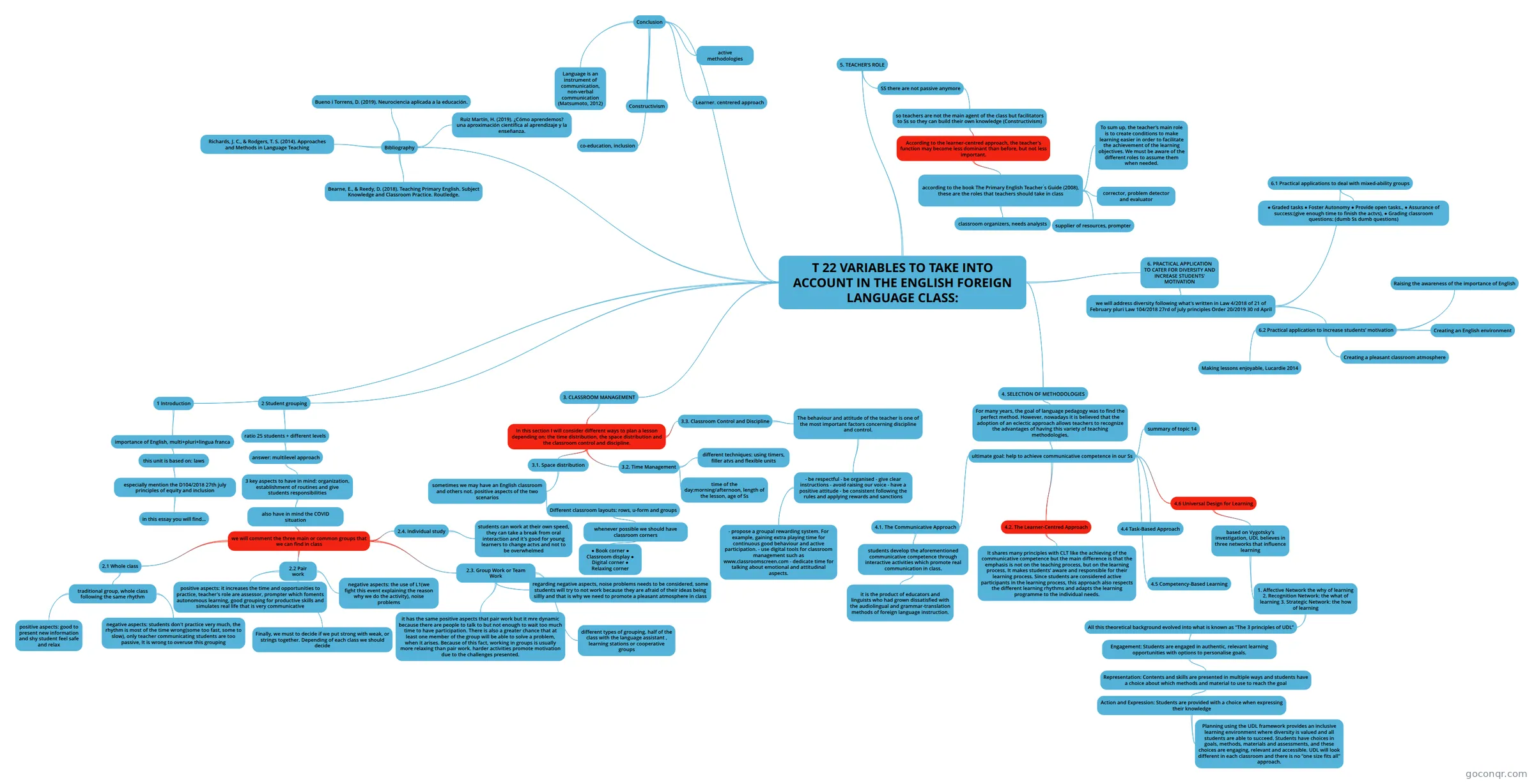
Mind map: variables in the English foreign language class
Contenido del mapa
T 22 VARIABLES TO TAKE INTO ACCOUNT IN THE ENGLISH FOREIGN LANGUAGE CLASS:
1 Introduction
- importance of English, multi+pluri+lingua franca
- this unit is based on: laws
- especially mention the D104/2018 27th july principles of equity and inclusion
- in this essay you will find...
- especially mention the D104/2018 27th july principles of equity and inclusion
- this unit is based on: laws
- importance of English, multi+pluri+lingua franca
2 Student grouping
- ratio 25 students + different levels
- answer: multilevel approach
- 3 key aspects to have in mind: organization, establishment of routines and give students responsibilities
- also have in mind the COVID situation
- we will comment the three main or common groups that we can find in class
- 2.1 Whole class
- traditional group, whole class following the same rhythm
- positive aspects: good to present new information and shy student feel safe and relax
- negative aspects: students don't practice very much, the rhythm is most of the time wrong(some too fast, some to slow), only teacher communicating students are too passive, It is wrong to overuse this grouping
- traditional group, whole class following the same rhythm
- 2.2 Pair work
- positive aspects: it increases the time and opportunities to practice, teacher's role are assessor, prompter which foments autonomous learning, good grouping for productive skills and simulates real life that is very communicative
- negative aspects: the use of L1(we fight this event explaining the reason why we do the activity), noise problems
- Finally, we must to decide if we put strong with weak, or strings together. Depending of each class we should decide
- 2.3. Group Work or Team Work
- it has the same positive aspects that pair work but it mre dynamic because there are people to talk to but not enough to wait too much time to have participation. There is also a greater chance that at least one member of the group will be able to solve a problem, when it arises. Because of this fact, working in groups is usually more relaxing than pair work. harder activities promote motivation due to the challenges presented.
- regarding negative aspects, noise problems needs to be considered, some students will try to not work because they are afraid of their ideas being sillly and that is why we need to promote a pleasant atmosphere in class
- different types of grouping. half of the class with the language assistant , learning stations or cooperative groups
- 2.4. Individual study
- students can work at their own speed, they can take a break from oral interaction and it's good for young learners to change actvs and not to be overwhelmed
- 2.1 Whole class
- we will comment the three main or common groups that we can find in class
- also have in mind the COVID situation
- 3 key aspects to have in mind: organization, establishment of routines and give students responsibilities
- answer: multilevel approach
- ratio 25 students + different levels
3. CLASSROOM MANAGEMENT
- In this section I will consider different ways to plan a lesson depending on: the time distribution, the space distribution and the classroom control and discipline.
- 3.1. Space distribution
- sometimes we may have an English classroom and others not. positive aspects of the two scenarios
- Different classroom layouts: rows, u-form and groups
- whenever possible we should have classroom corners
- ● Book corner ● Classroom display ● Digital corner ● Relaxing corner
- whenever possible we should have classroom corners
- Different classroom layouts: rows, u-form and groups
- sometimes we may have an English classroom and others not. positive aspects of the two scenarios
- 3.2. Time Management
- time of the day:morning/afternoon, length of the lesson, age of Ss
- different techniques: using timers, filler atvs and flexible units
- 3.3. Classroom Control and Discipline
- The behaviour and attitude of the teacher is one of the most important factors concerning discipline and control.
- - be respectful - be organised - give clear instructions - avoid raising our voice - have a positive attitude - be consistent following the rules and applying rewards and sanctions
- - propose a groupal rewarding system. For example, gaining extra playing time for continuous good behaviour and active participation. - use digital tools for classroom management such as www.classroomscreen.com - dedicate time for talking about emotional and attitudinal aspects.
- - be respectful - be organised - give clear instructions - avoid raising our voice - have a positive attitude - be consistent following the rules and applying rewards and sanctions
- The behaviour and attitude of the teacher is one of the most important factors concerning discipline and control.
- 3.1. Space distribution
- In this section I will consider different ways to plan a lesson depending on: the time distribution, the space distribution and the classroom control and discipline.
4. SELECTION OF METHODOLOGIES
- For many years, the goal of language pedagogy was to find the perfect method. However, nowadays it is believed that the adoption of an eclectic approach allows teachers to recognize the advantages of having this variety of teaching methodologies.
- ultimate goal: help to achieve communicative competence in our Ss
- summary of topic 14
- 4.1. The Communicative Approach
- students develop the aforementioned communicative competence through interactive activities which promote real communication in class.
- it is the product of educators and linguists who had grown dissatisfied with the audiolingual and grammar-translation methods of foreign language instruction.
- students develop the aforementioned communicative competence through interactive activities which promote real communication in class.
- 4.2. The Learner-Centred Approach
- It shares many principles with CLT like the achieving of the communicative competence but the main difference is that the emphasis is not on the teaching process, but on the learning process. It makes students’ aware and responsible for their learning process. Since students are considered active participants in the learning process, this approach also respects the different learning rhythms and adapts the learning programme to the individual needs.
- 4.4 Task-Based Approach
- 4.5 Competency-Based Learning
- 4.6 Universal Design for Learning
- based on Vygotsky's investigation, UDL believes in three networks that influence learning
- 1. Affective Network the why of learning 2. Recognition Network: the what of learning 3. Strategic Network: the how of learning
- All this theoretical background evolved into what is known as “The 3 principles of UDL”
- Engagement: Students are engaged in authentic, relevant learning opportunities with options to personalise goals.
- Representation: Contents and skills are presented in multiple ways and students have a choice about which methods and material to use to reach the goal
- Action and Expression: Students are provided with a choice when expressing their knowledge
- Planning using the UDL framework provides an inclusive learning environment where diversity is valued and all students are able to succeed. Students have choices in goals, methods, materials and assessments, and these choices are engaging, relevant and accessible. UDL will look different in each classroom and there is no “one size fits all” approach.
- Action and Expression: Students are provided with a choice when expressing their knowledge
- Representation: Contents and skills are presented in multiple ways and students have a choice about which methods and material to use to reach the goal
- Engagement: Students are engaged in authentic, relevant learning opportunities with options to personalise goals.
- All this theoretical background evolved into what is known as “The 3 principles of UDL”
- 1. Affective Network the why of learning 2. Recognition Network: the what of learning 3. Strategic Network: the how of learning
- based on Vygotsky's investigation, UDL believes in three networks that influence learning
- ultimate goal: help to achieve communicative competence in our Ss
- For many years, the goal of language pedagogy was to find the perfect method. However, nowadays it is believed that the adoption of an eclectic approach allows teachers to recognize the advantages of having this variety of teaching methodologies.
5. TEACHER’S ROLE
- SS there are not passive anymore
- so teachers are not the main agent of the class but facilitators to Ss so they can build their own knowledge (Constructivism)
- According to the learner-centred approach, the teacher's function may become less dominant than before, but not less important.
- according to the book The Primary English Teacher ́s Guide (2008), these are the roles that teachers should take in class
- classroom organizers, needs analysts
- supplier of resources, prompter
- corrector, problem detector and evaluator
- To sum up, the teacher’s main role is to create conditions to make learning easier in order to facilitate the achievement of the learning objectives. We must be aware of the different roles to assume them when needed.
- according to the book The Primary English Teacher ́s Guide (2008), these are the roles that teachers should take in class
- According to the learner-centred approach, the teacher's function may become less dominant than before, but not less important.
- so teachers are not the main agent of the class but facilitators to Ss so they can build their own knowledge (Constructivism)
- SS there are not passive anymore
6. PRACTICAL APPLICATION TO CATER FOR DIVERSITY AND INCREASE STUDENTS’ MOTIVATION
- we will address diversity following what's written in Law 4/2018 of 21 of February pluri Law 104/2018 27rd of july principles Order 20/2019 30 rd April
- 6.1 Practical applications to deal with mixed-ability groups
- ● Graded tasks ● Foster Autonomy ● Provide open tasks., ● Assurance of success:(give enough time to finish the actvs), ● Grading classroom questions: (dumb Ss dumb questions)
- 6.2 Practical application to increase students’ motivation
- Raising the awareness of the importance of English
- Creating an English environment
- Creating a pleasant classroom atmosphere
- Making lessons enjoyable, Lucardie 2014
- 6.1 Practical applications to deal with mixed-ability groups
- we will address diversity following what's written in Law 4/2018 of 21 of February pluri Law 104/2018 27rd of july principles Order 20/2019 30 rd April
Conclusion
- Language is an instrument of communication, non-verbal communication (Matsumoto, 2012)
- Constructivism
- Learner. centrered approach
- active methodologies
- co-education, inclusion
Bibliography
- Bearne, E., & Reedy, D. (2018). Teaching Primary English. Subject Knowledge and Classroom Practice. Routledge.
- Bueno i Torrens, D. (2019). Neurociencia aplicada a la educación.
- Richards, J. C., & Rodgers, T. S. (2014). Approaches and Methods in Language Teaching
- Ruiz Martín, H. (2019). ¿Cómo aprendemos? una aproximación científica al aprendizaje y la enseñanza.
Información
- Descripción
- C1 (Opos) Profesores de Primaria Mapa Mental sobre T 22 VARIABLES TO TAKE INTO ACCOUNT IN THE ENGLISH FOREIGN LANGUAGE CLASS:, creado por Jorge Pomar el 08/05/2022.
- Creado por
- Jorge Pomar
- Visitas
- 23
- Valoración